Five of Wands
✦ Minor Arcana ✦
Five of wands tarot meaning stands as one of Minor Arcana's most dynamic cards, representing situations where multiple forces collide without clear resolution or dominance. When exploring five of wands tarot yes or no questions, this card signals that the situation remains fluid—neither victory nor defeat has been determined. This is not a card of winning or losing, but of friction, of scattering, of the chaotic moment when power is abundant but alignment has not yet been achieved.
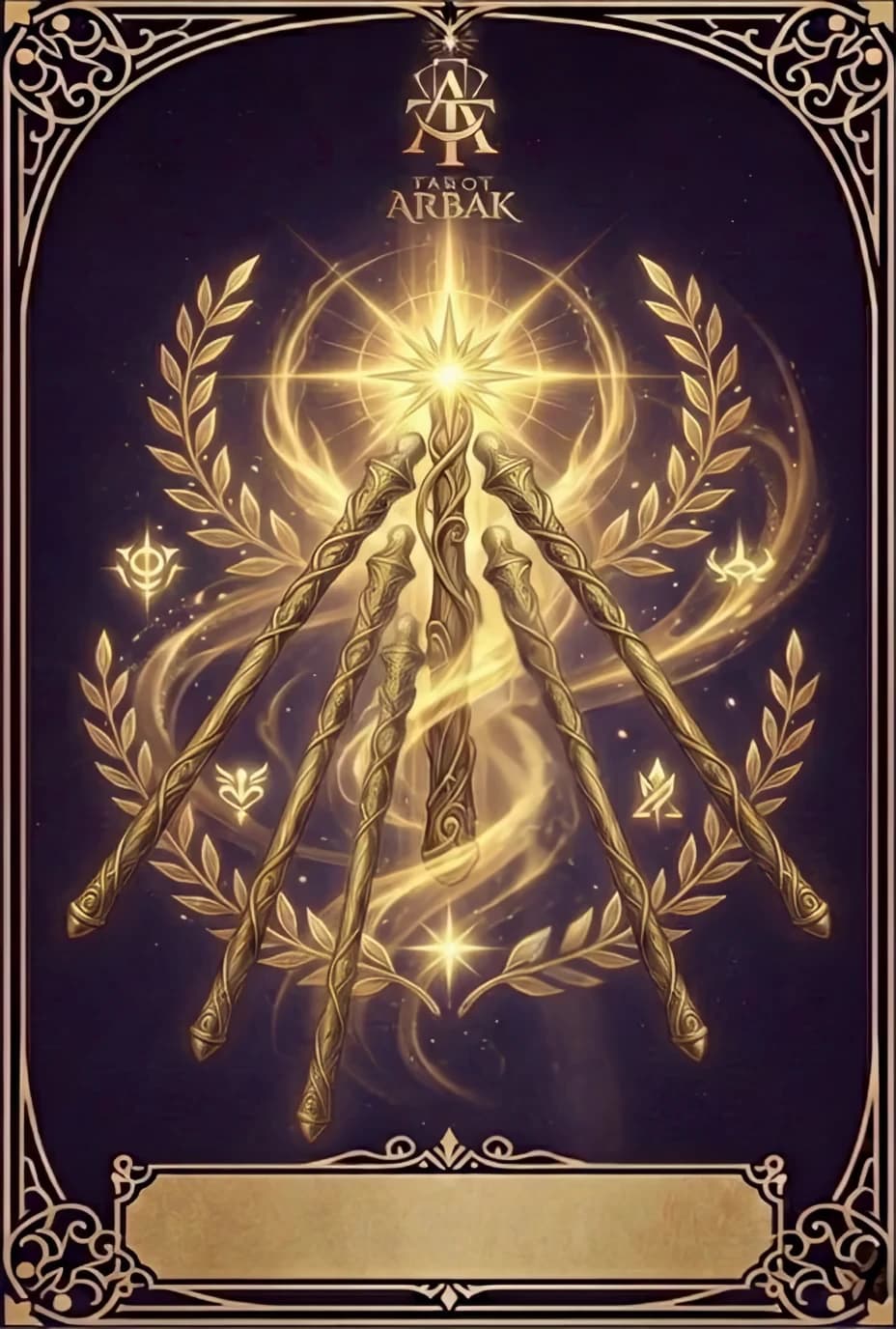
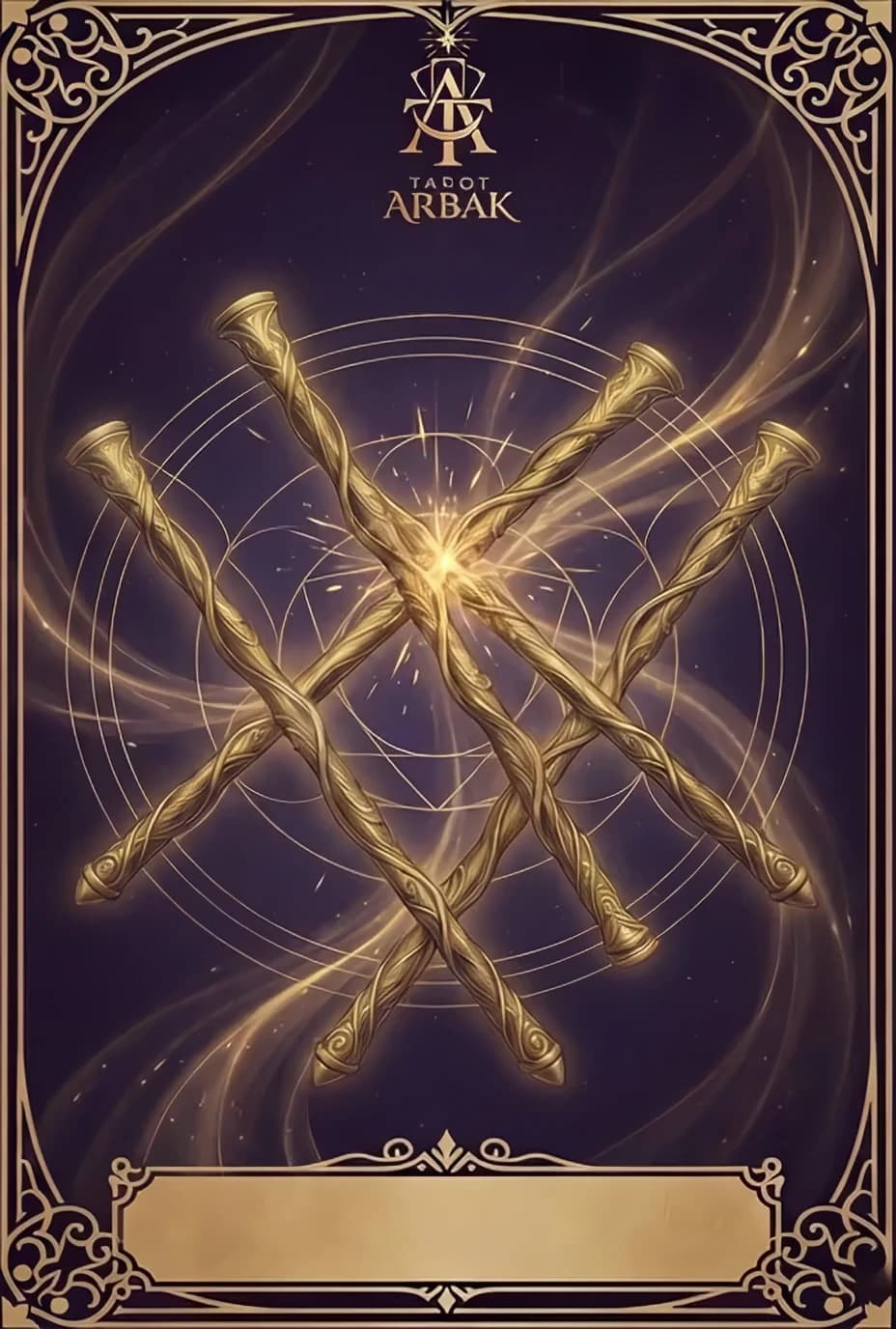
In Tarot Arbak, Five of Wands abstracts traditional struggle into a more precise teaching. Where Rider-Waite's version shows figures physically fighting, Tarot Arbak's composition reveals the structural nature of conflict itself. Five wands of equal length cross at a central explosion point—no human figures, no clear winner, no strategic positioning, only pure collision of energies. This abstraction teaches that the difficulty you face may not be between people but between ideas, projects, responsibilities, or aspects of your own nature.
This card does not say 'you are losing.' It states 'you are scattering.'
The five of wands tarot advice centers on recognizing that friction serves a function. The central explosion represents energy generated through collision—not destruction but awareness, not damage but learning. The equal length of all wands teaches that no force has inherent superiority; the challenge is not dominating others but creating alignment from chaos. This card appears when multiple aspects of life demand attention simultaneously, when you have power but lack clear direction, or when the path forward requires working through resistance.
The number 5 represents challenge, change, and the midpoint between stability (4) and harmony (6). Five of Wands therefore embodies the tension of being in transition—not settled enough to have order, not progressed enough to have harmony. The card teaches that friction is evidence that something matters enough to generate resistance, not proof that the situation is broken.
Five of Wands Symbolism
The five of wands tarot meaning reveals itself through precise visual composition in Tarot Arbak. Every element demonstrates what happens when equal forces meet at the same point without hierarchy or resolution.
Five Crossed Wands: Equal Forces in Collision
The five wands dominate the composition, each of equal length and similar form, crossing at a central point. Unlike Rider-Waite's version where each wand is held by a different person suggesting interpersonal rivalry, Tarot Arbak removes human carriers entirely, presenting the wands themselves as independent forces in direct interaction.
The equality of length and form is critical. No wand appears superior to others; none has advantage. This teaches that the forces colliding in your situation are fundamentally balanced in power. The five of wands tarot meaning shows that the difficulty you face is not that something is stronger than you, but that multiple aspects have equal claim to attention.
The crossing pattern itself creates the friction—forces meeting at the same point without hierarchy.
Central Explosion: Friction, Not Destruction
The light burst at the center where all five wands meet represents friction—the energy generated when multiple forces collide. This is not destructive explosion but generative heat. The wands remain intact; nothing breaks. The five of wands tarot meaning teaches that the collision itself produces awareness and learning.
This central illumination shows that friction is evidence that something real is happening, not proof of failure. The explosion point represents where trajectories cross, where resistance occurs, where potential converts into active energy through contact. The friction is not the problem to eliminate but the evidence that something requires realignment.
Absent Human Figures: Ego-Free Conflict
The complete absence of human figures teaches that this conflict operates at the level of energies, not personalities. Rider-Waite's five fighting figures suggest interpersonal rivalry or workplace competition between people. Tarot Arbak's crossed wands represent structural collision—multiple potentials, ideas, or demands meeting without ego involvement.
This teaches that the friction you experience may not be about who is against you but about what forces are colliding in your situation. The 'who' disappears because the struggle operates at the level of energies interacting, not individuals choosing to fight. The five of wands tarot meaning asks: What forces are competing for attention rather than who is opposing you?
Spiral and Circular Traces: Repeating Cycle
The spiral and circular traces in the background indicate that this struggle is a repeating cycle—same forces, same point, same collision. This teaches that the five of wands tarot meaning involves patterns rather than unique events. The friction recurs because alignment has not yet been achieved.
However, the repetition also suggests that experience is accumulating. Even without clear progress, the collision produces learning. The cycle is not pointless; it is educational. Each collision reveals more about what matters, what resists, what requires integration.
No Direction: Chaotic Interaction
The scattered, crossing pattern with no unified direction emphasizes that alignment has not emerged. Unlike cards showing clear forward movement or organized structure, Five of Wands presents pure chaos—energies in collision without trajectory. This teaches that the five of wands tarot meaning involves the testing phase before direction becomes clear.
The absence of direction is not failure but natural stage. Alignment cannot be forced; it emerges from working through collision. The chaos itself contains the information needed for eventual ordering.
- Symbol 1
Five crossed wands of equal length: balanced forces in collision
- Symbol 2
Central explosion: friction generating awareness, not destruction
- Symbol 3
Absent human figures: conflict between energies, not personalities
- Symbol 4
Spiral traces: repeating cycle of collision and learning
- Symbol 5
No unified direction: chaotic interaction before alignment
- Symbol 6
No victory or defeat: testing phase, not resolution
- Symbol 7
Equal forces: no inherent superiority, challenge is alignment
Five of Wands as Feelings: Scattered Emotional Energy
When examining five of wands as feelings, this card reveals an emotional landscape of competing feelings, internal friction, and emotional energy that exists without clear direction.
Upright: Emotional Collision
When Five of Wands appears as feelings upright, the emotional state involves:
-
Competing emotions simultaneously — Multiple feelings demanding attention at once, creating internal friction. The emotional system has abundant energy but lacks unified direction.
-
Friction without resolution — Feelings colliding rather than integrating. The emotional state is scattered, not settled. Different emotional needs pull in different directions.
-
Testing phase emotionally — The collision itself produces emotional learning. What creates heat reveals what matters. The five of wands tarot meaning shows that emotional friction teaches what you genuinely care about.
-
Equal emotional claims — No feeling has inherent superiority. Different emotions have equal legitimacy, creating challenge of integration rather than dominance.
Reversed: Avoided or Toxic Emotional Friction
When Five of Wands appears reversed as feelings:
-
Emotional avoidance — Refusing to engage with conflicting feelings, suppressing collision rather than working through it toward emotional alignment.
-
Emotional chaos — Friction has become destructive rather than generative. The emotional system is overwhelmed by competing demands without capacity to integrate.
-
Identified with emotional struggle — The emotional system has become addicted to internal conflict, creating unnecessary drama to feel alive.
-
Emotional exhaustion — Tired of ongoing internal friction, seeking escape from emotional collision rather than resolution through it.
Five of Wands Tarot Advice: Work Through Friction Toward Alignment
When Five of Wands appears in your reading, five of wands tarot advice centers on recognizing that friction serves a function and that working through collision produces alignment. You are not being asked to avoid struggle—you are being asked to engage with it consciously.
The core message transforms how you approach conflict: rather than seeking victory over opponents, focus on creating alignment among competing forces. The five equal wands show that no force has inherent superiority—the challenge is not domination but integration.
Specific advice by situation:
-
Workplace competition — You are in a testing ground where advancement requires proving yourself through resistance. Five of wands tarot career guidance shows that friction is normal when multiple capable people occupy the same space. Assert your position directly rather than avoiding conflict. Learn through competition.
-
Conflicting priorities — Multiple demands have equal claim to your attention. The five of wands tarot meaning teaches that the challenge is not eliminating demands but creating alignment among them. Work through the collision rather than letting it scatter you.
-
Internal conflict — Different aspects of yourself are pulling in different directions. This is not failure but evidence that you contain multitudes. The friction itself teaches what matters. Use collision to clarify priorities.
-
Relationship friction — Connection is being tested through challenge. The card does not predict breakup but indicates that the relationship must work through differences. Engage with conflict constructively rather than avoiding it.
-
Creative blocks — Multiple ideas competing for expression create friction. The challenge is not choosing one but finding alignment that honors multiple creative impulses.
The ultimate Five of Wands advice: You are not losing; you are scattering. Power exists but direction has not emerged. Work through friction toward alignment rather than seeking victory over opponents. The collision itself produces the awareness needed for eventual ordering. Engage consciously with resistance, learn what the friction teaches, and create alignment from chaos.
Five of Wands appears not to tell you that you are failing but to tell you that you are in a testing phase. The struggle itself is sacred ground for discovery. What creates heat reveals what matters. Use the friction rather than fleeing it.
UPRIGHT MEANINGS
General Meaning
When Five of Wands appears upright, five of wands tarot meaning signals a situation of competing forces where power exists but direction has not yet emerged. You are in the thick of collision—multiple priorities, demands, or interests are simultaneously active and creating friction through their interaction. This is not a negative card indicating failure or defeat, but a realistic card acknowledging the chaotic phase when expansion meets resistance.
The card does not ask who will win—it asks whether alignment can emerge from collision.
The five of wands tarot meaning indicates that the resistance you experience is structural rather than intentional. You are not being opposed by enemies or subjected to malicious attack; you are experiencing the natural friction that occurs when multiple legitimate forces occupy the same space. The card often appears in situations of workplace competition, conflicting responsibilities, or the challenge of managing multiple projects simultaneously.
The Five of Wands upright invites examining what forces are colliding in your life. Are you experiencing internal conflict between different desires or values? Are external demands from work, family, and personal goals all competing for limited attention? Are multiple aspects of yourself pulling in different directions? The card suggests that the solution is not to eliminate competition but to work through it toward alignment. Power is present; the challenge is creating unified direction.
Love & Relationships
In love readings, five of wands tarot meaning upright indicates a relationship or romantic situation experiencing friction without clear resolution. Multiple forces are at play—perhaps competing schedules, different values, or conflicting priorities creating resistance. This card does not necessarily indicate the end of relationship but suggests a testing phase where connection must prove itself through challenge.
For those in partnerships, this card suggests that love is currently in chaotic space rather than flowing smoothly. Disagreements may arise, or friction may characterize interaction. The Five of Wands does not predict breakup unless sustained without alignment, but indicates that the relationship is being tested. Five of wands tarot advice in love teaches that healthy relationships experience collision—the question is not whether conflict occurs but whether it leads toward growth or distance.
For those seeking relationships, Five of Wands may indicate a competitive dating environment or the challenge of standing out. Multiple potentials may be available, creating confusion about direction. The card suggests working through romantic friction rather than avoiding it.
Career & Money
Professionally, five of wands tarot career meanings strongly suggest workplace competition, conflicting projects, or the challenge of establishing your position among competing priorities. This card appears when you are in an environment of friction—where multiple legitimate demands create resistance, where ideas compete for approval, or where your capabilities must prove themselves through opposition.
The Five of Wands upright does not indicate that you will fail or be defeated; it indicates that you are currently in a testing ground where advancement requires working through resistance rather than finding smooth passage. Five of wands tarot career readings teach that workplace friction is normal when multiple capable people or projects occupy the same space.
If you are experiencing workplace conflict, Five of Wands suggests that the solution is not eliminating others but finding alignment that allows multiple forces to cooperate. Perhaps the friction reveals that priorities are misaligned, that communication creates confusion, or that roles overlap without clear boundaries. The card favors asserting your position, engaging with resistance directly, and learning through competition rather than avoiding it.
REVERSED MEANINGS
General Meaning
Five of wands tarot meaning reversed may indicate that friction has become avoidable, that you are refusing necessary engagement with resistance, or that competition has turned destructive rather than generative. Where the upright card represents natural collision of equal forces, the reversal suggests that the dynamics have become unhealthy—either through withdrawal from necessary struggle or through escalation into pointless conflict.
The reversal asks: Are you avoiding necessary learning or addicted to pointless struggle?
This reversal may suggest that you have multiple forces at play but are refusing to engage with them directly. Perhaps you are avoiding workplace competition, stepping back from necessary confrontation, or letting conflicting responsibilities slide rather than managing their collision. The Five of Wands reversed can indicate passivity in the face of resistance—you have power but are not using it.
The reversed Five of Wands invites honest examination of your relationship to friction. Are you avoiding necessary challenges out of fear? Are you creating conflict where none exists? Are you clinging to competition as identity? Work toward alignment with necessary forces and withdrawal from unnecessary ones.
Love & Relationships
In love readings, five of wands tarot meaning reversed may indicate that you are avoiding necessary relationship work, that conflict has turned toxic, or that you are creating unnecessary drama. The reversed position suggests that the testing phase has become either abandoned or distorted.
If you are in a relationship experiencing friction, the reversed card asks whether you are engaging constructively or avoiding the growth that collision offers. Are you letting fear prevent you from working through differences? Have you decided that easy relationship equals good relationship, rejecting necessary challenge?
For those seeking relationships, Five of Wands reversed may indicate that you are withdrawing from dating out of fear of competition, or that you have decided love is not worth the work and are avoiding romantic friction entirely. Five of wands tarot advice reversed suggests that authentic connection requires willingness to work through resistance, not avoidance of all friction.
Career & Money
Professionally, five of wands tarot career meanings reversed may indicate that you are avoiding necessary competition, refusing to assert your position, or that workplace friction has turned toxic. The reversed position suggests that you are not engaging with the testing ground but either withdrawing from it or escalating it destructively.
The reversal invites examining whether you are avoiding necessary professional friction. Are you refusing to compete for advancement even when you have capacity? Are you staying silent in the face of legitimate challenges? The Five of Wands reversed suggests that professional growth requires engaging with resistance.
Alternatively, the reversal may indicate that you have become identified with workplace struggle—creating unnecessary conflict, treating every interaction as battle. Work toward necessary professional friction and withdraw from pointless drama.
Frequently Asked Questions
Maintain the Crystalline Infrastructure
Tarot Arbak exists beyond ads and algorithms. Your contribution ensures the permanence of the Logos.