The Hermit
✦ Major Arcana ✦
The hermit tarot card meaning stands as the ninth card of the Major Arcana, representing the profound shift from seeking wisdom to embodying it. Where earlier cards explore the acquisition of knowledge, power, and experience, The Hermit demonstrates what remains when accumulation ceases and integration begins. The figure stands at a height not because wisdom lives at summits, but because authentic understanding requires distance that only wisdom can create.
In Tarot Arbak's psychologically rigorous interpretation, The Hermit carries a crucial distinction: he is not wise because he withdrew—he is alone because he became wise. This inverts conventional assumptions about spiritual seeking. Most people believe that withdrawal produces wisdom. Tarot Arbak reveals the opposite: wisdom produces withdrawal. When you no longer need external validation, external teaching, external authority, solitude becomes not a practice but a natural state.
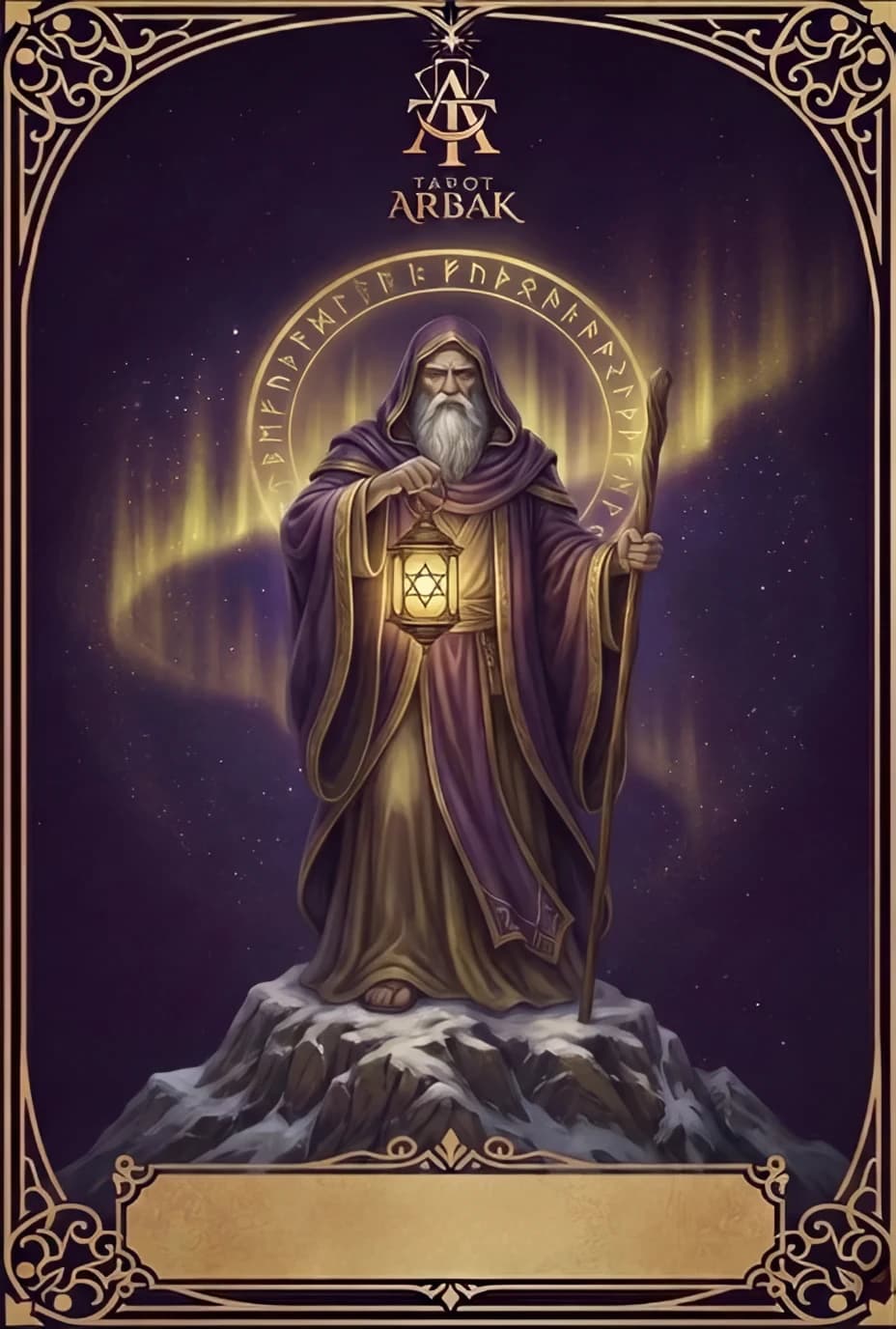
The lantern shines brightly, yet the surrounding darkness is deliberately preserved. This is not a limitation but a teaching: The Hermit does not solve darkness—he walks with it. Knowledge has expanded, but uncertainty has not been eliminated. True wisdom does not demand the removal of mystery; it learns to navigate mystery with confidence.
When exploring what does the hermit tarot card mean, you must confront the difference between seeking and finding. The Hermit has abandoned the search—not because he found everything, but because he discovered that what he sought was already within. The rune circle behind him represents not external belief systems but self-constructed inner law. He no longer takes his guidance from others because he has become his own authority.
Whether you are seeking the hermit tarot advice on inner development, or questioning the hermit tarot career direction, the message cuts through illusion: Stop looking outside for what can only be found within. The Hermit does not seek—he illuminates.
The Hermit Symbolism
To master the hermit tarot card meaning, one must understand not what the Hermit seeks but what he has stopped seeking. Tarot Arbak's interpretation emphasizes the completion of a journey rather than its continuation.
The Figure: Alone Because Wise, Not Wise Because Alone
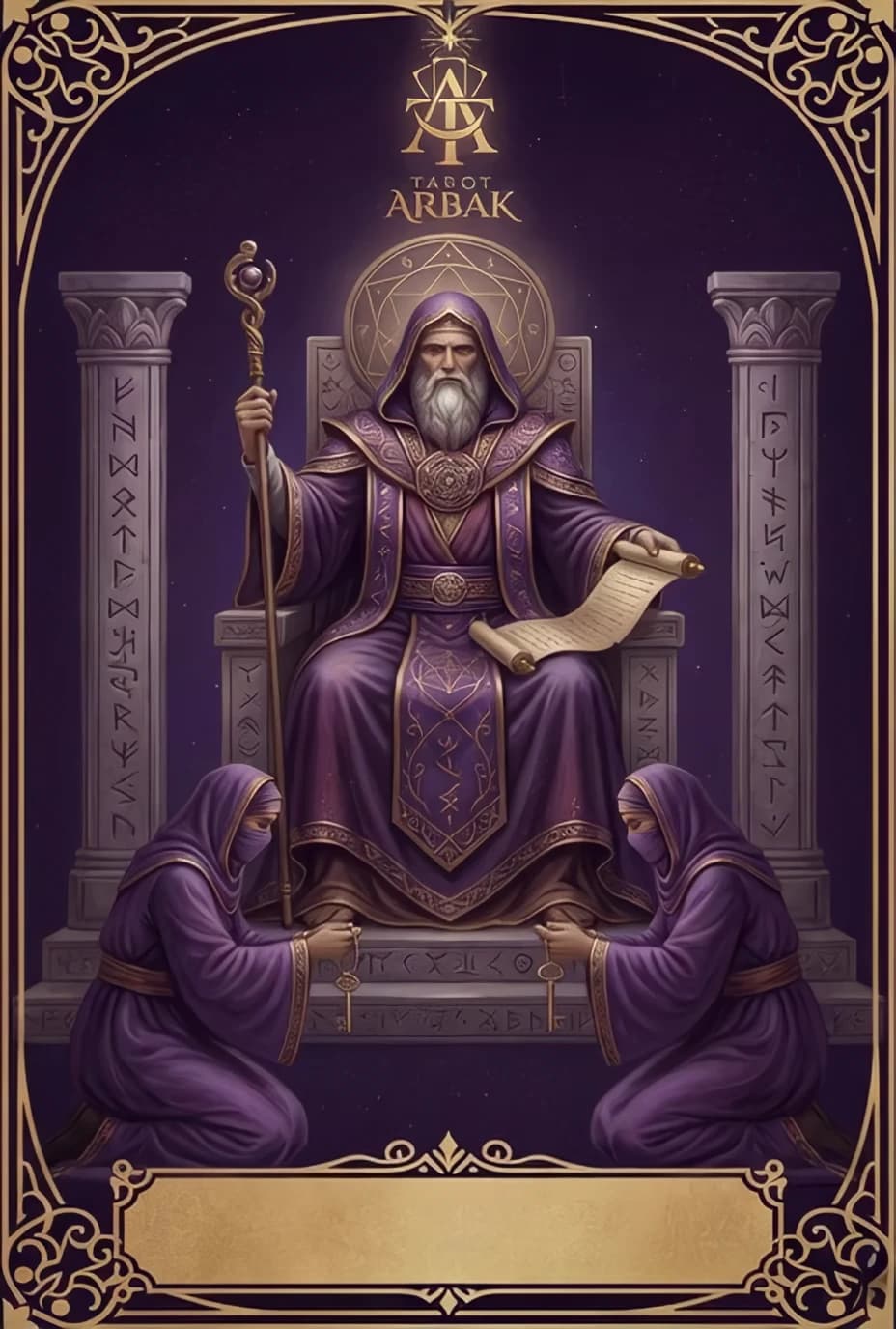
The solitary figure at the mountain's height represents wisdom that has made solitude inevitable. This is the crucial distinction that Tarot Arbak makes explicit. Conventional interpretation suggests that withdrawal leads to wisdom—the hermit goes to the mountain to become wise. Tarot Arbak reveals the opposite: wisdom leads to withdrawal. The figure is alone not because isolation produces enlightenment, but because enlightenment produces a natural distance from those who have not undertaken the same inner work.
The Hermit did not climb to become wise. He became wise, and the climb was the natural result.
This distinction matters profoundly. If you withdraw to become wise, you are still seeking—and seeking implies lack. The true Hermit has ceased seeking because he has recognized that what he sought was never external. His solitude is not a method but a manifestation of completed inner work.
The Lantern: Walking With Darkness, Not Dispelling It
The lantern in the Hermit's raised hand shines brightly—brighter than in traditional depictions—yet the surrounding darkness is deliberately preserved. This is not because the Hermit lacks power to illuminate more, but because solving darkness is not the point.
The lantern contains a six-pointed star, representing not absolute enlightenment but sufficient direction for the immediate step. This teaches that wisdom provides enough light to walk, not enough to see everything. The Hermit does not demand total certainty before moving. He trusts that the next step will be illuminated when it needs to be.
Crucially, Tarot Arbak preserves the darkness rather than trying to defeat it. This reveals a sophisticated understanding: The Hermit does not solve uncertainty—he walks with it. True wisdom does not eliminate mystery; it develops the capacity to move forward despite mystery. Those who demand complete illumination before acting will never move. The Hermit teaches that partial knowledge is sufficient for the journey.
The Staff: No External Authority Needed
The staff in the Hermit's other hand is simpler, rawer, than traditional depictions. In Rider-Waite, the staff helps the figure stand—a symbol of support. In Tarot Arbak, the staff represents the end of needing external support.
The Hermit no longer takes his law from others. He has constructed his own inner framework—the rune circle behind him represents this self-built system of meaning. He does not need teachers because he has become his own teacher. He does not need doctrine because he has developed direct relationship with truth. This is not rebellion against authority—it is the natural outcome of genuine inner development. When you have truly integrated wisdom, external validation becomes unnecessary, not because you reject it, but because you no longer need it.
The Rune Circle: Self-Constructed Inner Law
Behind the figure, a runic circle replaces the absent halo of traditional decks. This circle represents personal law rather than borrowed belief. The Hermit has not simply adopted inherited spiritual frameworks—he has constructed his own understanding through direct experience and honest integration.
This is dangerous territory if misunderstood. The rune circle does not represent arbitrary self-will or rejection of all tradition. It represents the outcome of genuine work: having tested teachings against experience, having integrated what resonates and discarded what doesn't, the Hermit has developed a personal relationship with truth that does not depend on external validation.
The Mountain: Distance, Not Achievement
The height at which the Hermit stands represents not achievement but the natural distance that wisdom creates. As understanding deepens, the gap between the seeker and the crowd widens. This is not superiority—it is simply the result of having done inner work that most avoid. The Hermit does not look down on those below; he simply sees from a different vantage point.
The difficult access to this height teaches that genuine wisdom cannot be easily reached. It requires effort, time, and the willingness to separate from comfortable collective illusion. Most people will not make this climb—not because they cannot, but because the cost seems too high. The Hermit has paid that cost and discovered it was worth paying.
The Hard, Isolated Ground: In the World, Not Of It
The ground beneath the Hermit's feet is harder and more isolated than traditional depictions. This teaches that the Hermit has not left the world—he simply no longer belongs to it in the same way. He remains connected to reality but not absorbed by collective consciousness. He walks on the earth but is not defined by earthly concerns.
This represents a middle path between world-denying asceticism and world-absorbed materialism. The Hermit engages with life but from a different center of gravity. His solitude is not escape from existence but a different relationship with existence—one grounded in inner authority rather than external validation.
The Central Message: The Search Has Ended
Every element builds toward a single realization: The Hermit has stopped seeking because he has found what he was looking for—not in the external world, but in himself.
This is not the end of growth or learning. It is the end of seeking from lack. The Hermit continues to develop, but from fullness rather than deficiency. He illuminates because he has light, not because he needs light. He guides because he knows the path, not because he is still searching for it.
The question The Hermit poses to you: Are you still seeking because you lack, or have you recognized that what you seek is already within?
- Symbol 1
Solitary Figure: Alone because wise, not seeking wisdom through isolation.
- Symbol 2
Lantern: Walking with darkness preserved, not dispelled.
- Symbol 3
Six-Pointed Star: Direction sufficient for the step, not the entire path.
- Symbol 4
Simple Staff: No external authority needed; inner law established.
- Symbol 5
Rune Circle: Self-constructed meaning, not borrowed belief.
- Symbol 6
Mountain Height: Distance created by wisdom, not achievement sought.
- Symbol 7
Hard Isolated Ground: In the world but not of it.
The Hermit as Feelings: The Presence of Inner Knowing
When querying the hermit as feelings, prepare for an answer about self-containment and inner authority rather than emotional need or romantic longing. The Hermit does not describe feelings of lack but feelings of completeness.
The Hermit as Feelings: Upright
If you want to know how someone feels about you, the upright Hermit indicates feelings characterized by independence, depth, and self-sufficiency:
-
They feel complete within themselves: Their feelings toward you are not about needing you to fill a void. They approach connection from fullness rather than deficiency.
-
They feel no urgency: They are not driven by fear of being alone or pressure to commit. They trust timing and process. This can feel like distance, but it is actually maturity.
-
They feel grounded in their own truth: They know what they value, what they need, what they will and won't accept. They are not looking for you to define them.
-
They feel appreciation without dependency: They can value connection without needing it for validation. Their feelings for you are genuine because they are chosen, not compelled by lack.
The Hermit as Feelings: Reversed
When drawn reversed, the hermit as feelings reveals isolation disguised as independence or withdrawal motivated by fear:
-
They feel defensive isolation: Their distance is not wisdom but protection. They have been hurt and now avoid vulnerability under the guise of self-sufficiency.
-
They feel superior through withdrawal: They may believe that being alone makes them special, evolved, or above ordinary connection. This is spiritual arrogance, not genuine solitude.
-
They feel unable to connect: They may want intimacy but have forgotten how. Their solitude has become a prison rather than a practice.
-
They feel unresolved seeking: They may appear wise but are actually still searching, still lacking, still looking outside for what they haven't found inside.
The Hermit Tarot Advice: Stop Seeking, Start Finding
When seeking the hermit tarot advice, the message is clear and challenging: Stop looking outside for what can only be found within.
Specific advice by situation:
-
If you are constantly seeking guidance: Stop. You have accumulated enough teachings, enough opinions, enough external input. What you need now is solitude to process what you already know. The answers you seek are within you—they have always been within you. Trust your own inner voice.
-
If you are afraid to be alone: Your fear reveals that you have not yet developed inner authority. Solitude is not punishment—it is the laboratory where wisdom develops. Spend time with yourself without distraction. Learn your own mind. Become your own company.
-
If you are walking through uncertainty: Do not demand complete illumination before moving. The Hermit's lantern shows only the next step, not the entire path. Walk with darkness rather than waiting for it to disappear. Partial knowledge is sufficient for the journey.
-
If you feel spiritually advanced: Examine whether your solitude is wisdom or avoidance. The true Hermit guides others eventually; he does not hoard his light. If you have withdrawn permanently, you may be hiding rather than developing.
The ultimate advice of The Hermit is this: The search ends when you recognize that what you have been seeking is the seeker itself. You are not separate from the wisdom you pursue. Stop looking outside and discover what has been within you all along.
UPRIGHT MEANINGS
General Meaning
The hermit tarot card meaning in general readings signals that the period of seeking is complete—now is the time for integration. You have gathered enough experience, enough information, enough external guidance. What you need now is solitude to process what you have accumulated and to discover that the answers you sought externally were always within you.
This card appears when outer exploration has reached its natural limit. Further seeking will not produce new results because the terrain has been mapped. The unexplored territory now is internal—the depths of your own consciousness where genuine wisdom resides.
The Hermit teaches that wisdom is not acquired but recognized. You already know more than you think. The lantern illuminates what is already there; it does not create light from nothing. Your task is not to learn something new but to integrate what you have already learned, to trust what you already know, to become your own authority rather than perpetually seeking external validation.
Ask yourself: Where are you still looking outside for answers that can only be found within? What would happen if you stopped seeking and started trusting your own inner guidance?
Love & Relationships
In romance, the hermit tarot love meaning indicates a time for understanding yourself before seeking or deepening connection with another. This is not a card of romantic union but of the inner work that makes genuine union possible.
If you're single: Do not seek relationship from lack. The Hermit teaches that who you attract reflects who you are—take time to become the person you want to be in partnership. Clarify your values, understand your patterns, develop comfort with your own company. When you approach connection from fullness rather than deficiency, you attract relationships that honor your authentic self.
If you're in a relationship: The partnership may benefit from individual growth that strengthens rather than threatens the bond. Healthy togetherness requires two whole individuals, not two halves completing each other. The Hermit may indicate a period of healthy distance—not separation but space for each person to develop their own inner authority. Trust that this distance serves deepening rather than destroying connection.
The Hermit in love asks: Are you seeking someone to complete you, or are you complete and seeking someone to share that completeness with?
Career & Money
When querying the hermit tarot career implications, expect a message about wisdom over action, integration over expansion, and inner authority over external validation.
You may have reached a point where the most valuable professional work you can do is not outward achievement but inward integration. The Hermit suggests stepping back from constant activity to assess direction, to integrate accumulated experience, to develop your own professional philosophy rather than following conventional paths.
This is an excellent time for mentorship, teaching, consulting, or any role that involves sharing the wisdom gained through experience. Your value lies not in being the busiest but in having the depth of understanding that comes from genuine integration.
The Hermit also asks whether your career direction reflects your authentic values or external expectations. Have you constructed your own professional framework—the rune circle of self-determined meaning—or are you still following paths laid out by others? True professional fulfillment comes from inner alignment, not external achievement.
REVERSED MEANINGS
General Meaning
The hermit reversed signals that solitude has become isolation, wisdom has become rigidity, or seeking has become endless avoidance. The withdrawal that once served growth now serves defense.
Isolation from Fear: You may have withdrawn not because you found inner authority but because you fear external challenge. Your solitude is a fortress, not a sanctuary. This isolation prevents the integration it was meant to serve because genuine growth requires some engagement with the world.
Endless Seeking: Alternatively, you may be trapped in perpetual seeking—accumulating teachings, practices, and experiences without ever integrating them. The search has become a way to avoid the responsibility of finding. You use spiritual or intellectual pursuit to escape actually living what you have learned.
Wisdom Turned Bitter: The knowledge you accumulated may have hardened into cynicism rather than ripened into wisdom. The reversed Hermit can represent the one who knows much but understands little, who has withdrawn from life while claiming superiority.
The reversal asks: Has your solitude made you wiser, or has it simply made you alone? Are you withdrawn because you have found your center, or because you are afraid to be challenged?
Love & Relationships
In love, The Hermit reversed indicates isolation that prevents connection or withdrawal that serves fear rather than growth.
Defensive Isolation: You may have built walls under the guise of independence. Your solitude is not chosen from fullness but imposed from fear. You have been hurt and now avoid vulnerability while claiming you don't need anyone.
Inability to Connect: The reversal can indicate someone who has been alone so long they have forgotten how to be with another. Intimacy feels threatening rather than natural. The skills of relationship have atrophied.
Superior Through Withdrawal: You may believe that being alone makes you more evolved, that relationships are for people who haven't reached your level. This is spiritual arrogance, not genuine wisdom.
The reversal calls for honest examination: Is your independence protecting your authentic self or preventing genuine connection?
Career & Money
Professionally, The Hermit reversed warns of isolation that limits growth or expertise that has become rigid.
Professional Isolation: You may have withdrawn from collaboration, feedback, or engagement under the guise of being misunderstood. Your solitude limits your development because growth requires some external input.
Rigid Expertise: Your accumulated knowledge may have become fortress rather than foundation. You dismiss new ideas without genuine examination. Your methods are outdated but you refuse to adapt.
Avoiding Necessary Engagement: You may be hiding in behind-the-scenes roles when your development requires stepping forward. The Hermit's wisdom is meant to be shared eventually; permanent withdrawal serves no one.
The reversal asks whether your professional solitude serves integration or avoidance.
Frequently Asked Questions
Maintain the Crystalline Infrastructure
Tarot Arbak exists beyond ads and algorithms. Your contribution ensures the permanence of the Logos.