Justice
✦ Major Arcana ✦
Justice tarot card meaning stands as the eleventh card of the Major Arcana, representing not the pronouncement of verdict but the rigorous process of arriving at one. Where preceding cards explored power, fortune, and inner wisdom, Justice introduces the demanding question that cuts beneath all others: By what standard do you measure?
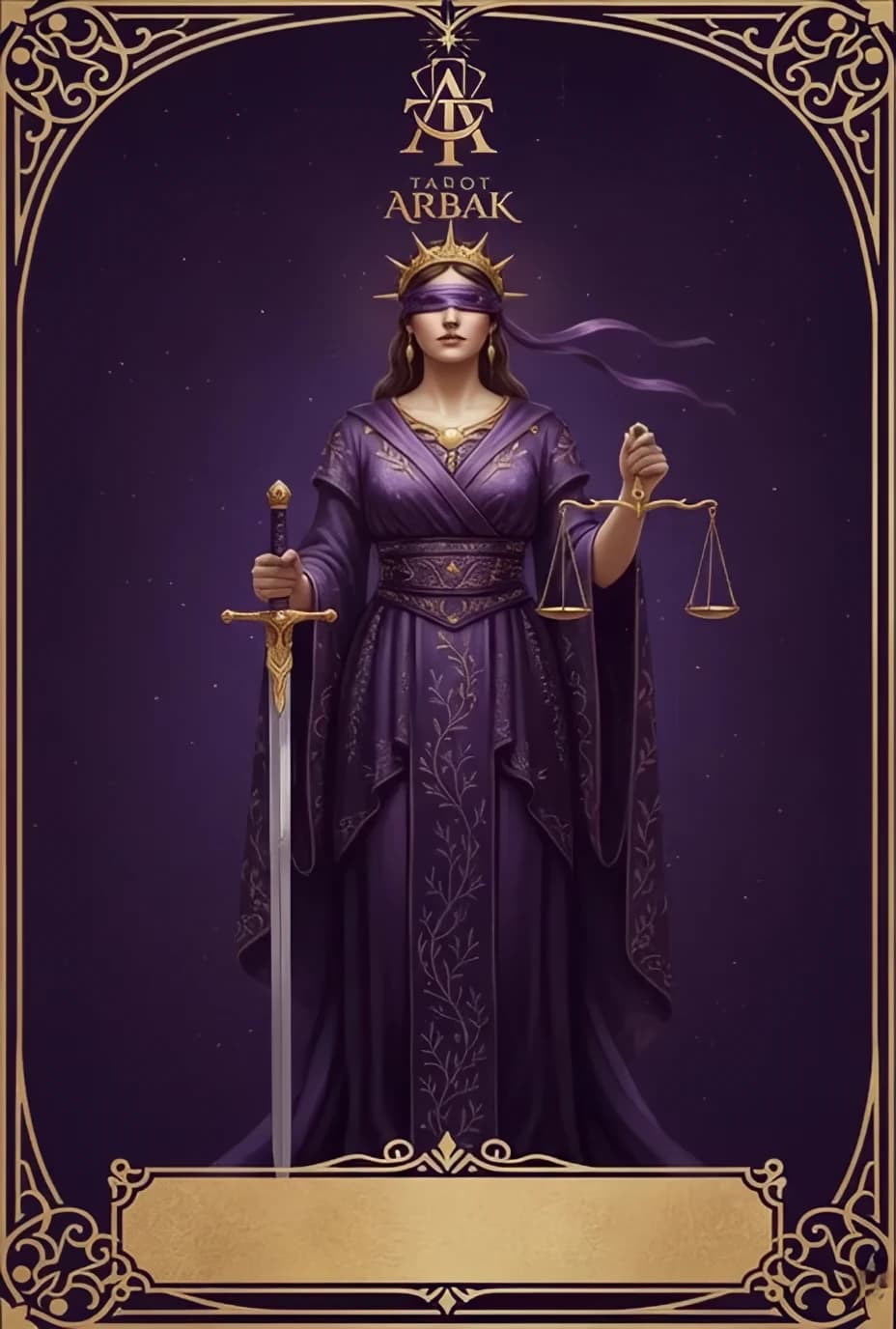
In Tarot Arbak's psychologically rigorous interpretation, Justice is stripped of its traditional association with divine judgment and legal pronouncement. The figure does not declare who is right—she asks what standard you are using to decide. This is not a card about outcomes but about criteria. The scales at chest level represent conscious reasoning, not intuition or emotion. The sword remains upright because the decision has not yet been executed. This is the threshold moment before judgment, not its conclusion.
The most striking departure from Rider-Waite tradition is the purple blindfold covering the figure's eyes. This is not blindness as ignorance—it is blindness as freedom from bias. Justice does not need to see external appearances because true weighing happens through internal criteria, not visual impression. The blindfold teaches that objective measurement requires the suspension of preference, the willingness to weigh without knowing whose side benefits from the outcome.
When exploring what does the justice tarot card mean, you must confront the difference between asking "who is right?" and asking "by what principle?" The first question seeks victory; the second seeks truth. Justice does not advocate for anyone—it asks what standard of measurement you are using and whether that standard can withstand scrutiny.
Whether you are seeking justice tarot advice on a difficult decision, or questioning justice tarot career fairness, the message cuts through assumption: Examine your criteria. What standard are you using? Is it truly objective, or does it favor outcomes you desire? The scales have not settled because the weighing is still in process.
Justice Symbolism
To master justice tarot card meaning, one must understand not what Justice decides but how she measures. Tarot Arbak's interpretation emphasizes process over pronouncement, criteria over conclusion.
The Blindfold: Freedom from Bias, Not Absence of Vision
The most striking element of Tarot Arbak's Justice is the purple blindfold covering the figure's eyes. In Rider-Waite tradition, Justice looks out with open eyes, seeing all. Tarot Arbak blindfolds her—and this is not limitation but liberation.
The blindfold represents freedom from visual bias. Justice does not need to see who stands before her because true weighing operates through criteria, not appearance. When you can see the person being judged, you cannot help but be influenced by their presentation—their beauty, their suffering, their status, their appeal to your emotions. The blindfold removes this contamination.
Blindness here is not ignorance—it is the rigorous suspension of preference in service of truth.
This teaches that objective judgment requires not knowing certain things. You must deliberately blind yourself to information that would bias the weighing: who benefits, what you want to be true, what outcome would be convenient. The blindfold is the discipline of excluding irrelevant data so that only relevant criteria remain.
The Scales at Chest Level: Conscious Reasoning, Not Emotional Response
The scales in Justice's right hand are positioned at chest level, not raised high or lowered. This placement is deliberate and significant: weighing happens through conscious reasoning, not through gut feeling, intuition, or emotional response.
The chest represents the heart center in many traditions, but here it represents the meeting point between head and heart, reason and value. The scales at this level teach that true judgment requires both logical analysis and ethical consideration—but neither alone suffices. Pure logic without values becomes cold calculation; pure emotion without reason becomes arbitrary preference. The scales at chest level integrate both.
The kefelere (scale pans) are equal—no side has tipped. This is crucial: the weighing is still in process. Justice has not yet rendered verdict because the measurement has not concluded. This card represents the threshold before decision, not the decision itself.
The Upright Sword: Authority Before Execution
The sword in Justice's left hand is held upright, not lowered. In Rider-Waite, this sword represents the power to execute judgment. In Tarot Arbak, the sword's position tells a different story: the sword remains raised because the execution has not yet occurred.
This is the sword of pre-judgment authority—the power to decide, not yet the act of deciding. The sword is ready, available, prepared to fall. But it has not fallen. Justice sits at the threshold between weighing and pronouncement, between criteria and consequence.
This distinction matters profoundly. Most people treat Justice as a card of verdict—the decision has been made, now face the consequence. Tarot Arbak reveals Justice as a card of process—the decision is still being weighed, the sword has not yet fallen, there is still time to examine the criteria before execution becomes irreversible.
The sword remains upright because this is a process card, not a pronouncement card.
The Frontal Stance: No Escape, No Evasion
The figure stands facing directly forward, body straight, no twist or turn. This frontal stance represents confrontation with truth that cannot be evaded. You cannot approach Justice from an angle, cannot find a perspective that flatters, cannot maneuver for advantage.
This geometric precision teaches that truth is not relative to perspective. The scales measure what is, not what appears to be from a convenient angle. The frontal stance demands that you face the weighing directly, without deflection or distortion.
The Crown: Mental Authority
The crown on Justice's head represents mental sovereignty—the authority that comes from disciplined consciousness. This is not the crown of worldly power or inherited status but the crown of earned wisdom, the mastery of reasoning that has proven reliable through testing.
The crown teaches that true judgment requires developed consciousness—you cannot weigh fairly if your mind is undisciplined, reactive, or captured by preference. The authority to judge is not given; it is cultivated through the rigorous practice of examining your own criteria.
Purple Robes: Responsibility, Not Power
The purple color of Justice's robes represents responsibility rather than power. This is not the purple of imperial authority but the purple of spiritual and ethical burden. To weigh is to carry responsibility for the outcome. To judge is to accept the karmic weight of your decision.
The robes teach that judgment is not privilege but burden. Those who sit in judgment carry the consequence of their weighing. The standard you apply to others becomes the standard applied to you. Justice does not stand above the process—she participates in it, bound by the same criteria she enforces.
Empty Background: Principles, Not Social Structures
Unlike Rider-Waite's architectural setting with pillars and curtains, Tarot Arbak's background is empty and abstract. This removal teaches that true justice operates from principles, not institutions. The weighing does not depend on social context, organizational authority, or established structure—it depends on criteria that exist independently of human systems.
The empty background also removes distraction. There is nothing to look at except the weighing itself. No context to justify bias, no circumstance to excuse preference, no situation to make deviation acceptable. Only the scales, the sword, the blindfold, and the question.
The Central Question: By What Criteria?
Every element builds toward a single question that Justice poses not to the world but to you: By what criteria do you decide?
This question cuts beneath all others. Before asking who is right, ask what standard you are using. Before asking what should happen, ask what principle governs your weighing. Before asking what outcome you want, ask whether your criteria can survive scrutiny.
Justice does not tell you the answer—she demands that you examine your process of arriving at one.
- Symbol 1
Purple Blindfold: Freedom from bias, not absence of vision.
- Symbol 2
Scales at Chest Level: Conscious reasoning integrating logic and values.
- Symbol 3
Equal Scale Pans: Weighing still in process; no verdict yet rendered.
- Symbol 4
Upright Sword: Pre-judgment authority; execution not yet occurred.
- Symbol 5
Frontal Stance: Direct confrontation with truth; no evasion possible.
- Symbol 6
Crown: Mental authority earned through disciplined consciousness.
- Symbol 7
Purple Robes: Responsibility and burden, not power and privilege.
- Symbol 8
Empty Background: Principles independent of social structures.
- Symbol 9
Central Question: By what criteria do you decide?
Justice as Feelings: The Question of Standards
When querying justice as feelings, prepare for an answer about criteria and standards rather than emotional warmth or romantic sentiment. Justice does not describe feelings of love or passion—it describes the quality of evaluation someone brings to connection.
Justice as Feelings: Upright
If you want to know how someone feels about you, the upright Justice indicates feelings characterized by evaluation, fairness, and the application of consistent standards:
-
They feel evaluative: They are assessing the connection against their criteria—not judgmentally but carefully. They want to understand whether this relationship meets their standards for partnership.
-
They feel committed to fairness: They do not want advantage or exploitation. They seek connection where both parties are weighed equally, where giving and receiving balance.
-
They feel process-oriented: They are not rushing to verdict. The sword remains upright. They want to understand before they decide, to weigh before they commit.
-
They feel transparent about criteria: They are willing to tell you what standards they are using. If you ask "what do you need?" they can answer clearly because they have examined their own criteria.
Justice as Feelings: Reversed
When drawn reversed, justice as feelings reveals unfair standards, hidden criteria, or judgment that serves preference rather than truth:
-
They feel judgmental without transparency: They are evaluating you against standards they have not disclosed. You are being weighed without knowing the criteria—a setup where you cannot win because you don't know the rules.
-
They feel unfair: Their standards may be impossible or contradictory. No matter what you do, the scales never balance because they are secretly weighted.
-
They feel like they have already decided: They pretend to be weighing while the sword is already falling. The appearance of process masks a pre-determined verdict.
-
They feel weaponized: Their standards become tools for control rather than genuine evaluation. The question "by what criteria?" is used to manipulate rather than to clarify.
Justice Tarot Advice: Examine Your Criteria Before You Decide
When seeking justice tarot advice, the message is demanding: Before you ask who is right, ask by what standard you are deciding.
Specific advice by situation:
-
If you are facing a decision: Do not rush to verdict. The sword remains upright—the execution has not occurred. Use this threshold moment to examine your criteria. What standard are you using? Is it truly objective? Would you accept this standard being applied to you?
-
If you feel you have been treated unfairly: Ask what criteria were used. Were the standards transparent? Were they consistently applied? Did the process allow for examination, or was the verdict pre-determined? Naming the corruption of criteria is the first step toward restoration.
-
If you are in a position to judge others: Recognize your responsibility. The standard you apply becomes the standard applied to you. The sword you wield will eventually be wielded over you. Ensure your criteria can survive the blindfold test before you execute judgment.
-
If you are uncertain about your own standards: Good. Uncertainty about criteria is healthier than false certainty. Justice asks not that you have answers but that you examine your process of arriving at them. The scales are still moving—that is appropriate for genuine weighing.
The ultimate advice of Justice is this: Criteria matter more than conclusions. The standard by which you decide determines whether your decision serves truth or preference. Examine your criteria with the rigor you would want applied to any judgment rendered against you. The sword remains upright—there is still time to ensure your weighing is fair.
UPRIGHT MEANINGS
General Meaning
Justice tarot card meaning in general readings signals a time of rigorous examination—not of outcomes but of criteria. You are being asked not whether you are right but by what standard you decide. This is a card of process, not pronouncement.
The upright Justice indicates that weighing is occurring. The scales are active. The sword remains raised. This is the threshold before verdict—the moment where criteria can still be examined, where standards can still be questioned, where the process of measurement can be made conscious and fair.
This card often appears when you face a decision that requires objective evaluation. But Justice does not tell you the answer—it demands that you examine your process of arriving at one. What standard are you using? Is it truly objective? Would you accept this standard being applied to you?
Justice asks not who is right, but by what principle you determine rightness.
The card also indicates that consequence is being prepared but not yet executed. The sword has not fallen. There is still time to ensure your criteria can survive scrutiny before the judgment becomes irreversible. Use this threshold moment wisely.
Love & Relationships
In romance, justice tarot love meaning indicates a relationship being evaluated against clear criteria. This is not a card of passionate union but of conscious partnership—connection that meets standards rather than connection that overwhelms standards.
If you're single: You may be evaluating potential partners against criteria you have finally clarified. This is healthy—knowing what you need prevents relationships that waste time and damage hearts. But Justice asks: Are your standards truly objective, or do they secretly favor outcomes you desire? Can your criteria survive the blindfold test?
If you're in a relationship: The partnership is being weighed. This is not ominous—it is necessary. Healthy relationships can survive evaluation because their criteria are fair and transparent. Unhealthy relationships fear evaluation because their dynamics cannot survive objective measurement. Justice asks: By what standards are you measuring this connection? Are those standards fair to both parties?
The card also suggests that commitment requires clarity about criteria. Before you promise forever, know what standards you are promising to meet and to hold your partner to.
Career & Money
When querying justice tarot career implications, expect a message about fair evaluation, clear criteria, and professional standards.
You may be in a situation where performance is being weighed against expectations. Justice indicates that this evaluation can be fair if the criteria are transparent and consistently applied. But the card demands that you examine those criteria: Are they truly relevant to job performance, or do they favor certain people for irrelevant reasons?
This is also a card of professional ethics. Justice asks what standards govern your work. Do you have criteria for quality, integrity, and excellence? Can those criteria survive scrutiny? The upright Justice suggests that your professional reputation will be determined by the consistency between your stated standards and your actual behavior.
If you are in a position to evaluate others, Justice demands that you examine your criteria before you render judgment. The sword remains upright—there is still time to ensure your weighing is fair before you execute decisions that affect others' livelihoods.
REVERSED MEANINGS
General Meaning
Justice reversed signals that criteria have been corrupted, that weighing serves preference rather than truth, or that the sword has fallen without fair measurement.
Corrupted Criteria: The standards being used are not objective but designed to produce desired outcomes. The question "by what principle?" has been replaced by "what result do I want?" This corruption may be conscious (weaponized standards) or unconscious (hidden preference pretending to be objectivity).
Unfair Weighing: The scales appear balanced but are secretly weighted. One side has been favored before measurement began. The blindfold is theatrical—removed when seeing benefits the preferred side. This is Justice as manipulation rather than measurement.
Premature Execution: The sword has fallen before the weighing concluded. Judgment has been rendered without fair process. This represents the damage of verdict without criteria, consequence without measurement, pronouncement without the discipline of examination.
The reversal asks: Are your criteria genuine or convenient? Is your process fair or theatrical? Have you rendered judgment before you finished weighing?
Love & Relationships
In love, Justice reversed indicates unfair evaluation, hidden criteria, or judgment that serves preference over partnership.
Hidden Standards: One partner is being evaluated against criteria that have not been disclosed. This creates a relationship where you cannot succeed because you don't know the rules. The blindfold is fake—your partner sees everything but pretends to objectivity.
Impossible Standards: The criteria may be contradictory or unachievable. No matter what you do, the scales never balance because they are secretly weighted against you. This is evaluation designed to fail.
Pre-determined Verdict: Your partner has already decided the outcome while pretending to weigh. The appearance of process masks a conclusion that was reached before evidence was considered.
The reversal calls for radical honesty: What are the actual standards in this relationship? Can they be named and examined? Or does naming them reveal their unfairness?
Career & Money
Professionally, Justice reversed warns of unfair evaluation, biased standards, or judgment rendered without due process.
Biased Evaluation: You may be experiencing performance review against criteria that favor others or disadvantage you for irrelevant reasons. The standards appear objective but are secretly designed to produce predetermined outcomes.
Weaponized Standards: Professional criteria may be used selectively—to punish enemies while protecting allies, to enforce conformity while claiming meritocracy. The question "by what standard?" becomes a tool of power rather than an instrument of fairness.
Judgment Without Process: Decisions have been made without fair weighing. The sword fell before the scales settled. This represents professional damage from premature verdict, career consequences from corrupted criteria.
The reversal asks whether you can name the actual standards governing your professional environment. If criteria cannot survive examination, the system is unjust regardless of its claims.
Frequently Asked Questions
Maintain the Crystalline Infrastructure
Tarot Arbak exists beyond ads and algorithms. Your contribution ensures the permanence of the Logos.