The Hierophant
✦ Major Arcana ✦
The hierophant tarot card meaning embodies the weight of institutionalized spirituality, the transmission of approved knowledge, and the unyielding structure of sacred tradition. As the fifth card of the Major Arcana, he stands as the spiritual counterpart to The Emperor's secular authority. Where The Emperor enforces the laws of the land, The Hierophant enforces the laws of the spirit. He is the bridge between humanity and the divine—but critically, you must cross that bridge his way.
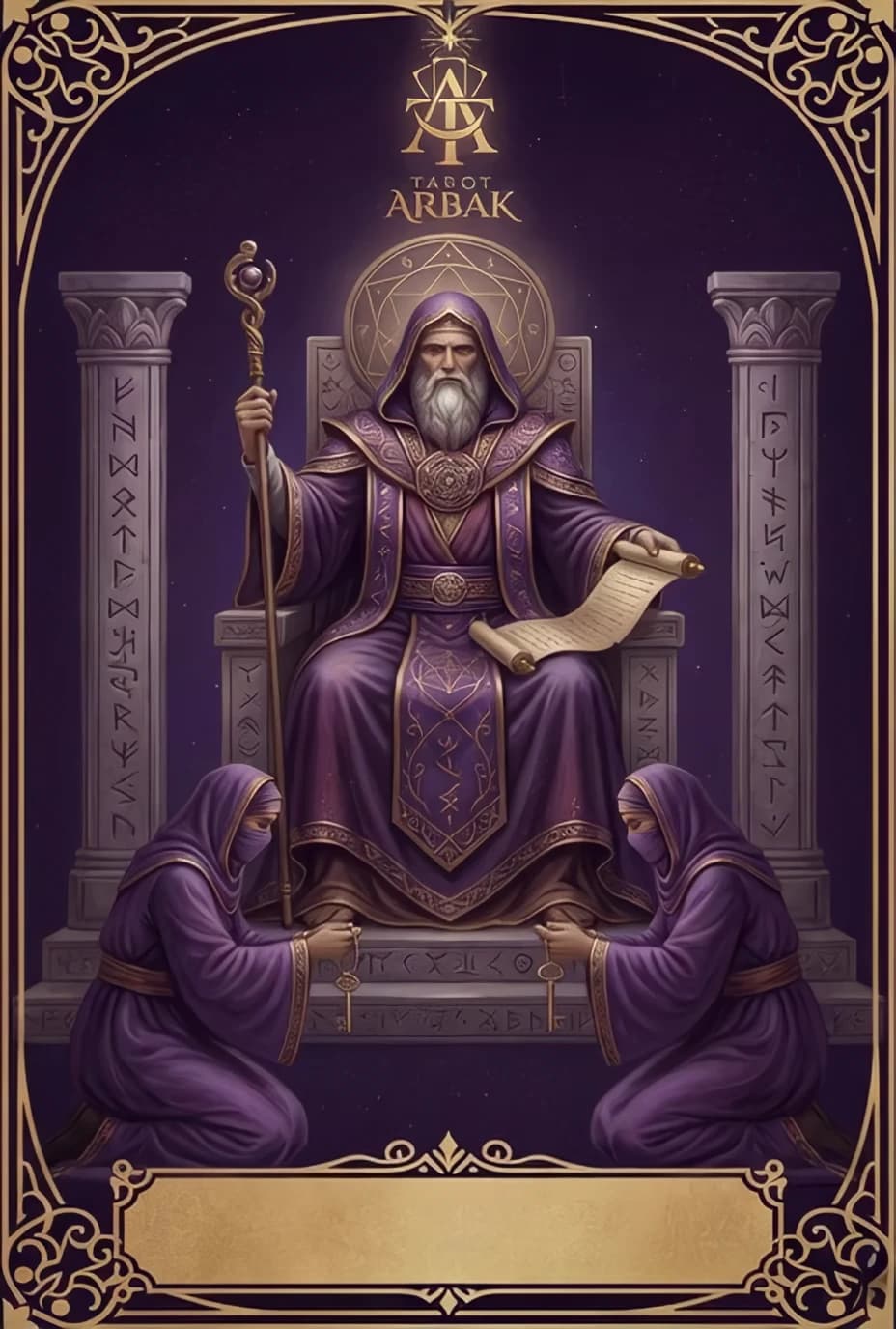
In Tarot Arbak's psychologically severe interpretation, The Hierophant is stripped of the gentle, fatherly wisdom sometimes attributed to him. He sits upon his throne not as a guide who helps you discover your own truth, but as the definitive gatekeeper of what is permitted to be known. His gaze does not judge; it standardizes. He does not search for truth—he defines it. The two disciples kneeling before him do not produce knowledge; they receive it. This is the card of unidirectional spiritual authority.
When exploring what does the hierophant tarot card mean, you must confront an uncomfortable psychological reality: this archetype represents both protection and imprisonment. The structure he provides shields the seeker from the chaos of unguided spiritual exploration, but it also demands the surrender of individual interpretation. Whether you are seeking the hierophant tarot advice on navigating institutional systems, or questioning the hierophant tarot career paths within academia or organized religion, his message is unwavering: the path has already been laid. Your task is to walk it correctly, not to question where it leads.
The Hierophant Symbolism
To master the hierophant tarot card meaning, one must dissect the precise visual architecture of transmitted authority. Tarot Arbak's interpretation emphasizes that The Hierophant represents knowledge that flows in one direction only—from the institution down to the individual.
The Throne of Institutional Authority
The Hierophant sits centered upon a massive throne, visually merging with the seat of power just as The Emperor does. However, where The Emperor's throne represents civic law and external boundaries, The Hierophant's throne represents sacred law and internal boundaries. He is not merely a man holding a spiritual title; he has become the institution itself. The throne does not move because doctrine does not move.
The Two Kneeling Disciples: Receivers, Not Creators
Before him kneel two figures, heads bowed, positioned to receive rather than to question. In Rider-Waite tradition, these acolytes represent the dual paths available to seekers. In Tarot Arbak's darker reading, they represent the fundamental truth of this card: before The Hierophant, you are not permitted to be a creator of meaning. You are a vessel for meaning that has already been established. The disciples do not debate; they absorb.
The Hierophant does not ask what you believe. He tells you what you are permitted to believe.
The Open Scroll: Transmitted vs. Hidden Knowledge
In his hand, he holds an open scroll—not a closed book like The High Priestess. This is the crucial distinction between the two cards. The High Priestess guards the esoteric, hidden knowledge that must be earned through personal initiation. The Hierophant displays the exoteric, public knowledge that is available to all who submit to the proper channels. The scroll is open, but access is still controlled through the keys.
The Crossed Keys: Controlled Access to the Sacred
The keys visible in this card do not represent freedom—they represent gatekeeping. The Hierophant holds the power to grant or deny access to spiritual truth. The keys tell you that the divine exists, but you cannot approach it directly. You must go through him. You must follow the procedure. You must meet the requirements.
The Geometric Halo: Structured, Abstracted Sacredness
Behind The Hierophant rises a geometric halo—an abstraction of sacred light that has been shaped, measured, and institutionalized. Unlike the wild, uncontrolled radiance of natural divine encounter, this halo is geometry. It is sacredness that has been tamed, codified, and made safe for mass consumption. The divine here is not a burning bush or a thundering voice; it is a curriculum.
The Staff of Teaching Authority
His staff differs fundamentally from The Magician's wand. The Magician's tool channels creative power to transform reality. The Hierophant's staff represents the authority to define what reality means. It does not create; it interprets. It does not generate new spiritual truth; it enforces the correct understanding of old truth.
The Absence of Movement: System Stability Over Growth
Most critically, there is no movement in this card. The system does not evolve because evolution is framed as corruption. The Hierophant's power comes not from flow or adaptation, but from continuity. What was true yesterday must be true today and tomorrow. This is both his greatest strength (providing stable ground for spiritual development) and his greatest shadow (resisting necessary evolution and condemning legitimate questioning as heresy).
- Symbol 1
The Throne: Institutional authority merged with sacred legitimacy.
- Symbol 2
Two Kneeling Disciples: Unidirectional knowledge transfer from institution to individual.
- Symbol 3
The Open Scroll: Exoteric, transmitted wisdom available through proper channels.
- Symbol 4
Crossed Keys: Gatekeeping access to spiritual truth; controlled permission.
- Symbol 5
Geometric Halo: Sacredness abstracted, codified, and made structural.
- Symbol 6
The Staff: Authority to interpret meaning, not to create it.
- Symbol 7
Absence of Movement: Doctrine as unchanging continuity, not evolving discovery.
The Hierophant as Feelings: Devotion Through Doctrine
When querying the hierophant as feelings, do not expect wild, untamed passion or spontaneous romantic impulse. The Hierophant feels through commitment, structure, and the desire for officially sanctioned connection.
The Hierophant as Feelings: Upright
If you want to know how someone feels about you, the upright Hierophant indicates feelings rooted in serious commitment and traditional values:
- They feel ready for official commitment: This person is not interested in casual exploration. They feel drawn toward marriage, public declaration, and building something that has formal recognition and legitimacy.
- They feel emotionally invested in "doing it right": They want the relationship to follow a proper structure—meeting family, following cultural norms, hitting traditional milestones. They feel anxious about relationships that exist outside established frameworks.
- They feel protective of shared values: Their feelings are deeply tied to shared beliefs, whether religious, cultural, or philosophical. They feel most connected to you when you reinforce their worldview.
- They feel safest in defined roles: They do not want ambiguity. They want to know who they are to you and who you are to them. Clear titles, clear expectations, clear boundaries make them feel emotionally secure.
The Hierophant as Feelings: Reversed
When drawn reversed, the hierophant as feelings reveals the shadow side of structured emotion:
- They feel judgmentally superior: They may feel that their way of loving is the only correct way. If you deviate from their expectations, they feel morally offended rather than simply disappointed.
- They feel trapped by their own rules: They may feel suffocated by the very structures they created. They want to break free but feel guilty or fearful about abandoning their commitments.
- They feel conditional love: Their feelings toward you may depend entirely on your conformity to their expectations. If you change, question, or grow in directions they haven't approved, their emotional investment withdraws.
- They feel spiritually or intellectually superior: They may use their beliefs, education, or social position as a way to feel above you in the relationship. There is a subtle (or overt) power dynamic where they are the teacher and you are the perpetual student.
The Hierophant Tarot Advice: Honor the Structure, Question the Shadow
When seeking the hierophant tarot advice, his directive is nuanced and requires psychological discernment: Respect legitimate authority, but never surrender your sovereignty.
Specific advice by situation:
-
If you are seeking knowledge or skills: Find a legitimate teacher or institution. Stop trying to teach yourself everything from the internet. There is wisdom that can only be transmitted through relationship with someone who has already walked the path. Submit to the process with humility.
-
If you are dealing with institutional systems: Follow the procedures precisely. Bureaucracy cannot be charmed or bypassed through individual charisma. Learn the rules, fill out the forms correctly, and respect the chain of command. The system rewards those who work within it.
-
If you feel rebellious against tradition: Ask yourself whether your rebellion is authentic spiritual independence or wounded ego. Are you breaking free from genuine oppression, or are you simply refusing to acknowledge that someone else might know more than you? True spiritual maturity knows when to submit and when to rebel.
-
If you are in a position of authority: Remember that your role is to transmit, not to control. You are a bridge, not a gate. Your authority is legitimate only insofar as it serves the spiritual development of those who come to you. The moment you use your position to feed your ego or enforce conformity for its own sake, you become the shadow Hierophant.
The ultimate advice of The Hierophant is paradoxical: use the structure to transcend the structure. Enter through the door he opens, but do not worship the door. The map is not the territory. The teacher points at the moon; do not mistake his finger for the moon itself.
UPRIGHT MEANINGS
General Meaning
The hierophant tarot card meaning in general readings signals that you are entering a phase where structure, tradition, and established systems will dominate your experience. This is not the time for radical innovation or rebellious reinvention. You are being asked to work within existing frameworks, respect legitimate authority, and follow proven procedures.
This card often appears when you need mentorship, formal education, or initiation into an established field. It suggests that the knowledge you seek already exists—you simply need to find the proper channel to receive it. Submit to the process. Find a teacher. Join the institution. The path is well-worn because it works. Your task right now is not to forge a new path, but to walk the old one with humility and precision.
Love & Relationships
In romance, the hierophant tarot love meaning points toward relationships defined by commitment, tradition, and formal recognition. This is the card of marriage, engagement, and relationships that seek public legitimacy.
If you're single: You may meet someone through traditional channels—family introduction, religious community, or professional networks. Alternatively, you are being called to examine what you truly value in partnership. Are you seeking connection, or are you seeking the social validation of being "properly" partnered?
If you're in a relationship: This card often precedes major commitment milestones: moving in together, engagement, marriage, or creating formal family structures. It can also indicate relationship counseling or returning to traditional relationship models to resolve modern confusion. The Hierophant asks: Are you building something that will last? Are you honoring the sacred commitment you've made?
Career & Money
When querying the hierophant tarot career prospects, this card emphasizes formal credentials, institutional advancement, and working within established systems. It favors careers in education, religion, law, healthcare, government, and any field requiring certification or formal training.
You are being advised to follow protocol precisely. This is not the time to challenge your boss or reinvent your company's workflow. Master the existing system before you attempt to change it. Seek mentorship from those who have walked the path before you. Get the degree. Pass the certification. Join the professional association. The Hierophant rewards those who respect the institution and work within its structures rather than against them.
REVERSED MEANINGS
General Meaning
The hierophant reversed signals a crisis of authority, a rebellion against structure, or the collapse of belief systems. You or someone around you is rejecting tradition, questioning dogma, or refusing to follow established procedures.
This can be liberating or destructive depending on context. If you have been unconsciously enslaved to oppressive systems, the reversed Hierophant represents necessary revolution. But if you are rejecting all structure simply out of wounded pride or fear of commitment, you are creating chaos that will not serve your growth. The reversed Hierophant asks: Are you breaking free from genuine oppression, or are you simply refusing to submit to any authority because you cannot handle not being in control?
Alternatively, this card can indicate corrupt institutions—spiritual teachers who abuse their power, organizations that have lost their way, or traditions that have become vehicles for control rather than liberation. If your instincts tell you something is wrong with the system you're in, trust them.
Love & Relationships
In love, the hierophant reversed points to relationships that defy convention, challenge traditional structures, or exist outside approved frameworks. This can manifest as non-traditional relationship models, secret affairs, or partnerships that reject societal expectations.
While this can represent authentic love that refuses to be constrained by arbitrary rules, it can also indicate commitment phobia disguised as rebellion. Ask yourself: Are you avoiding marriage or formal commitment because you genuinely don't need it, or because you're terrified of being bound? Are you in a relationship that exists in the shadows because it's genuinely sacred, or because one of you refuses to be publicly accountable?
In existing relationships, this card can signal a crisis of values—you and your partner may fundamentally disagree on moral, religious, or lifestyle questions that cannot be easily resolved.
Career & Money
In a work context, the hierophant tarot career reversed indicates conflict with institutional authority, frustration with bureaucracy, or a toxic workplace culture that demands blind obedience.
You may be working under a corrupt system that punishes independent thinking. Alternatively, you may be the problem—refusing to follow basic procedures, rejecting legitimate expertise, or sabotaging your own advancement through arrogant non-conformity. This card reversed asks you to distinguish between justified rebellion against a broken system and immature refusal to respect any structure. Sometimes the most revolutionary act is to master the system so thoroughly that you can change it from within.
If you are considering leaving an institution, make sure you are running toward something authentic, not simply fleeing authority you find uncomfortable.
Frequently Asked Questions
Maintain the Crystalline Infrastructure
Tarot Arbak exists beyond ads and algorithms. Your contribution ensures the permanence of the Logos.