Six of Pentacles
✦ Minor Arcana ✦
Six of pentacles tarot meaning captures the moment when accumulated resources meet conscious distribution. As the sixth card of the Pentacles suit, this card moves beyond accumulation toward measured sharing—the point where wealth becomes a tool for balance rather than mere possession. Where Five of Pentacles speaks of lack and isolation, Six of Pentacles demonstrates how resources flow when guided by principle rather than impulse.
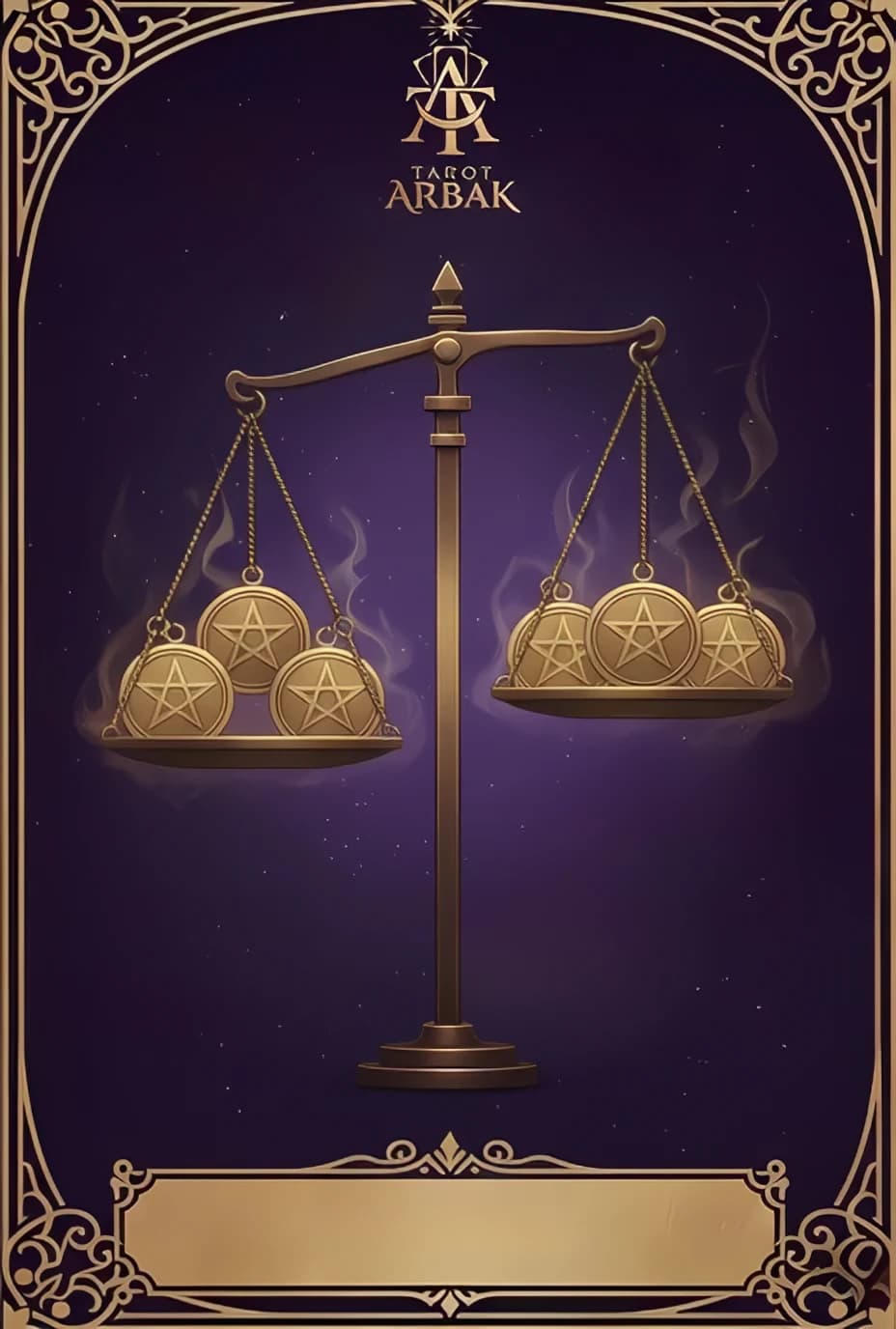
In Tarot Arbak, this card presents as a standing scale at center, its two pans balanced with gold discs bearing pentagrams. The absence of human figures abstracts the action itself, removing personality from the equation and focusing attention on the structural principle of distribution. This is not a card about who gives and who receives but about the ethical architecture of exchange itself. When Six of Pentacles appears, you are being asked to examine how resources move through your life and whether the principles guiding that movement align with your values.
The scale measures not only weight but worth.
The number six in numerology represents harmony, balance, and responsibility—the midpoint between creation and completion. In the Pentacles suit, this becomes the material expression of equitable distribution. This card appears when questions arise about fairness, when relationships require rebalancing, or when abundance meets opportunity for sharing. Six of Pentacles teaches that true wealth lies not in hoarding but in the conscious circulation of resources through intentional, measured generosity.
Six of Pentacles Symbolism
Six of pentacles tarot meaning reveals itself through geometric simplicity and symbolic precision. The card presents a standing scale with two pans, each holding gold discs bearing pentagrams. Unlike traditional Rider-Waite depictions featuring a merchant distributing coins to beggars, Tarot Arbak removes all human figures, abstracting the action to its essential principle. Every element teaches about the architecture of ethical exchange.
Tarot Arbak's Six of Pentacles creates a visual meditation on balance, fairness, and conscious distribution. The scale stands centered against an empty background, its two pans holding nearly equal weight. This composition invites contemplation of how resources move through our lives when guided by principle rather than impulse or ego.
Standing Scale: Measurement and Equilibrium
The standing scale at the card's center represents the principle of measurement—the conscious weighing of value and need. Unlike the scales of Justice, which often imply judgment after the fact, this scale suggests an ongoing process of calibration and adjustment. The vertical axis of the scale indicates that distribution is not arbitrary but follows a considered trajectory, descending from principle into practice.
In Rider-Waite tradition, a merchant figure stands with scales in one hand and coins in the other, actively deciding who receives charity. Tarot Arbak removes the merchant entirely, teaching that ethical distribution exists independently of personality. The scale itself becomes the protagonist, embodying the idea that fairness is a structural principle, not merely a human virtue. This abstraction invites us to consider distribution as an energy flow that can be aligned or misaligned, regardless of who participates in it.
The scale's positioning—centered and upright—suggests stability and intentionality. This is not accidental giving or impulsive charity but measured, considered exchange. The scale teaches that true generosity requires assessment, that sharing without discernment may serve neither giver nor receiver. Balance demands consciousness.
Gold Discs with Pentagrams: Material and Ethical Fusion
The gold discs in each scale pan represent material resources—wealth, resources, support, energy. Gold, associated with the Sun and with divine perfection, signifies that these resources carry inherent value. The pentagram etched upon each disc connects the material to the ethical, suggesting that true wealth contains a moral dimension. Resources are not neutral; how they are distributed matters as much as what they are.
The pentagram, an ancient symbol of balance among the elements, indicates that material resources operate within a larger ethical framework. In the classical understanding, the pentagram represents earth, air, fire, water, and spirit in harmony. Applied to material distribution, this teaches that generosity must account for physical needs, emotional impact, mental clarity, energetic integrity, and spiritual alignment. Resources moved without considering all these dimensions may create imbalance despite good intentions.
Gold shines with value; pentagrams shine with meaning.
The discs are identical in appearance yet their distribution across the two pans may vary slightly—the scales are nearly balanced rather than perfectly equal. This nuance teaches that Six of Pentacles is not about mathematical equality but about measured, ethical proportion. Fairness does not mean everyone receives exactly the same; it means everyone receives according to need, circumstance, and right relationship.
Two Pans: The Dance of Giving and Receiving
The two pans of the scale represent the two essential movements of resource flow: giving and receiving. Nearly balanced, they suggest that healthy distribution involves both directions. One pan cannot weigh much more than the other for long without the scale tipping entirely—relationships and systems that involve only giving or only taking inevitably become unsustainable.
In Rider-Waite imagery, the merchant gives while the beggars receive, creating a one-directional flow. Tarot Arbak's balanced pans teach that true reciprocity involves both movements, even if not simultaneously. The person who gives today may receive tomorrow; the organization that distributes resources may itself need support at another time. The pans hold the tension of this truth—that all relationships with resources are ultimately reciprocal, even when the immediate exchange appears one-sided.
The pans' near-equality also suggests that the card is not about absolute symmetry but about proportional balance. Some situations call for more giving than receiving in a particular moment; others require receiving more than giving. The scale adjusts to circumstance while maintaining its structural integrity. This teaches that flexibility within principle is itself a form of fairness.
Empty Background: Absence of Emotional Manipulation
The empty, simple background behind the scale carries profound symbolic weight. Unlike many tarot cards that feature complex landscapes, dramatic lighting, or emotionally charged settings, Six of Pentacles presents its subject against a plain field. This absence signals that distribution should be free from emotional manipulation, guilt, performative virtue, or transactional expectation.
In the Rider-Waite tradition, the scene often carries emotional undertones—the merchant's benevolence, the beggars' gratitude or shame. Tarot Arbak strips away these narratives, leaving only the principle itself. This teaches that ethical generosity operates beyond ego and emotion. True giving does not require gratitude; true receiving does not require shame. The scale measures without feeling, distributing according to principle rather than performance.
The empty background holds no guilt, no praise, only the principle itself.
This visual minimalism also invites the viewer to project their own relationship with resources onto the scene. Without human figures to identify with, we must examine our own position in the dance of giving and receiving. Are we the giver? The receiver? Both? Neither? The empty background becomes a mirror, reflecting our own patterns around wealth, generosity, and worthiness.
Vertical Axis: Conscious Decision-Making
The vertical axis of the scale—the line connecting the two pans through the central support—represents conscious decision-making descending from principle into practice. Unlike a horizontal line, which might suggest balance as a static state, the vertical axis implies movement and choice. Resources flow down this axis from intention to manifestation, from abstract principle to concrete action.
This verticality teaches that ethical distribution is not accidental; it requires active, ongoing participation. The scale does not balance itself—consciousness balances it. Each time resources change hands, a decision is made, whether consciously or not. Six of Pentacles calls us to make these decisions with awareness rather than habit, with intention rather than impulse.
The axis also connects earth and sky—practical material reality and higher ethical principles. True generosity, this card teaches, exists at the intersection of practical need and spiritual understanding. Resources moved without awareness of their larger purpose may do harm; resources moved with consciousness create ripple effects of positive change.
Near-Balance: Proportion Over Perfection
The fact that the scales are nearly balanced rather than perfectly equal carries important symbolic meaning. This card does not promise mathematical precision or absolute equality in distribution. Instead, it points toward proportion and appropriateness—giving and receiving that fits the context, need, and relationship.
Life circumstances are never perfectly symmetrical. One person may need more support at a given moment; another may have more capacity to give. An organization may distribute resources unevenly according to varying levels of need. The near-balance of the scales teaches that fairness exists in proportional relationship, not in identical treatment. Justice is not sameness; justice is right relationship.
This near-balance also acknowledges the reality of adjustment and correction. Perfect balance would imply stasis; near-balance suggests an ongoing process of calibration, reassessment, and fine-tuning. Relationships with resources require constant attention and adjustment as needs change, capacities evolve, and circumstances shift. The scale is never finished balancing.
- Symbol 1
standing scale
- Symbol 2
gold discs with pentagrams
- Symbol 3
two balanced pans
- Symbol 4
empty background
- Symbol 5
vertical axis
- Symbol 6
measured distribution
Six of Pentacles as Feelings: Balanced Emotional Exchange
Upright: The Experience of Reciprocal Connection
When six of pentacles as feelings appears upright in emotional readings, it represents:
- Reciprocal feelings — Emotions flow both ways; what is given is received in balanced measure
- Fair exchange in love — Both people contribute to emotional connection in ways that feel equitable
- Generosity without strings — Feelings offered freely, not as manipulation or transaction
- Worthiness to receive love — Ability to accept affection and support without shame or excessive debt
Reversed: The Distortion of Emotional Exchange
When six of pentacles as feelings appears reversed, it may indicate:
- One-sided feelings — One person gives emotionally while the other takes without reciprocity
- Transactional love — Affection given or withheld based on conditions, performance, or control
- Emotional debt — Feelings creating obligation rather than freedom; strings attached to every gesture
- Unworthiness — Struggling to receive love; refusing support out of false pride
Six of Pentacles Tarot Advice: Practice Conscious Exchange
Six of pentacles tarot advice teaches that resources flow best when guided by principle rather than impulse. The card advises giving with boundaries and receiving with grace.
Specific advice by situation:
- In generosity — Give from abundance, not depletion. Share according to capacity and principle, not guilt or obligation. True generosity empowers rather than creates dependency
- In receiving — Accept support with grace rather than shame. Receiving is not weakness; it is the other half of the cycle. Refusing needed help blocks the flow
- In relationships — Examine whether exchange is balanced. Both partners should contribute and receive. Resentment builds when balance is lost
- In finances — Ensure fair compensation for your contributions. Advocate for equitable treatment. If managing resources, distribute according to ethical principles
- In power dynamics — Be aware of how resources create or maintain power imbalances. Generosity should empower, not control
The ultimate six of pentacles tarot advice: Resources are energy meant to circulate. Give with boundaries, receive with gratitude. Balance creates sustainable exchange.
UPRIGHT MEANINGS
General Meaning
When Six of Pentacles appears upright, six of pentacles tarot meaning signals a time of conscious distribution and balanced exchange. You may find yourself in a position to share resources, or you may be receiving support from others. This card asks you to examine the principles guiding the flow of resources in your life—is there balance, fairness, and intentionality, or are old patterns of scarcity, guilt, or entitlement operating beneath the surface?
The scale measures not only what is given but why.
If you are in a position to give, Six of Pentacles encourages generosity with boundaries. Give from abundance rather than depletion, with clarity about your capacity and purpose. Avoid giving out of guilt, obligation, or desire for appreciation. True generosity serves both giver and receiver, creating exchange rather than debt. If you are receiving, this card reminds you to accept with grace rather than shame. Receiving is not weakness; it is the other half of the cycle. Refusing needed support out of false pride is as imbalanced as giving beyond one's means.
Six of Pentacles may also indicate that fairness is being restored in a situation where balance has been lost. Perhaps a financial matter will resolve equitably, or a relationship will find healthier terms of exchange. This card often appears when systems of distribution are being questioned and realigned toward greater justice. Trust that resources move according to principle when conscious intention guides them.
Love & Relationships
In love readings, six of pentacles tarot meaning upright often points to balance in the giving and receiving of love, support, and emotional resources. Healthy relationships involve reciprocity—not mathematical equality, but proportional exchange where both partners feel seen, valued, and supported according to their needs and capacities. This card may appear when a relationship has become one-sided and needs recalibration, or when existing patterns of exchange are working well and deserve acknowledgment.
For those seeking relationships, Six of Pentacles can indicate meeting someone who values fairness and reciprocity. This card warns against both extremes: the partner who takes more than they give, and the partner who gives to the point of self-abandonment. Healthy love involves mutual support, honest negotiation of needs, and the willingness to both offer and receive care.
In established relationships, this card may highlight questions about balance. Are both partners contributing to emotional needs, practical responsibilities, and relationship maintenance in ways that feel fair? Are resources of time, energy, and affection flowing freely both ways, or has one direction become dominant? Six of Pentacles invites honest conversation about what balance means in your particular relationship context.
Career & Money
Professionally, six of pentacles tarot meaning upright often relates to financial fairness, resource distribution, and equitable exchange. This card may appear when salary negotiations, raises, or bonuses are under discussion. Six of Pentacles favors those who advocate for fair compensation with evidence of their value—not out of entitlement or greed, but from a place of recognizing the worth they contribute and seeking commensurate return.
This card can also indicate positions of stewardship—managing budgets, overseeing distributions, making decisions about resource allocation. When in such roles, Six of Pentacles calls for principles-based decision-making that considers multiple factors: need, contribution, capacity, and impact. Fairness does not mean everyone gets the same; it means everyone gets appropriately according to relevant criteria.
Six of Pentacles asks: Do your professional exchanges reflect the value you offer?
For entrepreneurs and business owners, this card may relate to how resources are shared with employees, partners, and communities. Generous leadership is not about giving everything away; it's about creating ecosystems where value circulates and all participants thrive. The card asks you to consider whether your business practices reflect ethical principles and balanced relationships with all stakeholders.
REVERSED MEANINGS
General Meaning
Six of pentacles tarot meaning reversed signals imbalance in the flow of resources and the violation of fair exchange principles. This reversal may manifest in several ways: giving with strings attached, creating debt rather than empowerment; receiving without gratitude or need, draining resources without return; or unequal power dynamics where generosity becomes control. Alternatively, the reversed card may indicate unfair distribution—some receiving far more than their fair share while others go without.
The reversed scale asks: Who truly benefits from this exchange?
This card can point to patterns of codependency in resource exchange—the over-giver who gives to feel needed, the chronically needy who refuses to become self-sufficient. Both patterns create imbalance and perpetuate unhealthy dynamics. Six of Pentacles reversed calls for honest examination: Are you giving beyond your capacity out of guilt or people-pleasing? Are you receiving more than you need while others go without? Are your exchanges with resources characterized by manipulation, resentment, or power plays?
In some contexts, this reversal may indicate unfair treatment—being underpaid while contributing significant value, or having resources withheld due to bias, corruption, or unjust systems. Six of Pentacles reversed can signal the need to advocate for fair treatment and to resist arrangements that exploit rather than honor your contribution.
Love & Relationships
In love readings, six of pentacles tarot meaning reversed often points to imbalance in emotional exchange and unhealthy patterns of giving and receiving. This can manifest as codependency—one partner giving endlessly to avoid abandonment, the other taking endlessly without reciprocating. Alternatively, it may appear as transactional love, where affection and support are given or withheld based on performance, compliance, or control rather than flowing freely from genuine care.
For those seeking relationships, Six of Pentacles reversed warns against partners who create debt through generosity—giving much but expecting return in forms you cannot or should not provide. This card also cautions against seeking partners to rescue you from financial or emotional need, as this creates foundations of dependency rather than partnership.
In established relationships, this reversal may highlight resentments building around unequal contributions. One partner may feel they carry disproportionate burdens of emotional labor, practical responsibility, or financial support. The card calls for honest communication about balance and the willingness to negotiate new arrangements that feel fair to both. Unaddressed imbalances in emotional exchange will eventually undermine even relationships with strong foundations.
Career & Money
Professionally, six of pentacles tarot meaning reversed warns of unfair compensation, exploitation, or unethical resource distribution. You may be undervalued and underpaid, contributing significantly while receiving inadequate return. Alternatively, you may be in a position where you're expected to give beyond reasonable limits—working overtime without compensation, taking on responsibilities beyond your role, or being pressured to contribute to causes or colleagues in ways that blur professional boundaries.
This reversal can also indicate workplace cultures where favoritism, bias, or corruption determine who receives promotions, raises, or recognition. Merit and contribution may matter less than relationships, politics, or discriminatory factors. Six of Pentacles reversed signals the need to document your value, advocate for fair treatment, and potentially seek environments that honor equitable exchange.
Reversed Six of Pentacles asks: Are your professional exchanges characterized by respect for value or exploitation of need?
For those in leadership or management roles, this card may warn against playing favorites, withholding deserved recognition, or creating systems of patronage that reward loyalty over merit. Unfair distribution erodes morale, productivity, and trust. The card calls for examination of whether your leadership practices reflect principles of justice and fair exchange.
Frequently Asked Questions
Maintain the Crystalline Infrastructure
Tarot Arbak exists beyond ads and algorithms. Your contribution ensures the permanence of the Logos.