Seven of Swords
Seven of Swords
deceptiontrickerybetrayaldishonestystrategic thinking

Seven of Swords

Seven of Swords
Seven of Swords

Minor Arcana

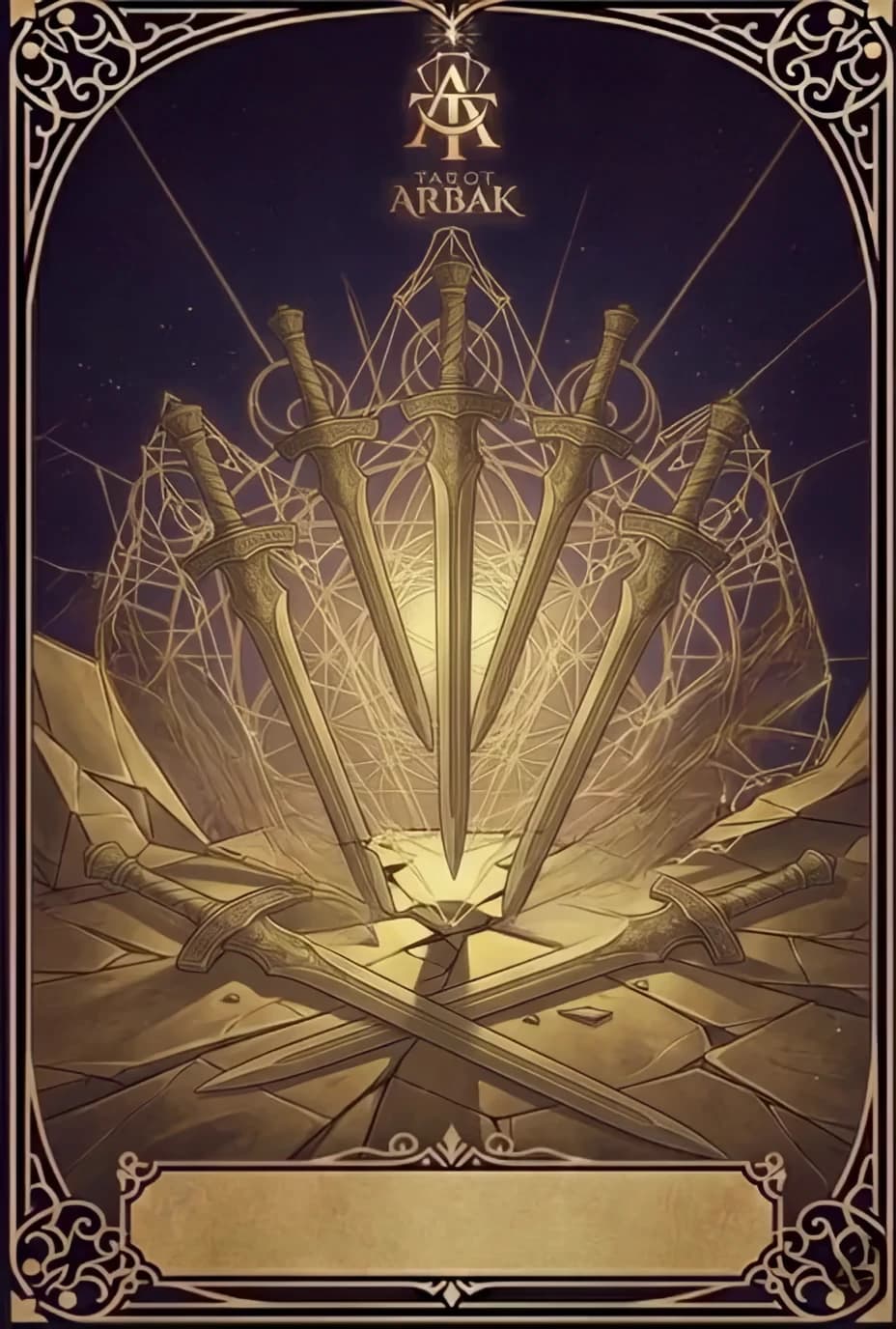
Seven of swords tarot meaning reveals when intelligence operates strategically but unethically—when the path of least resistance becomes the path of stealth rather than honor. Seven swords point in different directions, their asymmetrical arrangement creating a picture of disjointed strategy. This card captures the moment when someone chooses indirect methods over straightforward action, achieving goals through wit rather than force. In Tarot Arbak, there is no human figure sneaking away with stolen weapons; instead, the swords themselves tell the story of misalignment.

The Seven of Swords asks not just whether deception is occurring, but why it serves what purpose.

The swords do not converge at any central point, which reveals a crucial truth: truth is not being openly acknowledged or owned. In honest communication, intentions and actions align toward a shared purpose. In deception, truths are fragmented, partial, and arranged to mislead rather than reveal. The scattered swords represent pieces of information that have been selectively shared or concealed, creating a picture no one can fully grasp because no complete picture is being offered.

The sacred geometry that typically provides structure and harmony appears here, but the swords do not align with it. This misalignment is significant: the pattern of divine order exists in the background, but the swords operate outside that pattern. Intelligence is present, but not integrated with wholeness. Strategy is deployed, but not within an ethical framework. The card reveals that while the deceptive mind may be sharp, it has cut itself off from the larger harmony that gives meaning and sustainability to human action.

Number 7 in tarot represents completion, wisdom, and spiritual understanding—but in the Seven of Swords, this number takes on shadow meaning. The seven swords suggest intelligence that has become fragmented, wisdom turned to cunning, spiritual insight used for strategic advantage rather than authentic growth. This card appears when someone is choosing shortcuts over the full truth, when information is being withheld or manipulated, or when a situation requires you to read between the lines.

Seven of Swords Symbolism

Seven of swords tarot meaning unfolds through symbolic elements that reveal the structure of deception and its consequences. Every element teaches about the nature of strategic dishonesty and the costs of operating outside ethical boundaries. Understanding these symbols illuminates the card's deeper message about the relationship between intelligence and integrity.

Scattered Swords: Fragmented Intelligence

The seven swords positioned at different angles, none converging at a central point, represent disjointed strategy and fragmented truth. Unlike the unified formation of cards representing collective purpose or focused intention, the Seven of Swords shows intelligence operating in pieces—tactics that don't coordinate into a coherent whole. This represents the deceptive mind's tendency to tell different stories to different people, to withhold key pieces of information, and to create confusion by offering multiple partial truths rather than one complete one.

Truth is simple because it is one; deception is complicated because it must be many.

The asymmetrical, scattered arrangement creates a visual experience of fragmentation and disorder. This is not the unified focus of purpose or the coordinated effort of collective action—this is scattered energy, individual tactics, and strategies that do not add up to a coherent whole. The swords point in different directions because the deception serves multiple purposes simultaneously: hiding something while appearing transparent, gaining advantage while maintaining deniability, projecting one intention while pursuing another.

No Central Convergence: Truth Withheld

The swords do not meet at any central point, indicating that truth is not being openly acknowledged or owned. In honest communication, intentions and actions align toward a shared purpose. In deception, truths are scattered and hidden, making it impossible for anyone to grasp the full picture because no complete picture is being offered. The card asks: what is not being said? What information is being withheld or distorted?

This lack of central convergence reveals a fundamental truth about deception: it requires maintaining separation between different pieces of information. The deceiver cannot allow all the swords to point in one direction because that would reveal the contradiction. Each sword must be positioned separately to prevent anyone from seeing the relationship between them—the lie that connects them all must remain invisible. The scattered formation is not accidental but deliberately maintained to avoid detection.

Geometry Misalignment: Strategy Without Wholeness

The sacred geometry in the background represents the pattern of divine order and ethical harmony. The swords' failure to align with this pattern reveals that intelligence is present but not integrated with integrity. Strategy exists without wholeness, cleverness without wisdom. The card exposes the hollow victory of tactical success that comes at the cost of moral coherence. You may win the battle through deception, but you have cut yourself off from the larger harmony that gives victory meaning.

This misalignment teaches that intelligence divorced from ethics becomes a form of fragmentation. The sacred geometry represents the interconnectedness of all things, the understanding that individual actions exist within larger patterns of meaning and consequence. When the swords operate outside this pattern, they have become disconnected from their context, pursuing isolated advantage without regard for the whole. The deceiver may succeed tactically but has lost the integration that makes success meaningful and sustainable.

Cracked Ground: Trust Erosion

The fractured ground beneath the swords represents the erosion of trust that follows deception. Lies may achieve short-term goals—getting what you want, avoiding confrontation, gaining advantage—but they come at the cost of trust, both from others and within yourself. Each fracture represents a broken promise, a withheld truth, a moment when someone chose tactical advantage over honest connection. Over time, these accumulate until the ground becomes unstable, unable to support lasting structures of trust and intimacy.

Deception erodes the foundation that makes sustainable relationships possible.

The cracked ground warns that while the tactical maneuver may succeed in the short term, it undermines the very conditions that make long-term success possible. Trust is not optional in human relationships—it is the ground on which all connection stands. Each crack represents a choice to prioritize immediate advantage over the health of the whole. The Seven of Swords reveals that deception is not victimless; it damages the fabric of relationship and the deceiver's own capacity for authentic connection.

Non-Intersecting Traces: Parallel Deceptions

The traces on the ground that do not intersect suggest parallel deceptions—stories that don't add up, narratives that remain separate to avoid cross-examination. This represents the complexity of maintaining lies: the need to keep different tracks from meeting, the mental tax of remembering what you've told to whom. The card reveals that deception requires ongoing effort and vigilance. Truth is simple because it is one; lies are complicated because they must be many.

These non-intersecting traces represent the psychological burden of maintaining multiple narratives. The deceiver must keep track of which version of events they have presented to which person, ensuring that stories never meet in a way that would expose the contradiction. This requires constant mental energy and attention—the price of deception is not just ethical but psychological. The scattered traces show the exhaustion that comes from living outside alignment with truth, the constant vigilance required to prevent different pieces of the deception from intersecting and exposing the lie.

  • scattered swords at different angles
  • no central convergence point
  • swords misaligned with sacred geometry
  • cracked and fractured ground
  • non-intersecting traces and marks

UPRIGHT MEANINGS

General

When seven of swords tarot meaning appears upright, deception, trickery, or strategic dishonesty is at play in your situation. Someone may be withholding information, telling partial truths, or maneuvering behind the scenes to gain advantage. This card does not always mean malicious betrayal—sometimes it represents white lies, social tact, or necessary discretion in difficult circumstances. However, the Seven of Swords asks you to look beneath surface appearances and question whether you are getting the full story.

If someone is deceiving you, this card suggests the deception may be clever enough to avoid easy detection.

The asymmetrical arrangement of the swords indicates that what you are seeing is only part of the picture. Pieces are missing, stories don't quite align, and your gut may be signaling that something is off even if you cannot articulate what. The card urges you to pay attention to inconsistencies, to read between the lines, and to verify rather than assume.

If you are the one considering deception, the Seven of Swords appears as a caution. You may be contemplating a shortcut, a strategic lie, or a maneuver that would give you an advantage but compromise your integrity. The card asks you to consider not just whether you can get away with it, but what it will cost you in the long run. The cracked ground warns that deception erodes trust—including your own trust in yourself. Is the tactical gain worth the foundation damage?

Love

In love readings, seven of swords tarot meaning upright indicates deception, betrayal, or infidelity—but not always in straightforward ways. This card can reveal a partner who is hiding something, whether that's communication with an ex, online behavior they won't disclose, or feelings they are not expressing honestly. However, the Seven of Swords can also represent more subtle forms of romantic deception: leading someone on without commitment, keeping options open while pretending exclusivity, or presenting a false version of yourself to make a good impression.

For those in relationships, this card often appears when trust issues are present and for good reason. You may be sensing that your partner is not being fully honest, that stories don't quite add up, that there are gaps in their explanations. The Seven of Swords validates your suspicion while urging careful investigation rather than immediate accusation. Gather evidence, trust your gut, but verify before confronting.

For singles, the Seven of Swords can indicate dating someone who is not who they present themselves to be—someone who exaggerates their accomplishments, hides their relationship status, or says what you want to hear rather than what they actually mean. This card warns that the charming person may be strategically crafting their image rather than revealing their authentic self. Take time to see whether actions match words over the long term rather than getting swept up in first impressions.

Career

The Seven of Swords in career readings reveals workplace deception, office politics, or strategic maneuvering that operates outside official channels. You might be dealing with a colleague who takes credit for others' work, a boss who makes promises they don't keep, or a competitor who uses underhanded tactics to gain advantage. Alternatively, you might be the one considering whether to bend rules, withhold information, or use cleverness to get ahead.

This card often appears in situations involving intellectual property theft, idea appropriation, or claiming credit for work you didn't fully do.

The scattered swords represent pieces of others' contributions that have been rearranged to create the appearance of original effort. The Seven of Swords asks you to examine whether your professional success is built on honest effort or strategic appropriation of others' work.

For entrepreneurs and creatives, the Seven of Swords can indicate the temptation to cut corners—whether that's exaggerating qualifications, promising more than you can deliver, or using deceptive marketing tactics. The card urges you to consider the long-term costs of short-term gains. You might get the client or the sale through clever positioning, but if trust is broken when reality doesn't match the promise, your reputation may suffer permanent damage.

Spiritual

The Seven of Swords in a spiritual context represents spiritual bypassing, self-deception, or the use of spiritual practices and identities for strategic rather than authentic purposes. You might be tempted to present yourself as more enlightened or awakened than you actually are, using spiritual language and concepts to impress others rather than genuinely embodying wisdom. Alternatively, you might be deceiving yourself about your spiritual progress—convincing yourself that you've transcended emotions you haven't actually processed, claiming insights you haven't genuinely earned.

The card's misalignment with sacred geometry speaks to spiritual disintegration: when you use spiritual practices, teachings, or communities for strategic advantage rather than genuine growth, you cut yourself off from the very wholeness you claim to seek. The Seven of Swords invites you to examine where spiritual performance has replaced authentic practice, where the appearance of wisdom masks the reality of avoidance.

REVERSED MEANINGS

General

When seven of swords tarot meaning appears reversed, deception is being revealed, that the truth is coming to light, or that someone is reconsidering the use of dishonest tactics. The scattered swords are being gathered, the misalignment is being corrected, and what was hidden is becoming visible. This card often marks the moment when a lie collapses under its own weight, when inconsistencies can no longer be explained away, or when the deceiver decides that maintaining the deception is more costly than telling the truth.

Reversed, this card can indicate your own return to honesty after a period of deception or strategic dishonesty.

You might be confessing, coming clean, or simply deciding that the tactical advantage isn't worth the psychological burden of carrying secrets. The reversal represents realignment with integrity—choosing wholeness over cleverness, transparency over manipulation. However, this transition is often painful; the cracked ground in the card's imagery suggests that trust has already been damaged and will take time to repair.

However, the Seven of Swords reversed can also indicate increased deception or more sophisticated lying. When the upright card represents obvious trickery, the reversed position can represent gaslighting, deep-cover operations, or deception so elaborate that it becomes harder to detect. The reversal may mean the deceiver is doubling down rather than coming clean. The card asks you to examine whether apparent honesty might be another layer of deception.

Love

When the Seven of Swords appears reversed in a love reading, it suggests that deception in a relationship is being exposed or that the truth is finally coming out. You might discover that your partner has been hiding something—a secret relationship, financial infidelity, or feelings they haven't expressed honestly. Alternatively, you might be the one deciding to come clean after a period of hiding parts of yourself or your actions. The reversed card marks the moment when the scattered stories can no longer be maintained and truth must be faced.

For those healing from betrayal, the Seven of Swords reversed indicates the beginning of clarity after confusion.

You are piecing together what actually happened, the inconsistencies are making sense, and the full picture is finally emerging. This clarity, however painful, represents progress—you can only heal from betrayal when you know what you're healing from. The card reminds you that while the ground may be cracked, it is now honest ground, and rebuilding on truth is possible even if it takes time.

For singles, the Seven of Swords reversed can indicate discovering that someone you were dating was not who they presented themselves to be. The mask is slipping, the inconsistencies are adding up, and you are seeing the reality beneath the strategic self-presentation. This revelation might be disappointing, but the card urges you to see it as liberation—better to know the truth now than to invest further in someone based on deception.

Career

The Seven of Swords reversed in career readings indicates that workplace deception is being exposed, that credit theft is being corrected, or that office politics are coming to light. You might finally receive recognition for work that others claimed as their own. A toxic boss might be held accountable for promises they never kept. The strategic maneuvering that shaped your workplace culture might be disrupted by truth-telling and transparency.

This card often appears when you decide to stop playing political games and choose straightforward professional conduct instead. You might refuse to participate in office gossip, decline to cover for a colleague's unethical behavior, or simply decide that honest work, however slow, beats strategic shortcuts. The reversed Seven of Swords represents reclaiming your integrity even if it costs you tactical advantage.

For those who have been using deception to get ahead, the reversed card can signal the moment when this strategy stops working. The gaps between your claims and your actual capabilities are becoming visible, and you are facing the consequences of exaggeration or misrepresentation. The Seven of Swords reversed asks: are you ready to rebuild on honest foundations, or will you try more sophisticated deception to maintain the façade?

Spiritual

The Seven of Swords reversed in a spiritual position suggests spiritual honesty emerging after a period of self-deception or spiritual bypassing. You are admitting to yourself what you actually feel rather than what you think you 'should' feel as a spiritual person. You are dropping the performance of enlightenment and embracing the messy, complex reality of your actual journey. This return to authenticity may feel like a step backward, but the card reveals it as progress—real growth begins when you stop pretending to be further along than you are.

From a Jungian perspective, the reversed Seven of Swords indicates Shadow integration of the Trickster archetype. You are recognizing the ways you have used cleverness to avoid doing the real work, the ways you have crafted a spiritual identity rather than engaging in genuine transformation. By confronting these patterns, you can begin to integrate the Trickster's gifts—innovation, boundary-crossing, exposure of hypocrisy—without using them for egoic self-aggrandizement.

The reversed card can also mark the end of using spiritual practices and communities for strategic advantage. You might be leaving a community that was built on performance rather than authenticity, or you might be staying but dropping the performance and showing up real. The misalignment with sacred geometry is correcting as your actions come into alignment with your actual values.

Frequently Asked Questions

Related Cards