Five of Swords

✦ Minor Arcana ✦
Five of swords tarot meaning captures one of the most paradoxical moments in human experience: the instant when triumph tastes like defeat. When this card appears in a reading, it arrives as neither celebration nor warning but as a profound question about what we are willing to sacrifice to feel victorious. The Five of Swords speaks to those moments when we stand over conquered opponents, clutching the spoils of battle, only to discover that our victory has damaged what matters most—our relationships, our integrity, our peace of mind, and our capacity for genuine connection.
Victory achieved at all costs becomes a form of losing.
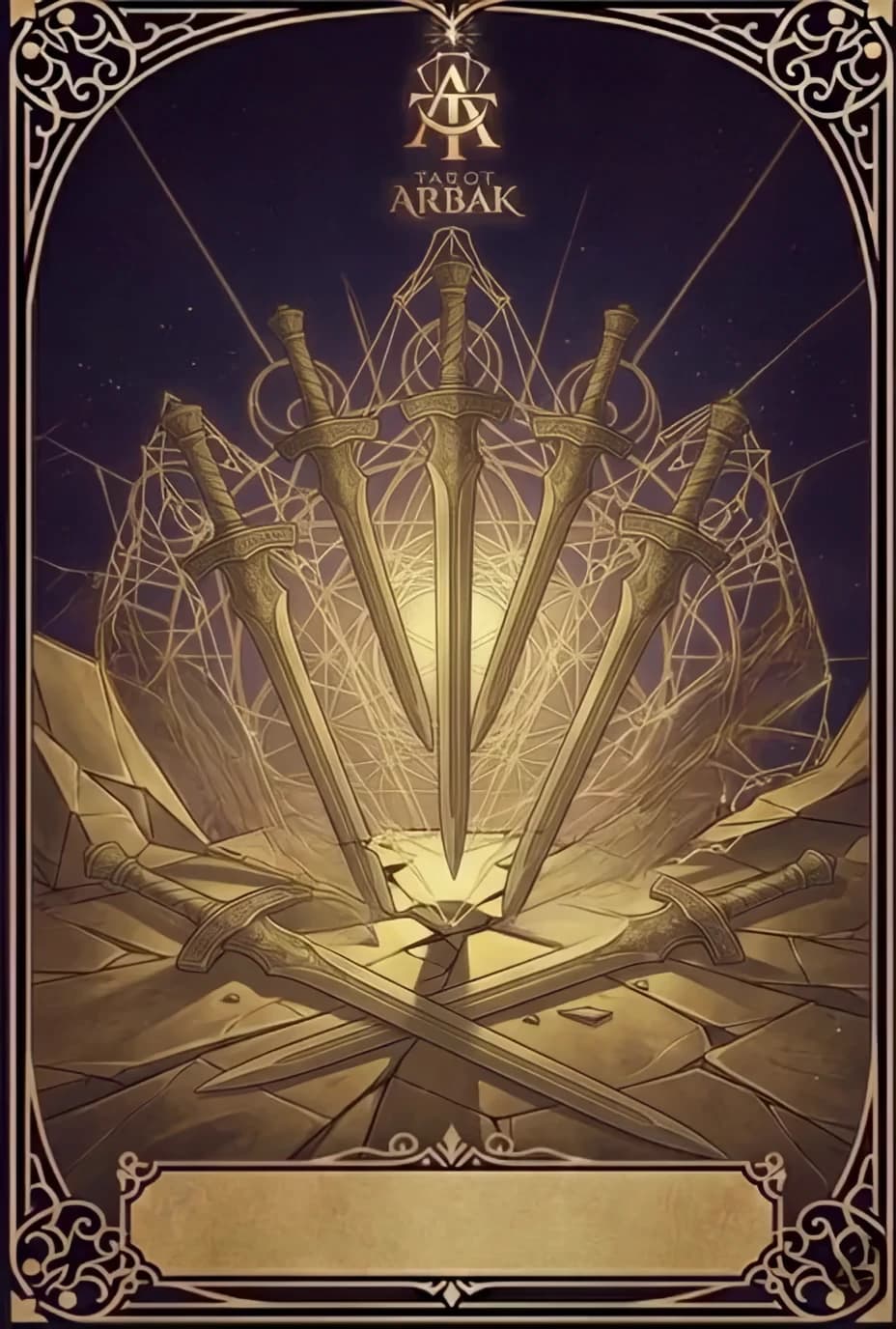
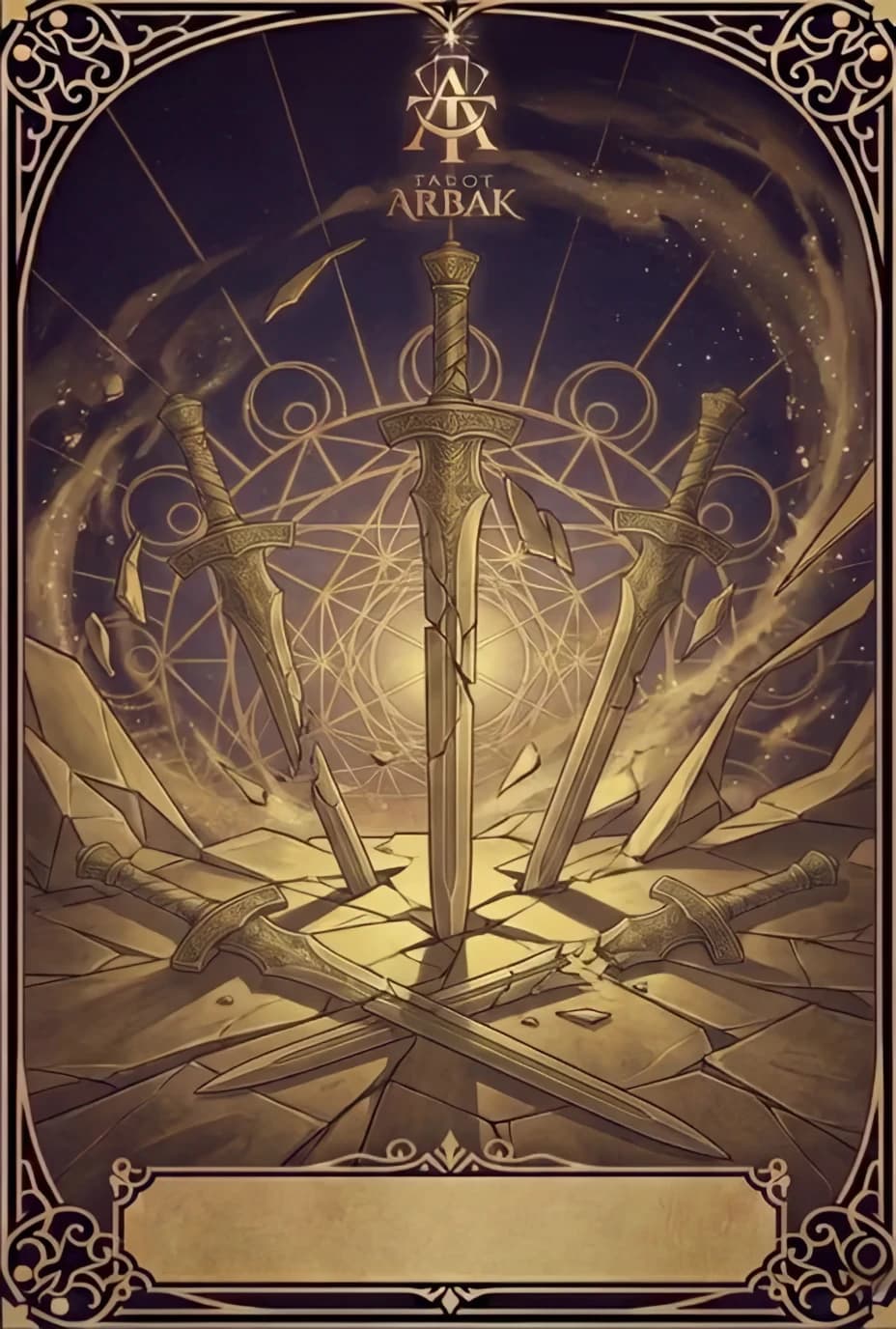
In Tarot Arbak's interpretation, this card presents itself not through human figures engaged in conflict but through the aftermath itself—the lone sword standing upright while broken blades scatter across cracked ground. This abstraction forces us to confront the reality of conquest without comfortable identification with either winner or loser. The Five of Swords illuminates uncomfortable truths about competitive dynamics: that winning can extract a devastating price, that domination creates survivors rather than victors, that some victories function as compensation for underlying wounds that no amount of conquest can heal. This card serves as a mirror reflecting our relationship with power, conflict, and the hollow pursuit of superiority.
Five of Swords Symbolism
The five of swords tarot meaning reveals itself through stark visual composition that eliminates human figures entirely, forcing us to confront the archetypal dynamics of victory at all costs. Every element in this arrangement speaks to the uncomfortable reality of conquest—what appears as triumph on the surface carries beneath it layers of damage, disconnection, and moral compromise.
Tarot Arbak's Five of Swords presents the aftermath of conflict as a structural problem rather than a personal narrative. The lone upright sword at center commands attention, suggesting victory has been achieved. Yet the scattered, broken blades surrounding it tell a different story: this is a battle in which everyone has lost something. The visual composition creates immediate tension between appearance of triumph and reality of devastation.
Central Upright Sword: The Hollow Victor
The lone sword standing upright at center represents apparent victory—the objective has been achieved, the opponent has been defeated, the battle has been won. In classical Rider-Waite interpretation, this sword belongs to a figure collecting weapons from defeated adversaries, collecting the spoils of conquest. However, Tarot Arbak's abstraction eliminates the human victor entirely, leaving only the weapon that made victory possible.
This central sword stands commanding attention, unbroken, apparently triumphant. Its very isolation, however, tells a deeper story. The sword's solitary state represents the price of that victory: damaged relationships that cannot be restored, lost goodwill that cannot be regained, broken trust that cannot be repaired through domination. The sword has won, yes, but it stands alone.
The upright position signifies that victory has been achieved, but the solitude of this blade questions whether anyone truly "wins" when conquest requires sacrifice of connection. In competitive situations, we often convince ourselves that winning will bring satisfaction, that being right will feel good, that proving our point will justify the methods. The Five of Swords confronts us with the hollowness of these assumptions—the lone sword standing over scattered debris, victorious but diminished.
The central sword is upright but stands in isolation.
The light source emanating from this sword is crucial—it shows that this conflict was not completely meaningless, that victory was achieved, that something of value was secured. However, the light does not illuminate the surrounding battlefield; it shines upon the weapon itself, suggesting that the value secured was the conquest itself rather than what conquest should have served.
Fallen/Cracked Swords: Mutual Destruction
Surrounding the central upright sword are five additional blades, all fallen or broken, scattered across cracked ground. These represent the mutual destruction that accompanies ruthess victory—what was lost or damaged in pursuit of conquest.
In traditional Rider-Waite imagery, defeated figures retreat from the victor, their swords scattered on the ground. Tarot Arbak eliminates the human element entirely, leaving only the broken weapons. This abstraction teaches that conquest destroys not only opponents but the relationships, trust, and possibilities that existed between all parties. The broken blades represent not merely the opponent's loss but everyone's loss—mutual damage even when only one party "wins."
The scattered arrangement of these broken blades is significant. They are not collected or organized but thrown across the battlefield, suggesting chaos and disconnection. Relationships that were damaged cannot be repaired; trust that was broken cannot be restored; goodwill that was lost cannot be regained. The conquest has left a battlefield of broken possibilities, and the cost of this damage falls on everyone involved.
Cracked Ground: Ethical Cost of Domination
The ground on which this scene unfolds is not solid but cracked and broken beneath the weapons. This represents the foundational damage that domination causes to relationships, communities, and shared reality.
In ethical terms, this cracked ground shows that conquest that prioritizes victory over connection undermines the very foundations upon which healthy interaction depends. Trust, goodwill, collaboration—all require solid ground. When pursuit of conquest cracks these foundations, the damage cannot be easily repaired. Even the victor stands on compromised ground; their victory was achieved, but the terrain they must navigate going forward has been weakened.
The cracking pattern itself is important—it radiates outward from the central sword, suggesting that the damage spreads. The conquest's impact extends beyond the immediate victory to damage surrounding relationships, broader community, and future possibilities that depend on the solid ground that has now been compromised.
Asymmetric Arrangement: Disorder of Conflict
The entire composition is asymmetric and disordered. The central sword stands upright and centered, but the surrounding broken blades are scattered without apparent pattern. This represents the disorder that conquest creates—what appeared as organized battle has left behind chaos and disconnection.
In competitive situations, we often imagine that victory brings order, that being right or winning will restore clarity and direction. The Five of Swords shows the opposite: conquest often creates more disorder than it resolves. The apparent victor stands alone, surrounded by debris, in a scene without clear forward direction. What was won was won, but the cost was disconnection, disorder, and broken foundations.
No Human Figures: Archetypal Dynamic
The complete absence of human figures in Tarot Arbak's Five of Swords is perhaps its most powerful statement. In traditional Rider-Waite and most other decks, this card shows a victorious figure standing over defeated opponents, collecting swords from those they have conquered. This personalization makes Five of Swords about someone's victory or defeat—about whether we are the winner or the loser in a conflict.
Tarot Arbak eliminates this human element entirely. No one stands victorious. No one retreats in defeat. No one collects weapons. The card contains only weapons: one standing, five fallen. This abstraction teaches that Five of Swords is not about personal triumph or personal defeat but about the archetypal dynamic of conquest itself—the inevitable destruction that occurs when winning becomes more important than connection.
This absence of figures forces us to confront uncomfortable truths about our own competitive patterns. We cannot comfort ourselves by identifying with the victor and blaming the loser. We cannot pretend that someone else's ruthlessness caused all the damage. The card presents the aftermath of conquest as a structural problem, asking us to examine our relationship with power rather than positioning ourselves as winner or victim.
Sacred Geometry: Not Random Consequence
The background against which this scene unfolds is not a natural landscape but a geometric pattern—sacred geometry arranged with intentional design. This teaches that the conflict depicted is not random but the inevitable consequence of mental patterns, power games, and ego-based decisions.
In traditional interpretations, Five of Cards often suggest conflict arising from external circumstances or other people's actions. The sacred geometry in Tarot Arbak's interpretation suggests otherwise: this destruction emerges from predictable patterns, from the very geometry of domination and conquest. When we approach situations with the mindset that winning matters most, the outcome is predictable—victory at the cost of connection, triumph at the expense of relationships, apparent success that masks foundational damage.
The geometric background teaches that these patterns are not accidental but follow the laws of their own system. Power games that prioritize domination over connection produce inevitable destruction. Competitive approaches that measure worth through conquest inevitably damage relationships. Ruthless ambition that values victory above integrity creates hollow victories as surely as night follows day. The Five of Swords shows the predictable outcome of these patterns.
The Architecture of Hollow Victory
Taken together, these elements construct a precise anatomy of conquest without satisfaction. The central upright sword represents apparent victory—the objective achieved, the battle won. The fallen and broken blades surrounding it represent mutual destruction—everyone lost something through this conflict. The cracked ground beneath shows foundational damage—conquest cracks the very foundations relationships and community depend upon. The asymmetric arrangement demonstrates disorder—conquest creates chaos rather than order. The absence of human figures reveals the archetypal dynamic—this is not about personal triumph but the inevitable cost of domination. The sacred geometry background teaches that this outcome is not random but the predictable consequence of patterns prioritizing victory above all else.
What this card eliminates is equally important. There is no celebration of victory. There is no suggestion that winning was worth the cost. There is no comforting narrative that this was necessary or justified. The card presents the aftermath of ruthess conquest and asks a simple question: was this victory worth its price?
- central upright sword
- fallen/cracked swords
- light source
- cracked ground
- asymmetric arrangement
- no human figures
- sacred geometry background
UPRIGHT MEANINGS
General
When the five of swords tarot meaning appears upright in a reading, it signals situations marked by victory achieved through questionable means or at excessive cost. You may have won an argument, defeated a competitor, or achieved a desired outcome—but the manner of your victory has created lasting damage. The card illuminates moments when winning has become disconnected from worthy purpose, when conquest itself has become the goal regardless of what is sacrificed to achieve it.
The upright Five of Swords asks: Would you be proud of how you achieved this win a year from now?
This position often indicates power struggles where you have prevailed but damaged relationships, conflicts where being right became more important than connection, or competitions where you secured victory at cost to your integrity. The energy is fundamentally uneasy—you have won, yes, but your triumph feels hollow. Rather than satisfaction, you may be experiencing guilt, unease, or painful recognition of what was sacrificed along the way.
The Five of Swords upright suggests that balance has tipped too far, when winning has become its own end rather than a means to worthy goals. You may be technically correct but emotionally wrong. You may have achieved your objective but lost goodwill. You may have proven your point but damaged trust. The card invites honest examination of your methods and motivations: Why was winning so important in this situation? What values or principles were at stake? What are you willing to sacrifice, and are those sacrifices worth the prize?
This card can also indicate situations where you are on the receiving end of someone else's ruthless need to dominate. If you feel diminished, hurt, or damaged by another's conquest, Five of Swords validates your experience while also suggesting you consider your response carefully. Not every battle needs to be fought; not every slight requires retaliation; not every loss of face requires revenge. Sometimes the strongest choice is to refuse engagement, to preserve relationships over proving points, to accept diminished status in exchange for maintaining connection and integrity.
Love
In love readings, the five of swords tarot meaning upright signifies competitive dynamics within relationships where one partner's need to be right or win arguments creates lasting damage. You may be winning conflicts but losing emotional connection. The card appears when relationships become battlefields rather than partnerships, when proving points becomes more important than mutual understanding, when domination replaces collaboration.
This position can indicate situations where you are technically correct in arguments but emotionally wrong. You may have won a disagreement, proven your partner mistaken, or demonstrated that you were right all along—but at cost to intimacy, trust, and the relational fabric itself. The Five of Swords asks whether being right is worth the price of being alone or distant within your relationship.
Alternatively, you may be experiencing a partner's ruthless competitive behavior. This person needs to win every discussion, must always have the last word, cannot tolerate any admission of wrongness, or approaches relationship as a series of battles to be conquered. Living with such energy is exhausting—it creates constant tension, undermines genuine connection, and leaves you feeling perpetually on guard.
The Five of Swords in love readings asks fundamental questions: Would you rather be right or happy? Would you rather win this argument or preserve your connection? Is your need to dominate protecting something vulnerable, or is it defending a wound that no conquest can heal? The card suggests that healthy relationships require collaboration rather than conquest, mutual understanding rather than victories won, and vulnerability rather than constant battle.
Career
Professionally, the five of swords tarot meaning upright suggests you are achieving goals through methods that may be compromising your integrity or damaging important professional relationships. You might be winning workplace politics but earning enemies, prevailing over colleagues but damaging team dynamics, getting promoted but being resented or mistrusted, or achieving success through cutthroat tactics that will ultimately damage your reputation.
Professional success achieved through ruthlessness often creates career advancement that feels hollow.
This card can indicate situations where you are outmaneuvering competitors in ways that, while effective, are burning bridges. You may secure the client, win the contract, or get the promotion—but at cost to professional goodwill, collaborative capacity, or long-term reputation. The Five of Swords asks whether you will be proud of how you achieved your professional goals a year from now.
Alternatively, you may be on the receiving end of workplace ruthlessness. Colleagues or superiors might be engaging in cutthroat behavior, taking credit for your work, undermining your efforts to advance themselves, or creating competitive environments that make collaboration difficult. The card validates your experience while suggesting you consider whether this environment aligns with your values and whether the cost of remaining is worth whatever success you might achieve there.
The Five of Swords in career contexts invites examination of your relationship with ambition: Is professional advancement worth sacrificing your integrity? Will winning this office politics battle make enemies that matter more than the victory? What kind of professional reputation are you actually building—one of ruthless competence or one of collaborative excellence? The card reminds us that career success achieved through methods that damage relationships often proves unsustainable in the long run.
Spiritual
Spiritually, the five of swords tarot meaning upright illuminates the shadow side of the warrior archetype—the dominator pattern that seeks superiority rather than capability, needs to win rather than to achieve worthy goals, views others as obstacles or threats rather than collaborators, and measures worth through conquest rather than contribution. This card reveals that excessive competitiveness often functions as compensation for underlying feelings of inadequacy, powerlessness, or unworthiness.
When this card appears in spiritual readings, it may indicate that your approach to spiritual development has become competitive or ego-driven. You might be approaching spiritual practice as another arena to excel, another way to prove superiority, or another domain to conquer. Comparison with others' spiritual progress, judgment of different paths, and need to be "right" about spiritual matters can all manifest as dominator pattern in disguise.
The Five of Swords also illuminates that some victories function as compensation—ways of proving worth or power that actually reveal underlying doubts and fears. The person who must win at all costs, who cannot tolerate losing, who treats every interaction as a battle to be won, often carries within them a profound wound that no amount of conquest can heal. Spiritually, this card asks whether your pursuit of victory is serving your highest good or whether it has become a self-defeating pattern that leaves you surrounded by the debris of damaged relationships and lost opportunities for genuine connection.
This position suggests a need to examine the relationship between your spiritual journey and your ego. Are you using spiritual insights to dominate conversations rather than connect? Are you measuring spiritual progress through conquest rather than transformation? Are you approaching spiritual communities as competitors rather than fellow travelers? The Five of Swords invites you to consider whether your pursuit of victory is serving spiritual growth or merely reinforcing ego patterns that must eventually be released.
REVERSED MEANINGS
General
The five of swords tarot meaning reversed signals that you are becoming aware of the costs of your approach to winning and conflict. You may be experiencing guilt or regret over how you have handled situations, awareness of the damage your winning strategies have caused, discomfort with victories that required ethical compromise, desire to repair relationships damaged by your need to dominate, or recognition that winning hasn't brought the satisfaction you expected. This awareness, while painful, represents profound growth and possibility of choosing different patterns.
The reversed Five of Swords represents the beginning of moving beyond conquest as a way of being.
This reversal indicates that you are ready to acknowledge the dominator pattern in yourself or others. You may be recognizing that your need to win has damaged what matters most—that being right isn't worth the cost to connection, that proving superiority has left you isolated, that victories achieved through ruthless means have felt hollow rather than satisfying. This recognition opens pathways to reconciliation, repair, and transformation.
The Five of Swords reversed suggests a shift from competitive to collaborative approaches. You may be choosing ethical methods over shortcuts, mentoring rather than dominating others, valuing team success over personal glory, or recognizing that your need to win has been damaging your relationships and opportunities in the long term. This position supports making amends and demonstrating changed behavior through consistent actions rather than words alone.
However, the reversal can also indicate that you are on the receiving end of someone's attempted repair after ruthless behavior. When someone who has dominated in the past recognizes the damage they have caused and attempts to make amends, this represents genuine growth. But the card also suggests discernment: not all apologies are genuine, not all remorse leads to change, and not everyone who claims to have changed actually has. The Five of Swords reversed supports evaluating repair efforts carefully, looking for consistent changed behavior rather than empty words or temporary gestures of remorse.
Love
When reversed in love readings, the five of swords tarot meaning indicates desire to repair relationships damaged by power struggles. You may be recognizing the cost of your need to be right and experiencing genuine remorse for ruthless behavior in relationships. This card suggests willingness to apologize, take responsibility, let go of the need to win arguments, prioritize connection over victory, and learn to compromise without feeling diminished.
This position often signals a turning point in relationship dynamics. You or your partner may be moving away from treating every disagreement as a battle to be won, recognizing that being right doesn't matter if you're alone, acknowledging that the relationship itself matters more than individual victories in conflicts. The Five of Swords reversed supports the difficult work of rebuilding trust after it has been damaged by competitive behavior.
Alternatively, you may be receiving an apology or attempt at repair from a partner who has been dominating the relationship. The card suggests evaluating this offering carefully: Is the remorse genuine? Does the apology include changed behavior? Is there willingness to do things differently going forward, or merely regret about consequences? Some damage cannot be repaired with words alone—it requires consistent, demonstrated change over time.
The reversed Five of Swords in love invites hope: patterns of ruthless conquest can change, relationships damaged by power struggles can heal, and connection can be restored when both parties value it more than being right. This reversal represents the difficult but rewarding work of moving beyond dominator patterns toward healthy collaboration.
Career
In career readings, the five of swords tarot meaning reversed suggests you are shifting from competitive to collaborative approaches and repairing professional relationships damaged by ambition. You may be recognizing that your need to win has been damaging your career in the long term, choosing ethical methods over shortcuts, mentoring rather than dominating others, valuing team success over personal glory, or understanding that ruthless tactics ultimately undermine sustainable success.
This position often indicates professional maturation. You may have learned through experience that workplace victories achieved through cutthroat methods create enemies rather than allies, that winning office politics damages your reputation more than it advances your career, that colleagues who feel diminished by your competitive behavior will not support you when you need them. The Five of Swords reversed supports choosing different patterns—building bridges rather than burning them, creating collaborative environments rather than competitive ones, and measuring success through contribution rather than conquest.
Alternatively, you may be working in an environment where the culture itself is shifting from ruthless competition toward collaboration. Organizations sometimes recognize that cutthroat dynamics damage productivity, innovation, and retention. You may be experiencing or helping create workplace cultures where mutual success is valued over individual triumph, where collaboration is rewarded rather than domination, and where ethical conduct is expected rather than punished.
The reversed Five of Swords in career contexts suggests that sustainable success requires relationships as much as results. The card supports recognizing that your reputation matters, that your ability to work effectively with others matters, and that the way you achieve success matters as much as whether you achieve it. Professional growth involves learning from the costs of ruthlessness and choosing collaborative excellence over competitive isolation.
Spiritual
Spiritually, the five of swords tarot meaning reversed supports integration of the shadow dominator pattern—acknowledging the part of you that wants to dominate, understanding its roots in fear or insecurity, and choosing healthier ways of being in the world. This card invites you to develop internal security that doesn't require external validation, find strength in cooperation rather than conquest, and embrace warrior energy in service to worthy causes rather than ego battles.
This reversal often indicates spiritual growth around issues of power and competition. You may be recognizing that your spiritual journey had become competitive, that you were measuring spiritual progress through conquest rather than transformation, or that need to dominate had infiltrated even your spiritual life. The Five of Swords reversed supports letting go of the need to be right about spiritual matters, releasing judgment of others' paths, and embracing collaboration with fellow spiritual seekers rather than treating them as competitors.
Spiritual integration transforms warrior energy from conquest to protection.
The card also suggests that you may be encountering spiritual teachings about power, conflict, and the shadow side of the warrior archetype. This is a time for deep reflection on how you engage with spiritual concepts and communities: Are you using spiritual knowledge to elevate yourself above others? Are you treating spiritual differences as battles to be won? Are you allowing competitive dynamics to damage your capacity for genuine spiritual connection?
The reversed Five of Swords invites spiritual integration not through eliminating the dominator impulse but through transforming it. Warrior energy can be redirected toward protection of what matters—protection of the vulnerable, defense of truth, service to justice. The strength that once drove ruthless competition can become strength that creates strong spiritual communities, protects the sacred, and serves something larger than ego-driven conquest.