Ten of Swords
Ten of Swords
mental exhaustionfinal endingtransformation through painrelease from sufferingnew beginnings after crisis

Ten of Swords

Ten of Swords
Ten of Swords

Minor Arcana

Ten of swords tarot meaning represents the definitive conclusion of a mental journey, marking the moment when an entire thought pattern reaches its final, irretrievable end. Unlike other Swords cards that suggest conflict or struggle, the Ten signifies complete exhaustion—the point where further suffering becomes impossible because the old structure has collapsed entirely. The interlocking swords form a sealed geometric pattern, indicating that the cycle is closed; there is no escape route, no alternative path forward within the old framework. This card does not depict physical defeat but rather the exhaustion of a zhiniscal narrative that can no longer sustain itself.

The Ten of Swords represents the moment when you can finally stop fighting against reality.

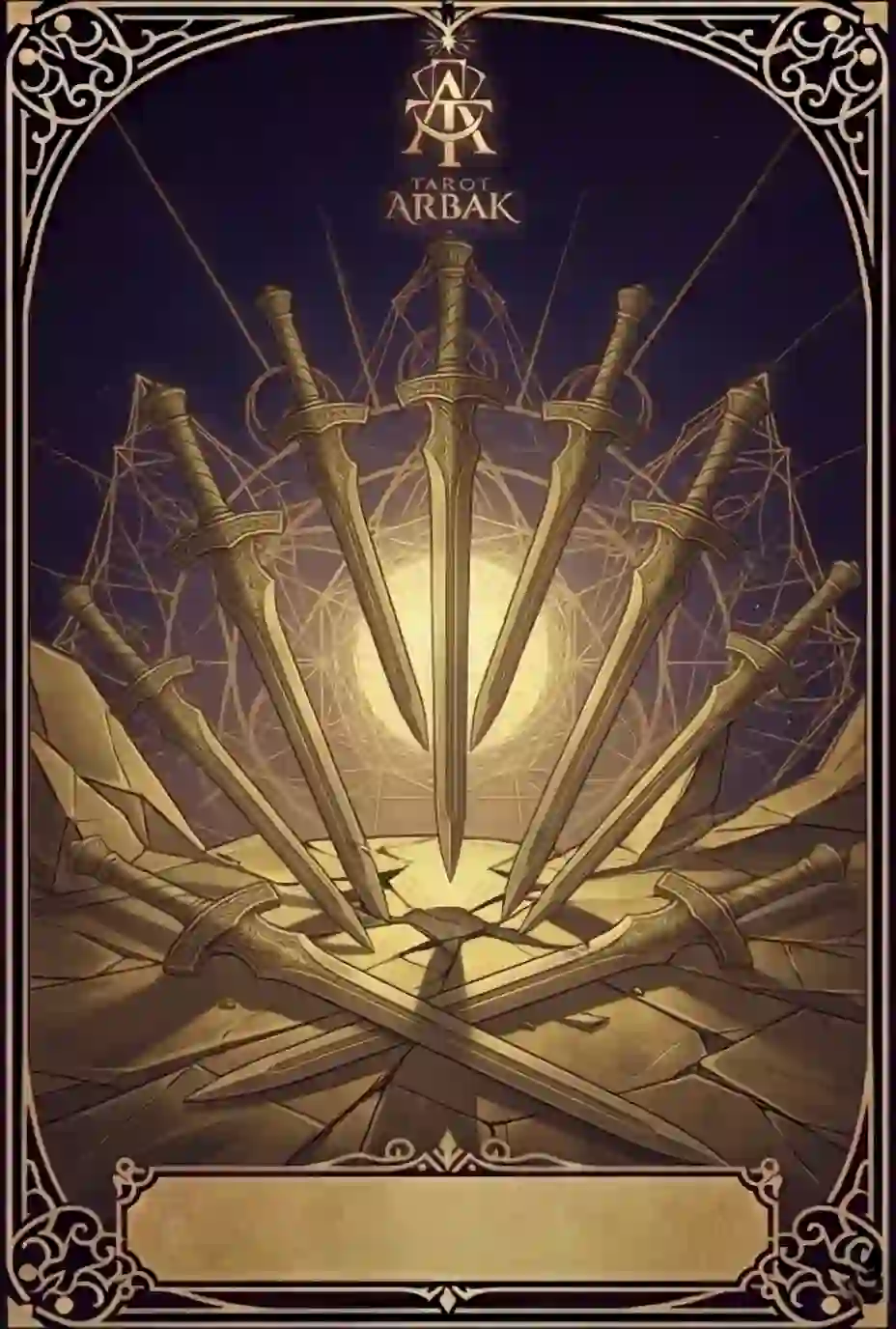
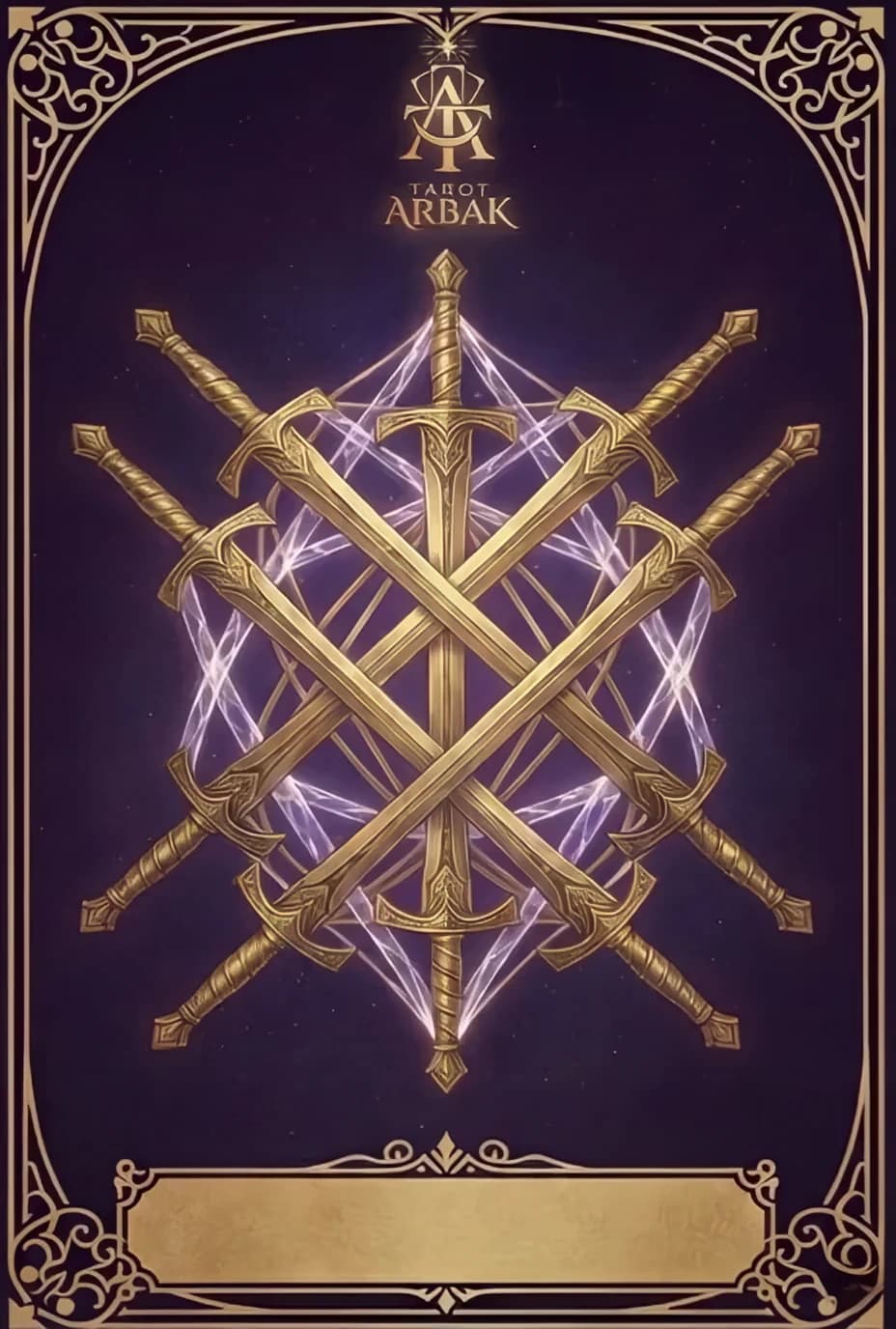
In Tarot Arbak, ten of swords tarot meaning transcends traditional interpretations of betrayal or victimization. Instead of a human figure struck down by external forces, this card presents a purely abstract representation: ten swords intersecting and overlapping to create a completely sealed geometric structure. The human figure is absent entirely, emphasizing that what has ended is not a person but a way of thinking, a mental framework, or an intellectual belief system that has run its course. This distinction matters immensely for understanding the card's true message. The Ten of Swords is not about what has happened to you from the outside—it is about what must end within you.

The number 10 in numerology represents completion, finality, and the culmination of a cycle. In the Swords suit, which governs intellect, communication, and mental constructs, 10 signifies the ultimate endpoint of a thought process. This is not a temporary setback or a problem to be solved—it is the death of something that has long been unsustainable. However, unlike many endings in the Swords suit that bring ongoing pain, the Ten of Swords carries within it the seed of liberation. When the old story finally collapses, you are freed from the burden of maintaining it.

Ten of Swords Symbolism

Ten of swords tarot meaning reveals itself through precise visual symbolism. Every element in this card speaks of finality, structural completion, and the paradox of death as a prelude to rebirth. Understanding these symbols unlocks the card's deep message about necessary endings and inevitable transformation.

Tarot Arbak's Ten of Swords presents a radical departure from traditional tarot iconography. Where Rider-Waite shows a fallen figure with swords in their back, Tarot Arbak presents only the swords themselves—intersecting, overlapping, forming a completely sealed geometric structure. This abstraction teaches that what has died is not a person but a thought pattern, a narrative, or a worldview that has reached its natural endpoint.

Interlocking Swords: Sealed Closure

The ten swords intersect and overlap to create a sealed geometric formation—a completely closed structure with no gaps, no escape routes, no room for further movement. This precise arrangement indicates that the cycle has reached absolute completion. Unlike earlier sword cards that suggest conflict, struggle, or potential resolution, the Ten of Swords presents a finished state. The swords are locked together; they cannot be rearranged, removed, or repurposed within the current structure.

This interlocking pattern teaches that some endings are absolute and necessary. When a mental framework has exhausted itself, continuing to operate within it becomes impossible—not because you lack effort, but because the structure itself can no longer support continued existence. The geometric precision of the swords suggests mathematical inevitability: this outcome has been building toward completion regardless of conscious resistance. Recognizing this inevitability is the first step toward liberation.

In Rider-Waite, the swords appear as weapons thrust into a victim. Tarot Arbak transforms this meaning entirely. The swords are not weapons of external attack but architectural elements of closure. They do not represent violence done to you but structural completion of a process you have been living through. The interlocking formation indicates that every aspect of the old narrative has been addressed and brought to its final point.

Absence of Human Figure: Purely Mental Death

The most striking feature of Tarot Arbak's Ten of Swords is the complete absence of a human figure. Where traditional decks show a person fallen to the ground, stabbed in the back, Tarot Arbak shows only the swords—pure, abstract, complete. This radical difference changes the entire meaning of the card. What has died is not the person, not the body, not even necessarily outer circumstances—what has died is a thought pattern, a belief system, a story that has been running in your mind.

This distinction is crucial for understanding ten of swords tarot meaning in practical terms. The card is not asking you to identify as a victim of external betrayal. Rather, it is asking you to recognize that an entire way of thinking has collapsed. The narrative you have been telling yourself about who you are, what is possible, or what reality looks like has reached its final, unsustainable point. The human figure's absence teaches that you are not what has ended—you are the consciousness that remains when the story collapses.

Rider-Waite's imagery emphasizes physical suffering and betrayal. Tarot Arbak shifts the focus entirely to the realm of the mental. The death that has occurred is psychological, emotional, intellectual—not physical. This shift makes the card's message more empowering: when you recognize that what has ended is only a thought pattern, not your essential self, you can release it more completely. You are not the swords; you are the space beyond them.

Repeating Intersections: Exhausted Cycles

The swords intersect with each other repeatedly, creating a pattern of crossing and recrossing that visually represents cycles of thought turning back upon themselves. This repetition signifies exhaustion—the same ideas, the same arguments, the same mental patterns have been repeated until they have worn themselves down completely. The crossed swords indicate that the old way of thinking has been going in circles, returning to the same points without resolution or progress.

This visual pattern teaches that mental exhaustion is not a failure but a natural endpoint. When a way of thinking has exhausted all its possibilities, when every angle has been explored and found wanting, when the same conflicts keep repeating without moving toward resolution—this is the condition the Ten of Swords depicts. The card does not criticize this exhaustion; it acknowledges it as a necessary precursor to transformation. The repeating intersections show that the old pattern has been thoroughly explored; there is nothing left to discover within it.

Unlike earlier Swords cards that suggest internal conflict or external opposition, the Ten of Swords indicates that the struggle itself has become unsustainable. The fighting is over because the structure can no longer support it. This is not defeat but completion. The repeating intersections teach that sometimes the most honest action is to recognize when a mental pattern has run its course and cannot be sustained further.

Complete Closure: No Escape Possible

The swords form a totally sealed structure—no gaps, no openings, no possibility of movement within the old framework. This closure represents absolute finality. There is no way to continue operating within the old system because the system itself has collapsed. The sealed formation indicates that escape is not only unnecessary but impossible; the structure has reached its natural endpoint and cannot be extended or modified to avoid this conclusion.

This aspect of the card's symbolism addresses the human tendency to cling to familiar patterns even after they have become unsustainable. The mind tries to find ways to avoid endings, to patch together old structures, to maintain familiar narratives despite evidence that they no longer serve. The Ten of Swords teaches that sometimes closure is not optional. Some endings happen whether you accept them or not; the sealed swords show that this ending has already occurred on a structural level, regardless of your conscious resistance.

The absence of escape routes is not punitive but liberating. When you genuinely recognize that the old pattern cannot continue, you are freed from the exhausting effort of trying to sustain it. The sealed structure means that the fighting is over—the collapse has already happened. What remains is not the effort to maintain the old but the opportunity to embrace whatever comes next.

Light Energy Lines: Potential for Transformation

Running between the swords are glowing lines of energy—light passing through the darkness of the crossed blades. These energy lines indicate that the death represented by the Ten of Swords is not absolute darkness but contains within it the seed of new life. The cycle has ended, but the energy has not been destroyed; it has only changed form and is now ready to move into a new configuration. The light between the swords represents the potential for rebirth that exists within every ending.

This visual element teaches that collapse and transformation are two sides of the same process. When the old structure collapses, the energy that sustained it does not disappear—it becomes available for new creation. The glowing energy lines signify that what follows the Ten of Swords is not nothing but something else—something that can only emerge after the old has reached its final endpoint. The light between the swords offers hope without romanticizing the pain of the ending.

The Ten of Swords teaches that endings are not final destinations but necessary thresholds for new beginnings.

In Rider-Waite, dawn breaking on the horizon offers similar symbolism of hope after devastation. Tarot Arbak's glowing energy lines express the same principle through abstract form rather than natural imagery. The light is not coming from an external source but emerging from within the structure itself—suggesting that the potential for transformation is inherent in the ending, not something that must be imported from outside.

Sacred Geometry: Tension Resolved

The swords form a complete sacred geometric pattern in the background—a flawless whole with no cracks, no fragments, no missing elements. This geometric perfection indicates that the tension represented by the Swords suit has reached resolution. Throughout the Swords journey, conflict, opposition, and struggle have predominated. The Ten of Swords shows the moment when all that tension finally resolves into stillness, completion, and perfect form.

The sacred geometry teaches that after turmoil comes peace—not through effort or forcing resolution, but through allowing the natural progression of the cycle to complete itself. The geometric pattern is not created by forcing the swords into an artificial order but emerges from their natural intersections when the process runs to completion. This suggests that peace comes not from fighting against the ending but from allowing it to reach its final form.

Unlike earlier Swords cards that show conflict in progress or suffering being endured, the Ten of Swords presents a finished state. The geometry is complete, the pattern is sealed, the resolution has occurred. This teaches that the suffering represented by the Ten of Swords is not ongoing but already passed—the worst has happened, and now the aftermath can be faced. The sacred geometry offers assurance that despite the apparent destruction, the overall pattern maintains perfect integrity.

The Bridge to Rider-Waite: Structural Comparison

Understanding the connection between Tarot Arbak's Ten of Swords and its traditional counterpart reveals how meaning transforms through symbolic evolution. Rider-Waite depicts a human figure lying face down with ten swords in their back, often interpreted as betrayal, defeat, or victimization. The rising sun on the horizon suggests that despite the darkness, dawn will come. This imagery emphasizes physical suffering and the promise of eventual recovery.

Tarot Arbak transforms this narrative by removing the human figure entirely. The swords stand alone, forming their own geometric structure. This shift moves the card's focus from physical victimization to psychological transformation. The betrayal is not external but internal—the betrayal of an old self-concept by new awareness. The death is not bodily but mental—the collapse of a narrative that has become unsustainable. The rising dawn becomes the glowing energy lines running between the swords, signifying that rebirth potential exists within the ending itself, not as a separate event.

This bridge between interpretations enriches understanding of both versions. Rider-Waite's human figure makes the ending personal and emotional. Tarot Arbak's abstract swords make the ending structural and philosophical. Together, they teach that endings are both deeply felt and structurally necessary—simultaneously a personal crisis and a natural conclusion. The Ten of Swords in Tarot Arbak does not reject traditional meanings but reframes them through a lens of psychological transformation rather than external misfortune.

  • interlocking swords
  • sealed geometric formation
  • absence of human figure
  • repeating intersections
  • complete closure structure
  • glowing energy lines
  • sacred geometry pattern

UPRIGHT MEANINGS

General

Ten of swords tarot meaning upright signals the absolute end of a mental journey—the moment when an entire thought pattern, narrative, or belief system has collapsed entirely and cannot be reconstructed. This card does not represent temporary setbacks or problems to be solved; it indicates structural completion of a cycle that has exhausted itself. The interlocking swords form a sealed pattern, showing that the old framework has reached its natural endpoint. While this ending may feel devastating in the moment, the Ten of Swords teaches that some collapses are not failures but necessary thresholds for authentic transformation.

The Ten of Swords asks: What story have you been telling yourself that can no longer sustain you?

This position often emerges after prolonged struggle or exhaustion—the same conflicts, the same arguments, the same mental patterns have been repeating without resolution until the structure itself collapses. The card indicates that further suffering is impossible not because pain has ended but because the old mechanism for generating suffering has broken down. The interlocking swords teach that when a mental framework reaches its limit, continuing to operate within it becomes impossible regardless of effort or intention. Recognition of this collapse is the first step toward liberation.

The absence of a human figure in Tarot Arbak's imagery is crucial for understanding this card's upright meaning. What has died is not you but a way of thinking about yourself. The narrative you have been inhabiting has collapsed, but the consciousness that experienced that narrative remains. This distinction is empowering: when you recognize that only a thought pattern has died, you can release it more completely. The Ten of Swords upright marks the end of an era in your mental life—not the end of you.

Love

In love readings, ten of swords tarot meaning upright typically marks the absolute end of a relationship or a relationship pattern. This is not a temporary crisis or a challenge to be overcome but a structural collapse of the emotional or mental framework that sustained the connection. The interlocking swords indicate that the old dynamics have exhausted themselves and cannot be prolonged, patched, or reconstructed. While painful, this ending may be necessary for liberation from unfulfilling patterns that have been repeating without resolution.

For those in relationships, the Ten of Swords upright suggests that the narrative holding the partnership together has collapsed—perhaps the shared vision has died, perhaps the emotional foundation has eroded, perhaps the mental agreement that made the relationship work has become unsustainable. The card does not necessarily indicate betrayal from outside; rather, it suggests that the internal structure of the relationship has reached its endpoint. The closed swords teach that when a relationship's foundational narrative dies, continuing the connection becomes impossible regardless of love or effort.

For singles, the Ten of Swords upright indicates that an old pattern of relating or a self-concept around love has died. Perhaps you have been operating from a story that is no longer true—maybe about what you deserve, about what love looks like, or about what will make you happy. This collapse of your love narrative, while disorienting, makes space for authentic connection once the old beliefs have been released. The Ten of Swords in love asks: What story about relationships do you need to let die so you can experience something genuine?

Career

Professionally, ten of swords tarot meaning upright indicates the collapse of a career narrative or professional identity. This may manifest as job loss following a long period of unsustainable conditions, the failure of a project or venture you had invested significant mental energy into, or the recognition that your chosen path no longer aligns with who you have become. The interlocking swords teach that when a professional framework exhausts its possibilities, maintaining it becomes impossible regardless of skill or effort.

This card often appears after prolonged struggle at work—the same conflicts, the same obstacles, the same frustrations repeating until the entire structure collapses. The Ten of Swords upright suggests that continuing on this path is not an option; the old professional narrative has died and cannot be reconstructed. While devastating in the moment, this collapse may be liberating if it releases you from a career pattern that was causing chronic dissatisfaction or misalignment.

The card does not predict failure; it marks the completion of a cycle that had already exhausted itself. The sealed swords indicate that the professional identity you have been occupying has reached its endpoint. What remains is not the effort to rebuild the old but the opportunity to discover what emerges when the familiar framework collapses entirely. The Ten of Swords in career suggests that your true professional calling may lie in directions you cannot yet imagine.

Spiritual

Spiritually, ten of swords tarot meaning upright represents the death of a spiritual narrative or belief system. You may have reached a point where the framework you have used to understand meaning, purpose, or divine connection has collapsed entirely. This could manifest as crisis of faith, disillusionment with a spiritual path you had deeply invested in, or the recognition that old ways of relating to the sacred no longer resonate. The interlocking swords indicate that the spiritual narrative you have been inhabiting has exhausted its possibilities and cannot continue.

This position teaches that spiritual growth requires the periodic death of frameworks we have outgrown. The Ten of Swords upright marks the moment when an old way of understanding the divine dies—not as punishment but as preparation for deeper connection. The glowing energy lines between the swords signify that despite this collapse, spiritual potential has not been destroyed; it is only being released from forms that can no longer contain it. The sealed swords show that the old must completely collapse before the new can emerge authentically.

The absence of a human figure in Tarot Arbak's imagery is especially meaningful spiritually. What has died is not your capacity for spiritual connection but a narrative about what that connection looks like. Your essence remains; the framework through which you express it has collapsed. This distinction is crucial: when you recognize that only a spiritual story has died, you can release it without losing your sense of the sacred. The Ten of Swords in spirituality marks the death of a map—not the territory itself.

REVERSED MEANINGS

General

Ten of swords tarot meaning reversed typically indicates either resistance to an ending or the early stages of recovery after collapse. You may be refusing to accept that a mental pattern or narrative has already died, clinging to a story that has collapsed, or denying the necessity of letting go despite evidence that the old framework is unsustainable. This resistance prolongs suffering, creating a purgatory where the ending has occurred on a structural level but has not been acknowledged consciously. Alternatively, the reversal can mark the beginning phase of healing—the worst has passed, and you are tentatively starting to rebuild after collapse.

The reversed Ten of Swords asks: Are you prolonging suffering by refusing to acknowledge that something has already ended?

This card often emerges during the transition period between collapse and renewal. The old structure has broken down, but the new has not yet formed. You may find yourself oscillating between grief for what has ended and tentative steps toward something unknown. The reversed Ten of Swords teaches that resistance to endings does not prevent them—it only prolongs the suffering. The swords are still interlocked; the structural completion has already occurred regardless of whether you accept it. Your task is not to undo the ending but to integrate it so movement can resume.

When this position represents early recovery, the card indicates that the most difficult phase has passed and the long process of rebuilding can begin. The glowing energy lines between the swords signify that potential for renewal exists within the collapse itself. The reversed Ten of Swords marks not the death itself but the aftermath—the period when you must choose between getting stuck in the narrative of victimization or allowing genuine transformation to occur.

Love

In love readings, ten of swords tarot meaning reversed may indicate resistance to accepting a relationship's end or the early stages of healing after breakup. You may be clinging to a connection that has structurally collapsed, refusing to let go of a narrative that can no longer sustain the partnership. This resistance creates a painful limbo where the relationship's foundation has died but neither partner fully acknowledges it. Alternatively, the reversal can mark the beginning phase of recovery—the grieving process has started, and you are slowly learning to live without the old relationship structure.

For those in relationships, the reversed Ten of Swords suggests that the partnership's narrative has collapsed but may not have been fully acknowledged. You might be trying to patch together something that has already broken down, reviving old patterns that have already exhausted their possibilities. The card warns that continuing without genuine recognition of the collapse prolongs suffering for both people. The interlocked swords indicate that the relationship's foundational story has reached its endpoint regardless of conscious awareness.

For singles, the reversed Ten of Swords suggests that an old pattern of relating has died but may not have been fully released. You might be operating from beliefs about love that no longer serve, holding onto expectations that have already collapsed, or repeating relationship dynamics that you have already outgrown. The card invites honest assessment: What stories about love are you clinging to despite evidence they are no longer true? Release these old narratives so authentic connection can emerge.

Career

Professionally, ten of swords tarot meaning reversed may indicate resistance to acknowledging that a career path has collapsed or the early stages of rebuilding after professional crisis. You may be trying to sustain a work situation that has structurally broken down, refusing to accept that the narrative supporting your current path has died. This resistance often manifests as staying in an untenable situation hoping conditions will improve, or trying to salvage a project that has already failed. Alternatively, the reversal can mark the beginning phase of professional recovery—you are starting to consider new directions after a collapse.

This card often appears during career transitions when the old professional identity has died but the new one has not yet formed. You may find yourself oscillating between grief for the path that has ended and tentative exploration of what might come next. The reversed Ten of Swords teaches that professional collapse, while painful, often liberates you from patterns that had become unsustainable. The swords are still interlocked; the completion has occurred regardless of whether you acknowledge it. Your task is not to reconstruct the old path but to discover what emerges when the familiar framework has fully released.

The glowing energy lines between the swords signify that professional potential has not been destroyed by collapse but is being released from forms that could no longer contain it. The reversed Ten of Swords in career suggests that the collapse, however difficult, may ultimately free you for work that aligns more authentically with who you have become.

Spiritual

Spiritually reversed, ten of swords tarot meaning may indicate resistance to acknowledging that a spiritual framework has collapsed or the early stages of discovering new meaning after disillusionment. You may be clinging to a spiritual narrative that no longer resonates, trying to maintain faith in beliefs that have already died, or refusing to accept that your understanding of the sacred has outgrown old forms. This resistance creates a painful spiritual limbo where the old story has collapsed but new understanding has not yet emerged. Alternatively, the reversal can mark the beginning of genuine spiritual rebirth after a crisis of faith.

This position often emerges during dark nights of the soul when old spiritual certainties have dissolved but new understanding has not yet formed. You may find yourself in the void between belief systems, experiencing profound disorientation and questioning. The reversed Ten of Swords teaches that spiritual collapse, while terrifying, may be necessary for authentic growth. The interlocked swords indicate that the old narrative has reached its endpoint regardless of whether you accept this completion.

The glowing energy lines between the swords signify that spiritual potential has not been destroyed by collapse but is being released from forms that could no longer contain authentic meaning. The reversed Ten of Swords in spirituality suggests that the death of a spiritual framework, however painful, may ultimately free you for deeper connection with the sacred. The old map has died, but the territory remains—and you may discover it through direct experience in ways the old story could never reveal.

Frequently Asked Questions

Related Cards