Nine of Swords

✦ Minor Arcana ✦
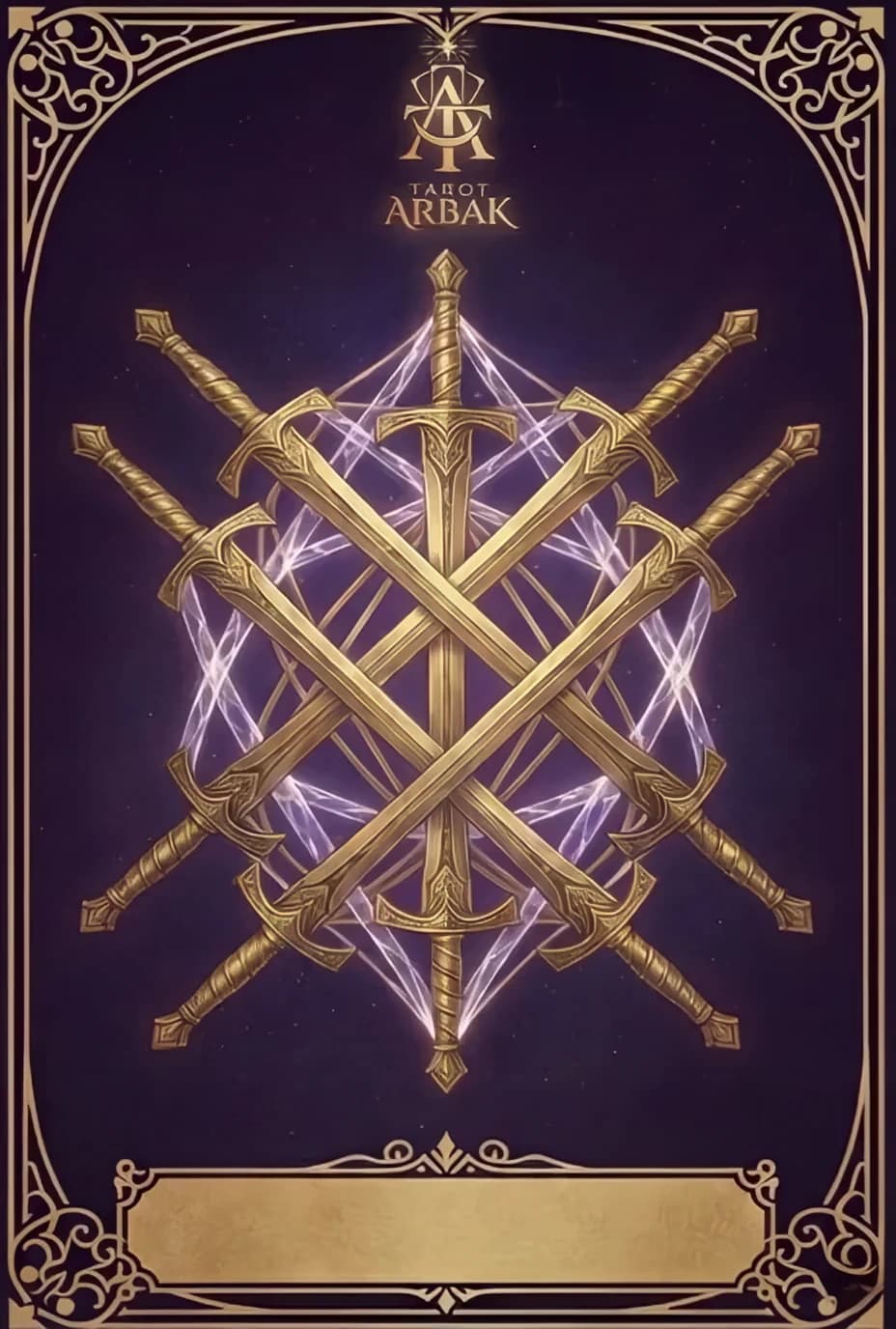
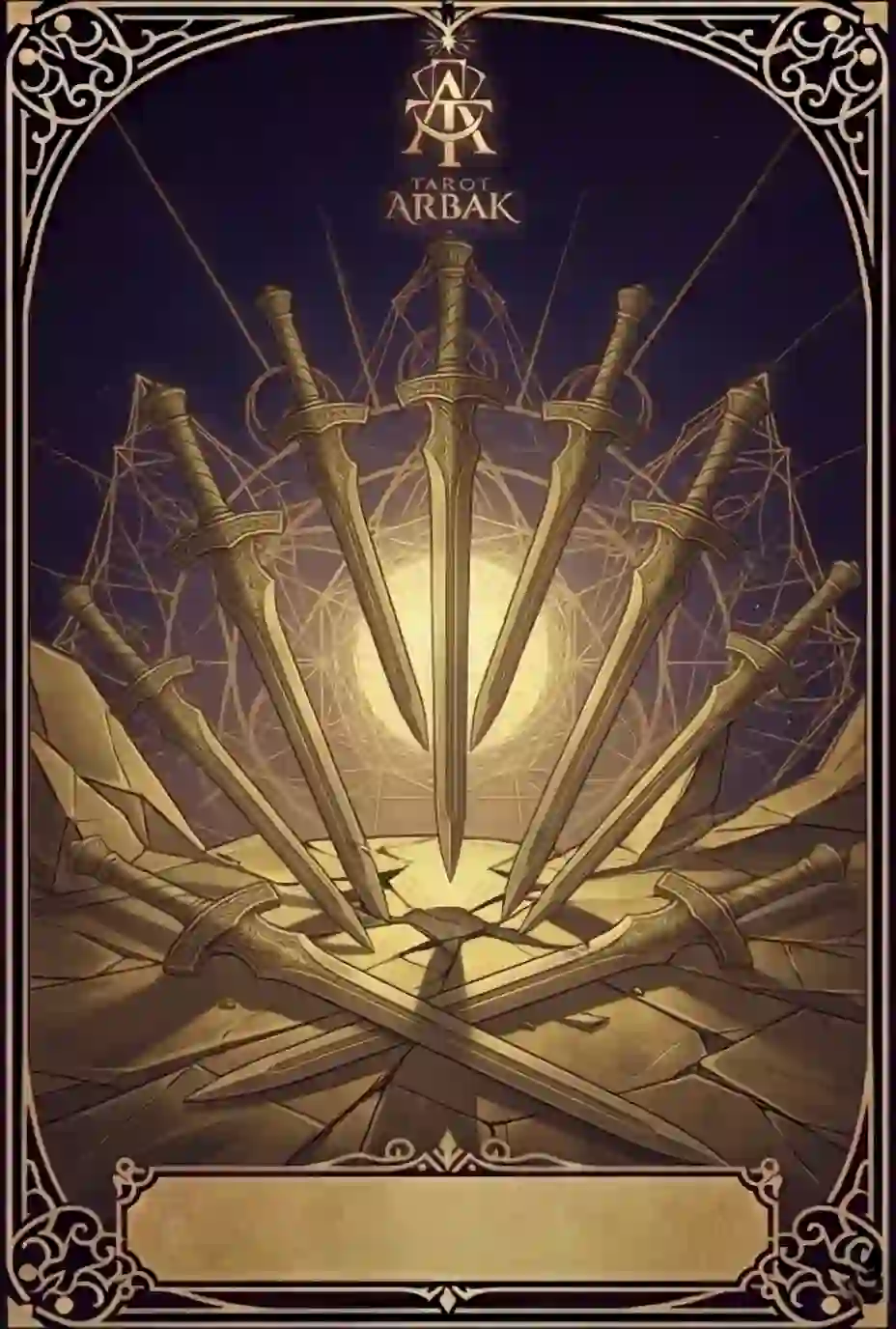
Nine of swords tarot meaning captures the quintessential experience of human anxiety—the moment when the mind becomes its own worst enemy. Nine swords rise upward from a central point, their blades clustered together in a formation that speaks of pressure, threat, and overwhelming mental burden. Unlike traditional Rider-Waite depictions that show a figure awakening in terror, Tarot Arbak presents this psychological crisis through the swords themselves, emphasizing that the true battle occurs within consciousness, not in the physical world.
The nine swords do not wound from without but pierce from within.
The number nine in tarot carries profound significance, representing completion, culmination, and the final stages before transition. In the Swords suit—associated with intellect, communication, and the mind—the Nine of Swords marks the zenith of mental distress before the release found in the Ten. This is not a card of external disaster, but of disaster anticipation. The agony it portrays is real, yet often disconnected from actual circumstance. Sleeplessness, nightmares, and racing thoughts characterize this state—a mind that has turned against itself through patterns of catastrophic thinking.
Understanding nine of swords tarot meaning requires recognizing that anxiety often tells convincing lies. The mind constructs elaborate scenarios of doom, each more terrifying than the last, while reality may be far less threatening. The card teaches us that the sword cuts both ways: intellect can illuminate truth or manufacture torment. When anxiety takes command, the mind's sharp edge becomes weaponized against the self, creating what psychologist Carl Jung would identify as the shadow in its most destructive manifestation.
Nine of Swords Symbolism
The nine of swords tarot meaning reveals itself through a stark visual composition that transforms the traditional nightmare scene into pure psychological abstraction. Every element in this card speaks of internal pressure, mental constriction, and the way consciousness can become trapped by its own creations. Understanding these symbols is essential for navigating the card's profound lesson about the nature of fear and the power of the mind to both create and dismantle suffering.
Tarot Arbak's Nine of Swords is deliberately unsettling yet structurally precise. The swords emerge from darkness, pointing upward in a formation that suggests both defense and entrapment. Here is the blueprint for understanding how anxiety operates, how it builds upon itself, and how—ultimately—it can be dismantled by recognizing its true source.
Nine Rising Swords: The Weaponized Mind
The nine swords rising outward from a central point represent anxiety multiplied—fear that has expanded through repetition and reinforcement. In classical sword symbolism, the blade represents the intellect's capacity to cut through illusion and discern truth. Here, that cutting power has turned inward, becoming an instrument of self-torture rather than liberation. Each sword symbolizes a specific worry or catastrophic thought, yet their common origin point reveals the deeper truth: beneath seemingly distinct fears lies a single, fundamental wound.
The upward-pointing orientation suggests that these threats feel imminent and overwhelming—as if descending from above—but the swords actually rise from below, from the darkness of unconscious material surfacing into conscious awareness. This teaching is crucial: the Nine of Swords does not represent external attack but internal uprising. The mind manufactures its own terrors, then reacts to them as if they were inevitable and authentic threats. The number nine, being the culmination of the numerical sequence, indicates that this anxiety has built through time, layer upon layer, until reaching its current crescendo.
The mind that created the prison holds the key to its own liberation.
The swords' clustered, crowded arrangement creates a sense of suffocation and entrapment. There is no space between them for perspective, no room for the light of reason to penetrate. This reflects the psychological state described by cognitive psychologists as catastrophic thinking—the tendency to spiral from one concern into many, until fear becomes all-consuming. The Nine of Swords shows us that anxiety does not multiply because there are that many real problems; it multiplies because the anxious mind knows how to generate infinite variations on the same underlying theme.
Common Center: The Single Source of Fear
All nine swords emerge from a single central point, creating a powerful visual metaphor for what psychologists recognize as a core wound or fundamental fear from which all other anxieties branch. In tarot tradition, swords represent the element of Air and the realm of intellect, thought, and communication. When this element becomes distorted through anxiety, the mind demonstrates its most dangerous capability: the power to construct elaborate narratives of suffering that feel completely real while being fundamentally illusory.
This central point teaches us about the architecture of fear. Whether someone worries about health, relationships, career, finances, or existential meaning—nine different categories of concern—the underlying question is often the same: "Am I safe?" or "Will I be okay?" The Nine of Swords reveals that anxiety, despite its thousand faces, often springs from a single root. Recognizing this unity in diversity offers a pathway out of overwhelm; instead of fighting nine separate battles, the seeker can address the central fear that feeds them all.
The visual convergence also suggests that anxiety operates through feedback loops. One fear gives birth to another, which reinforces the first, creating a self-sustaining cycle. This aligns with how catastrophic thinking works in practice: the mind generates worst-case scenarios, then treats those scenarios as evidence that reality is threatening, which generates more worst-case scenarios. The Nine of Swords depicts this process frozen at its peak moment—the instant before the cycle either breaks or completely consumes consciousness.
Dark Ground and Cracked Surface: The Unconscious Breaking Through
The dark ground upon which the swords rise represents the unconscious foundation from which anxiety emerges. In Jungian psychology, what remains repressed or unexpressed does not disappear but gains power in the shadows, eventually surfacing as symptoms, nightmares, or inexplicable dread. The Nine of Swords shows this emergence in dramatic form: the darkness below is not empty but charged, and the cracks in the surface suggest that what has been suppressed can no longer be contained.
The tension traces and cracks in the ground indicate that this mental pressure is not a new development but the result of long-suppressed thoughts, emotions, or memories gradually breaking through the conscious mind's defenses. Anxiety often seems to arise suddenly—a sleepless night, a panic attack—but the Nine of Swords teaches that sudden eruptions usually have long histories. The mind can only maintain repression for so long before the accumulated pressure demands release. When release comes through anxious spiraling rather than conscious processing, the result is the torment this card depicts.
These ground-level cracks also symbolize the fragility of the ego's defenses. The conscious mind attempts to maintain order, control, and a coherent narrative of safety. When unconscious material overwhelms these defenses, the ego experiences its own vulnerability as terrifying. What appears as nine external threats may actually be the ego's reaction to recognizing that control is, and always was, an illusion. The cracks reveal that the foundation itself—our sense of separate, defended selfhood—is not as solid as believed.
Concentrated Light: The Illumination of Suffering
Amidst the darkness and threatening swords, concentrated light emerges from the same central point. This represents a crucial teaching: the light of consciousness that creates awareness of suffering also contains the potential for liberation. The Nine of Swords is not merely about anxiety but about awareness of anxiety. Without this light, one would remain in unconscious suffering, completely identified with fear and unable to observe it.
The concentrated light suggests that the same mental clarity which can construct elaborate nightmares also possesses the capacity for self-reflection and metacognition—the ability to observe thoughts without being consumed by them. This is the essence of meditation and mindfulness practices: developing the capacity to see anxiety as a mental event rather than becoming anxiety itself. The light represents the awakening observer who recognizes that the mind creates the scene of terror and therefore can dismantle it.
This illumination, however painful, is actually the beginning of healing. The Nine of Swords represents a crisis point, but crisis also means opportunity. The concentrated light shows that the anxiety has become fully conscious—which means it can now be addressed. Fear kept in darkness exercises unlimited power; fear brought into light can be examined, understood, and ultimately released. The card teaches that what you cannot see cannot be transformed; once seen, even the deepest terror becomes workable.
Invisible Sacred Geometry: Order in the Midst of Chaos
Barely visible in the background, sacred geometry retreats into near-invisibility, suggesting that the cosmic order underlying reality has not disappeared but is obscured by the intensity of anxious focus. This subtle element carries profound meaning: even in the depths of mental anguish, the universe maintains its fundamental patterns of harmony and balance. The problem is not that order has vanished but that perception has narrowed to exclude everything except the threatening.
This invisible geometry teaches us about the selective perception that characterizes anxiety disorders. When the mind is gripped by fear, attention becomes like a spotlight that illuminates only danger while everything else fades into darkness. The Nine of Swords shows this narrowing in visual form: the swords and central light dominate awareness while the geometric patterns that signify wholeness and integration recede to the periphery, barely perceptible.
The presence—however faint—of sacred geometry also carries an essential promise: anxiety is not reality's final word. Behind the overlay of catastrophic thinking, the underlying order remains intact. When the anxious state passes, when the mind quiets and perspective returns, that geometry becomes visible again. The Nine of Swords reminds us that no matter how convincing the nightmare feels in the moment, it exists within a larger context of meaning and coherence. This teaching offers hope without minimizing suffering: the pain is real, but it is not ultimate.
The Absent Figure: Consciousness Without Identification
Unlike traditional Rider-Waite depictions that show a figure awakening in horror, Tarot Arbak's Nine of Swords presents the scene without a human figure. This absence carries profound significance: suffering occurs in consciousness, not in a person separate from consciousness. The card suggests that what we call "the anxious person" is actually consciousness temporarily identified with anxious patterns. Remove the identification, and what remains is not a broken self but awareness itself—unchanged, unharmed, and already free.
This removal of the figure teaches a crucial lesson about the nature of identity. We tend to say "I am anxious," as if anxiety were our fundamental identity. The Nine of Swords shows anxiety as something that happens within awareness but is not awareness itself. The swords represent thoughts, emotions, and sensations—all arising and passing within the field of consciousness. By removing the figure who is supposedly anxious, the card points toward what Buddhist psychology calls the anatta or not-self doctrine: the recognition that what we call "I" is a process rather than an entity, and therefore cannot be fundamentally harmed by the experiences it contains.
This abstract representation also emphasizes that nine of swords tarot meaning is not about a specific type of person but about a universal human experience. Anyone, regardless of strength, wisdom, or spiritual attainment, can encounter this state of mental anguish. The absence of a figure means no one is immune, but also no one is permanently defined by it. The anxious state is a wave in the ocean of consciousness—powerful, overwhelming, but ultimately passing. The card teaches not how to avoid anxiety permanently but how to recognize its impermanent nature and relate to it with wisdom rather than identification.
- Nine rising swords
- Central emergence point
- Dark ground with cracks
- Concentrated light
- Subtle sacred geometry
- Climactic number nine
UPRIGHT MEANINGS
General
When Nine of Swords appears upright, nine of swords tarot meaning signals a period of acute anxiety, sleepless nights, and mental anguish. You may be experiencing a cluster of worries that feel overwhelming, racing thoughts that prevent rest, or catastrophic thinking that paints worst-case scenarios in vivid detail. This card does not necessarily indicate that actual disaster is coming—rather, it suggests that your mind has constructed a convincing nightmare and is responding to it as if it were real.
The suffering is real, but the cause may be imagined.
This position often appears during times of high stress, transition, or when long-suppressed fears surface into consciousness. Insomnia, nightmares, and persistent anxiety characterize this state. The Nine of Swords asks: Are these fears proportionate to actual threat, or have they multiplied through catastrophic thinking? What core wound feeds the many specific worries? The card teaches that the mind possesses the power to both create suffering and dismantle it—awareness is the tool that shifts from creation to deconstruction.
The Nine of Swords upright invites you to acknowledge anxiety rather than fight it. What you resist persists; what you observe with awareness can begin to transform. This may be a time for therapy, meditation practices, or conversations that bring hidden fears into the light. The intensity of this card indicates that the issue has reached a turning point—either the anxiety will be addressed consciously, or it will continue to escalate until it demands attention.
Love
In love readings, Nine of Swords upright indicates relationship anxiety, insecurity, or the haunting of past relationship wounds in the present. For those seeking partnership, this card can show fear of intimacy, belief that love is dangerous or unavailable, or catastrophic thinking about potential relationships. You may be carrying scars from previous experiences that color your perception of current possibilities, seeing threat where opportunity actually exists. The Nine of Swords in this position asks: Are you protecting yourself from pain or preventing yourself from connection?
For those in relationships, Nine of Swords can indicate trust issues, communication problems driven by fear, or one partner projecting past trauma onto the current relationship. Sleeplessness, worry about the relationship's future, or imagining worst-case scenarios about betrayal or abandonment characterize this energy. The card may show that anxiety itself is the primary threat—not actual infidelity or betrayal but the fear of these possibilities, which can create self-fulfilling prophecies through behavior driven by insecurity.
The Nine of Swords in love readings invites honest examination of what the anxiety is actually about. Is this relationship genuinely unsafe, or are old patterns reemerging? Are you responding to present reality or past wounds? This card suggests that working through underlying fears—perhaps with therapy, self-reflection, or open communication—may be necessary before the relationship can flourish. The anxiety will not resolve through ignoring it; it must be brought into the light and examined.
Career
Professionally, Nine of Swords upright suggests work-related anxiety, fear of failure, or catastrophic thinking about career prospects. You may be experiencing sleeplessness over work concerns, obsessing over potential mistakes, or convinced that disaster looms despite evidence that things are actually proceeding adequately. This card can indicate impostor syndrome—feeling like a fraud despite competence—or excessive worry about job security, performance reviews, or upcoming projects.
Workplace anxiety often creates the very problems it fears.
The Nine of Swords may appear when you are facing genuine challenges: tight deadlines, high stakes, or difficult colleagues. However, the card suggests that your mind may be multiplying these pressures, creating scenarios of doom that exceed actual threat. The swords' common origin point teaches that beneath various work worries—about competence, relationships, advancement—there may be a single core fear: "Am I good enough?" or "Will I be okay if this fails?" Identifying this core can help address multiple surface anxieties simultaneously.
This position invites strategic anxiety management rather than elimination. Some level of alertness is appropriate for professional responsibility; the question is whether anxiety has become disproportionate or paralyzing. Break large worries into manageable actions, seek clarification rather than assuming worst outcomes, and communicate with supervisors or colleagues rather than suffering in isolation. The Nine of Swords teaches that what seems overwhelming at 3 AM often appears workable in the morning light.
Spiritual
Spiritually, Nine of Swords upright represents a dark night of the soul—a period of profound spiritual crisis, doubt, or inner turmoil. This card may appear when long-held beliefs are being questioned, when faith feels abandoned, or when the spiritual journey has entered a phase of intense challenge rather than peace. Unlike other cards that might show spiritual conflict with external forces, Nine of Swords shows internal struggle: the mind turned against itself, consciousness fighting its own shadows.
This dark night, however painful, is recognized across spiritual traditions as potentially transformative. The mystics speak of necessary phases of desolation before deeper consolation. The Nine of Swords may indicate that previous spiritual comfort or understanding is insufficient for the current depth of inner work. The concentrated light in the card suggests that even in this darkness, awareness is present—meaning the opportunity for awakening exists within the suffering itself.
The Nine of Swords in spiritual readings invites you not to flee the darkness but to explore it with curiosity and courage. What spiritual beliefs are being challenged? What core assumptions about reality or selfhood are undergoing deconstruction? This crisis may be necessary for a more authentic spirituality to emerge—one not based on comfort but on truth. The card teaches that spiritual maturity includes the capacity to sit with darkness without being destroyed by it, to meet anxiety with awareness rather than escape, and to trust that this too shall pass.
REVERSED MEANINGS
General
Nine of swords tarot meaning reversed typically signals the beginning of recovery from anxiety, the passing of a mental crisis, or finally finding relief after a period of suffering. The swords no longer point with the same threatening intensity, suggesting that the peak of anguish has been reached and passed. This reversal may indicate that therapy, self-reflection, or simply the passage of time has brought perspective to previously overwhelming fears. What once felt catastrophic may now appear manageable or even irrational in hindsight.
The nightmare was real; the monster was imagined.
Alternatively, the reversed Nine of Swords can indicate that anxiety has been acknowledged rather than suppressed—a crucial step toward healing. Sometimes, naming our fears reduces their power, and bringing mental struggles into consciousness removes the mystery that made them terrifying. The card may show that the worst has happened and you survived, or that anticipated disaster never materialized, revealing the anxiety as exaggerated all along.
This reversal can also serve as a warning that while the immediate crisis has passed, underlying patterns remain. Like physical wounds that heal but leave scars, mental anguish may recede while leaving sensitivity to certain triggers. The reversed Nine of Swords suggests doing the work to understand what created the anxiety in the first place—not just celebrating its departure but learning from its message. Prevention requires understanding, not just recovery.
Love
In love readings, Nine of Swords reversed often indicates that relationship anxiety is beginning to lift, that fears were exaggerated, or that a period of relationship turmoil is finding resolution. What seemed like relationship-ending problems may now appear as challenges that can be worked through. The card can show that worst-case scenarios about love did not materialize, or that communication has brought hidden fears into the light where they can be addressed.
For singles, Nine of Swords reversed suggests recovery from past relationship trauma. The anxiety that made new connection feel threatening may be receding, opening space for genuine possibility. This card can indicate that the period of healing from previous heartbreak is nearing its end, that the protective walls built after hurt are becoming permeable again. However, the reversed card also warns that rushing into relationship while still vulnerable may recreate old patterns—healing is a process, not an event.
For couples, Nine of Swords reversed shows that the crisis has passed or is passing. What seemed like a threat to the relationship's foundation may have been a misunderstanding, a projection of past wounds, or a problem that can be solved with communication. The card invites celebrating that the worst did not happen while also learning from what did: what triggered the anxiety? What does this reveal about underlying fears that still need attention? The Nine of Swords reversed suggests that relationship security requires not just resolving immediate problems but understanding the patterns that created them.
Career
Professionally, Nine of Swords reversed indicates that work anxiety is decreasing, that feared disasters did not materialize, or that a period of career crisis is finding resolution. The project that seemed destined to fail may succeed after all; the job that seemed threatened may prove secure; the performance review that was dreaded may go better than expected. This card shows the gap between anxiety's predictions and reality's outcomes—the gap that Nine of Swords energy creates and that reality eventually reveals.
The reversal can also indicate that you have taken steps to address workplace anxiety: sought support from colleagues or supervisors, broken overwhelming tasks into manageable pieces, or simply reframed problems as challenges rather than threats. What felt like insurmountable obstacles may now appear as difficult but solvable. The Nine of Swords reversed reminds us that anxiety often lacks accurate information—fear operates without evidence, and when evidence finally arrives, it frequently contradicts the worst fears.
Professional growth often follows periods of professional anxiety.
This position also warns that while the immediate crisis has passed, the underlying patterns of career anxiety may remain if not consciously addressed. Why did work fears reach such intensity? What does this reveal about relationship with success, failure, or security? The reversed Nine of Swords suggests using the recovery period not just to celebrate relief but to build resilience: develop stress management practices, clarify career values, strengthen professional support networks. Prevention requires understanding what creates vulnerability to work anxiety in the first place.
Spiritual
Spiritually reversed, Nine of Swords suggests emerging from a dark night of the soul, finding faith restored after doubt, or reaching a new level of understanding after a period of spiritual crisis. The darkness that felt impenetrable may be receding, allowing light to return. This card can indicate that the questions or challenges to faith have been integrated rather than defeated—that spirituality has deepened through the struggle rather than been destroyed by it.
The reversed Nine of Swords often shows that what seemed like abandonment by the divine was actually a phase of spiritual growth that required temporary distance from comfort. The mystics teach that after desolation comes consolation that is deeper for having passed through the dark. The card suggests that the spiritual crisis, however painful, may have been necessary for a more authentic relationship with the sacred to emerge—one based on reality rather than comfort, on experience rather than dogma.
This reversal can also indicate that the spiritual struggle has been acknowledged and brought into conscious awareness rather than suppressed. Speaking the spiritual doubts, sharing the inner turmoil, or simply admitting that faith is struggling can paradoxically strengthen faith. The Nine of Swords reversed shows that honesty about spiritual difficulty is itself a spiritual practice—that the light cannot enter what remains hidden in darkness.
The card also warns that while the immediate crisis has passed, the spiritual work revealed by the crisis continues. What questions remain unanswered? What beliefs need re-examining? What does the dark night teach about the nature of faith itself? The reversed Nine of Swords invites integrating the lessons of spiritual suffering into an ongoing practice, not just celebrating its end but allowing it to deepen wisdom for the future.