The Tower
✦ Major Arcana ✦
The tower tarot card meaning stands as one of the most powerful cards of transformation in Major Arcana, representing the moment when false structures collapse under their own weight. Where other cards speak of gradual change or deliberate transition, The Tower depicts sudden and unavoidable breakdown—the point of no return when what was built can no longer be sustained. A crown sits atop a tower that appears stable yet is already fracturing from within, cracks spreading outward from the center. This is not destruction from external forces but structural failure from accumulated contradictions.
The problem is not that something came at you from outside—the problem is that you built something you can no longer carry.
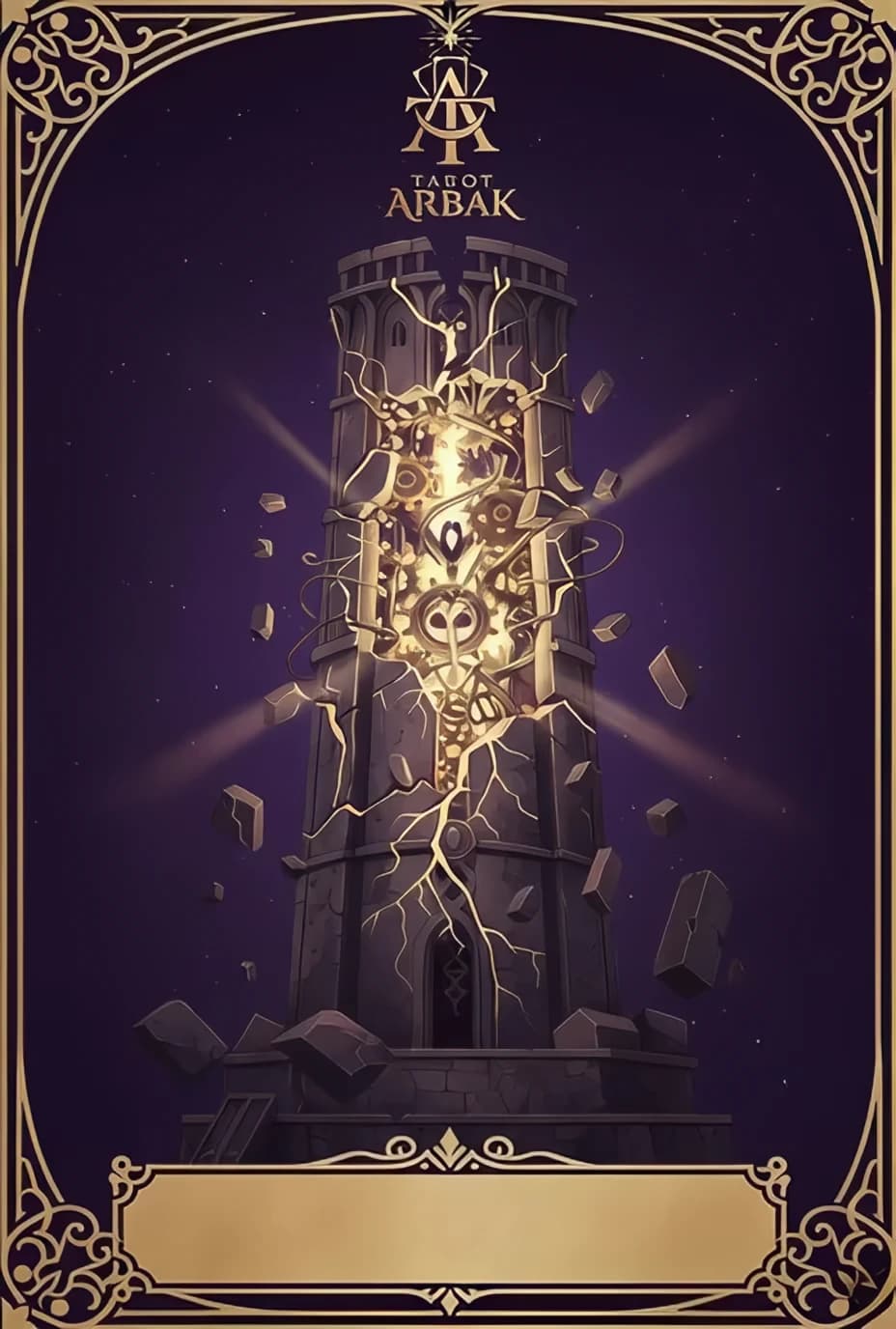
In Tarot Arbak, The Tower represents systemic collapse rather than divine punishment. Unlike traditional depictions showing lightning striking from above and figures falling in terror, this version reveals the tower standing alone, cracked from the center outward, with no human figures present. The absence of human dramatization is significant: this is not about personal victimhood but about structural reality. What was false has reached its breaking point. What was unsustainable can no longer be postponed. The Tower does not bring destruction—it reveals what was already destroyed.
The number 16 marks this card in Major Arcana. In numerology, 1+6=7, representing spiritual truth and hidden knowledge revealed through crisis. The Tower's position teaches that enlightenment sometimes requires the collapse of illusion before truth can emerge. Before renewal comes revelation, and before reconstruction comes destruction of what cannot stand.
The Tower asks the central question: What have you built on foundations that cannot hold? The card does not say 'disaster is coming.' It says 'the disaster has already occurred—you just haven't acknowledged it yet.' This is not a warning but a recognition: collapse is not punishment but the natural consequence of structural inadequacy finally reaching its breaking point.
The Tower Symbolism
The tower tarot card meaning reveals itself through precise visual composition that shifts from apparent stability to inevitable collapse. Every element in this card teaches about structural failure, accumulated contradiction, and the liberation that follows destruction of the false.
Tarot Arbak's Tower presents a scene of contained catastrophe—the moment of fracture frozen in time. The tower stands, crown still atop its summit, yet cracks spread from the center outward. No external force is visible; no lightning from above, no attacking army, no divine punishment. Only the tower and its internal collapse. This abstraction teaches that true structural failure comes from within, not from outside.
Unlike traditional Rider-Waite representations featuring falling figures and lightning bolts from heaven, Tarot Arbak's Tower removes all dramatization. There are no people to experience trauma, no external forces to blame. The tower simply is—cracked, collapsing, inevitable. This removal of human elements transforms the card's meaning from personal catastrophe to systemic truth.
The Tower Structure: False Foundation Revealed
The tower at the card's center represents any structure built on false premises—belief systems, relationships, careers, identities, institutions. The tower appears solid from a distance, suggesting stability and permanence, yet the cracks tell another story. This teaches that collapse often begins long before it becomes visible—by the time fractures appear, structural failure has already occurred internally.
What appears stable may already be broken from within.
The tower's construction is architectural yet abstract, suggesting that this is not a literal building but a metaphor for any human construction. The tower represents what we build—our lives, our beliefs, our systems. When The Tower appears, something you have constructed has reached its breaking point not because of external attack but because its internal contradictions have become unsustainable.
Crown at Summit: False Authority Falls
The crown perched atop the tower represents false claims to authority, power, or status—the ego's assertion of control over what it does not actually control. In Tarot Arbak, the crown falling is not punishment but correction: the structure claimed an authority it never legitimately held. When the tower collapses, the crown falls with it—unauthorized claims are revoked.
The crown teaches that what we build often includes assertions about ourselves that exceed reality. We claim stability when we are fragile. We claim certainty when we are confused. We claim permanence when we are temporary. The Tower strips away these false claims, not to humiliate but to reveal truth. The falling crown is not tragedy but liberation from unwarranted pretension.
Internal Explosion: Accumulated Contradiction
The energy erupting from within the tower represents accumulated contradiction reaching critical mass. This is Tarot Arbak's crucial innovation: there is no lightning bolt from outside. The destruction originates internally, from tensions and contradictions that have been building within the structure until they can no longer be contained.
This symbol teaches that collapse is not something that happens to you from outside but something that emerges from within what you have built. The contradictions were always there. The structural weakness was always present. You simply refused to acknowledge them until they became undeniable. The Tower does not create the contradiction; it reveals what was always there but denied.
The explosion comes from within because the problem was always internal.
Spreading Cracks: Irreversible Threshold
The cracks spreading from center to periphery represent irreversible structural failure. Unlike surface damage that can be repaired, these fractures originate at the core and spread outward. By the time cracks reach the surface, the structure has already failed internally. There is no repair possible—only inevitable collapse.
This teaches that The Tower represents not the beginning of problems but the moment when existing problems become undeniable. The cracks were always there; now they are visible. The failure was always occurring; now it cannot be ignored. The Tower is the threshold between hidden collapse and visible collapse, between structural failure and structural recognition.
Still Standing: The Illusion of Stability
The tower remains standing despite the cracks—a detail that creates profound tension between appearance and reality. The structure looks stable enough. The crown still sits atop. Yet the cracks reveal that collapse is already in progress, inevitable, and irreversible. This visual paradox represents the moment when outward appearance has not yet caught up with internal reality.
This teaches that The Tower often appears before complete collapse has finished—it marks the threshold, not the aftermath. You may still be standing. Your life may still look normal from outside. Yet internally, the structure has already failed. Recognition of this failure is The Tower's gift: it shows you what is already broken so you can stop pretending otherwise.
Empty Background: No External Cause
The absence of any background elements—no storm clouds, no attacking forces, no divine presence—teaches that collapse has no external cause to blame. There is no enemy. There is no act of God. There is only the tower and its internal failure. This emptiness forces confrontation with an uncomfortable truth: what is collapsing fell from its own contradictions, not from outside attack.
There is no one to blame because the destruction came from within.
No Human Figures: Structural Truth, Not Personal Drama
The absence of falling figures removes personal dramatization from the scene. Traditional depictions show people falling in terror, emphasizing the human experience of catastrophe. Tarot Arbak removes them entirely, teaching that The Tower is not about personal suffering but about structural reality. What collapses is not the person but the system—not the individual but the construction.
This abstraction teaches that The Tower's message is not 'you will suffer' but 'what you built is failing.' The collapse is structural, not personal. The person survives; only the false structure falls. This distinction liberates: you are not what collapses. What collapses is something you built, not something you are.
- Symbol 1
Tower structure: false foundation revealed
- Symbol 2
Crown at summit: false authority falling
- Symbol 3
Internal explosion: accumulated contradiction
- Symbol 4
Spreading cracks: irreversible threshold
- Symbol 5
Still standing: illusion of stability
- Symbol 6
Empty background: no external cause
- Symbol 7
No human figures: structural, not personal
The Tower as Feelings: When Emotional Structures Collapse
When examining the tower as feelings, this card reveals an emotional landscape of sudden upheaval, shattering realizations, and the collapse of emotional frameworks that can no longer contain truth.
Upright: Emotional Earthquake
When The Tower appears as feelings upright, the emotional state involves:
- Shattering realizations — The person has experienced or is experiencing a sudden revelation that destroys previous understanding. What they believed about themselves, others, or situations has collapsed under contradiction.
- Overwhelming upheaval — Emotions feel chaotic, unmanageable, beyond control. The emotional structure that provided stability has failed, leaving disorientation and shock.
- Forced truth — Something hidden has become undeniable. Denial is no longer possible. The emotional impact comes from truth forcing its way through structures built to contain it.
- Liberation through destruction — Beneath the shock and chaos, there may be strange relief. What collapsed was false. What remains, though painful, is authentic.
Reversed: Denial or Aftermath
When The Tower appears reversed as feelings:
- Resisting collapse — The person feels the structure shaking but refuses to acknowledge the truth. Emotional denial maintains a facade of stability while internal reality has already failed.
- Post-collapse emptiness — The destruction has already occurred, and what remains is the hollow feeling of aftermath. The emotional debris has settled, revealing the void where false structures once stood.
- Fear of truth — There may be terror of what emotional collapse would reveal. The person clings to unstable structures rather than facing what lies beneath.
- Numbness following shock — After emotional upheaval, there may be dissociation or numbness. The psyche protects itself by shutting down feeling until it can process what occurred.
The Tower Tarot Advice: Let the False Fall
When The Tower appears in your reading, the tower tarot advice centers on surrender rather than resistance. The collapse is already in progress. Your task is not to prevent destruction but to navigate it honestly and learn from what falls.
The core message is stark: what is collapsing cannot be saved because its foundation was never adequate. Stop trying to patch cracks in a structure that has already failed internally. Let the false structure fall completely. Only then can you see what actually remains and build on authentic foundation.
Specific advice by situation:
-
Facing collapse — Do not try to save the structure. Acknowledge that what is falling cannot stand. Let the destruction complete itself. Resistance only prolongs suffering and delays the reconstruction that must eventually occur.
-
In relationships — If a relationship is collapsing, examine its foundation honestly. Was it built on truth or illusion? What falls was not real love; what remains may be the possibility of authentic connection after illusion has been stripped away.
-
Career upheaval — Professional collapse carries information about what does not work. Do not immediately rebuild the same structure. Learn from the failure. What collapsed? Why? What foundation would actually sustain you?
-
Spiritual crisis — When beliefs collapse, do not rush to adopt new ones. Sit in the emptiness. Let deconstruction complete itself. What remains after false certainty falls will be authentic truth, not borrowed belief.
-
Emotional devastation — Allow the feelings. The shock, grief, and disorientation are appropriate responses to structural collapse. Do not numb yourself to the process. Feel fully, then rebuild differently.
The ultimate Tower advice: What falls was never real. What remains cannot be destroyed. Stop clinging to illusion and start building on truth.
The Tower appears not to punish but to reveal. It shows you that what you thought was solid was already broken. This recognition, while painful, is actually liberation. You are free to stop maintaining what cannot stand. You are free to build on what is real rather than what is false. Let the debris settle. Then reconstruct on foundation of truth.
UPRIGHT MEANINGS
General Meaning
When The Tower appears upright, the tower tarot card meaning signals sudden and unavoidable structural collapse. This is not a card of gradual transition or planned change; it is the moment when false structures break under accumulated contradictions. What seemed stable reveals itself as already compromised. What appeared permanent proves to be temporary. The Tower does not bring destruction—it reveals what was already destroyed. The collapse may feel catastrophic, but this feeling comes from attachment to illusion, not from loss of what was real.
The Tower does not ask whether you are ready for collapse—it announces that collapse is already occurring.
This position indicates that something you have built—a relationship, career, belief system, identity, or life structure—has reached its breaking point. The cracks are visible. The internal contradictions have become undeniable. Attempts to maintain the status quo will fail because the foundation itself has failed. The Tower teaches that some changes cannot be managed—they can only be navigated. Resistance to collapse will not prevent it; it will only make the fall more painful.
This card often appears during periods of crisis, upheaval, or sudden life change. Job loss, relationship breakdown, health crises, financial collapse, or spiritual deconstruction—all are forms of The Tower's energy. What these experiences share is the stripping away of illusion and the confrontation with reality. The Tower does not promise that what comes next will be easy, but it does promise that what remains is authentic. The debris clears to reveal solid ground. What falls was false; what stands is real.
Love & Relationships
In love readings, the tower tarot card meaning upright often signals sudden relationship collapse or dramatic revelation that transforms understanding. This may manifest as breakup, infidelity discovered, or the recognition that a relationship was built on false premises from the beginning. The Tower in love is not about minor conflicts or solvable problems—it is about foundational issues that cannot be repaired because the relationship's core was compromised.
For those seeking relationships, this card may indicate that patterns from past relationships need to collapse before healthy connection becomes possible. The Tower destroys romantic illusions—about love, about yourself, about what you need. While painful, this destruction clears ground for authentic connection based on truth rather than fantasy.
The Tower in love does not destroy what was real—it only removes what was false.
For those in partnerships, The Tower may signal a crisis that forces truth to the surface. Suppressed issues can no longer be contained. Denial becomes impossible. The relationship may end, or it may transform dramatically after passing through intense difficulty. The Tower teaches that relationships built on lies, suppression, or incompatible foundations will eventually collapse under their own contradictions.
Career & Money
Professionally, the tower tarot career meanings indicate sudden career upheaval, job loss, or the recognition that your career path is built on foundations that cannot sustain you. This may manifest as layoff, burnout, industry disruption, or the realization that your work no longer aligns with your values. The Tower in career is the moment when professional structures reveal themselves as inadequate or compromised.
This position may indicate that a business venture collapses, a company fails, or an industry transforms dramatically. What seemed like a secure position suddenly appears unstable. The Tower teaches that professional security built on external validation rather than authentic alignment is fragile—it collapses when conditions change because the foundation was never solid to begin with.
The Tower in career asks: What are you actually building, and on what foundation?
The Tower in career may also represent positive transformation disguised as destruction. Sometimes what collapses is not your career but your attachment to a particular identity, role, or path. When the false self falls away, authentic vocational direction becomes visible. What remains after professional collapse may be clearer purpose, more aligned work, and freedom from false structures that were limiting your growth.
REVERSED MEANINGS
General Meaning
The tower tarot card meaning reversed signals either resistance to inevitable collapse or the aftermath of destruction that has already occurred. This reversal may indicate that you are in denial about structural failure—seeing the cracks but pretending the tower is stable, acknowledging the contradictions but refusing to acknowledge their implications. Alternatively, it may represent the period after collapse, when debris has settled and the emptiness of what remains becomes apparent.
The reversed Tower asks: Are you denying the collapse, or are you living in its aftermath?
This position may represent the reconstruction phase—the temptation to rebuild the same false structure because the emptiness feels unbearable. The Tower reversed warns against rebuilding on foundations that have already proven inadequate. What collapsed did so for a reason. Rebuilding without understanding that reason guarantees future collapse. The wisdom of this position lies in embracing the emptiness, learning from the destruction, and constructing something fundamentally different rather than recreating what fell.
Alternatively, The Tower reversed may indicate that collapse has already occurred but you have not fully acknowledged it. You may be going through motions, maintaining appearances, pretending that a structure still exists when it has already fallen. This position calls for honest recognition of what has already been lost.
Love & Relationships
In love readings, the tower tarot card meaning reversed may indicate denial about relationship collapse—refusing to acknowledge that a relationship has already ended or that it was built on false foundations from the beginning. You may be trying to patch cracks in a structure that cannot be saved, holding onto a relationship that has already collapsed internally. This position calls for honesty about what is actually still standing and what has already fallen.
This reversal can also represent the aftermath of relationship breakdown—the period when debris has settled and the reality of what remains becomes clear. You may be grieving not only what was lost but also the illusion of what you thought you had. The Tower reversed teaches that grief following collapse is appropriate, but clinging to false structures prolongs suffering.
The Tower reversed in love asks: Are you rebuilding the same pattern, or have you learned from the collapse?
For those seeking relationships, this reversal may indicate that patterns from past collapses have not been understood or integrated. You may be attracted to the same type of partner, the same dynamic, the same foundation that has already proven inadequate. The Tower warns that unlearned lessons recreate the same structures—different faces, same foundation, inevitable collapse.
Career & Money
Professionally, the tower tarot career meanings reversed warn against rebuilding on foundations that have already collapsed. You may have experienced career failure, job loss, or business collapse, and the temptation is to immediately reconstruct what was lost in the same form. This reversal advises against rushing into reconstruction without understanding what actually failed and why.
This position may also indicate that you are in denial about professional structures that are already failing. You may see the cracks—the burnout, the misalignment, the shrinking opportunities—but you are pretending that the structure is stable because the alternative feels too threatening. The Tower reversed teaches that denial does not prevent collapse; it only makes the eventual fall more devastating.
The Tower reversed in career asks: What did you actually build, and why did it collapse?
The Tower reversed in career may also represent the aftermath of professional collapse—the period of uncertainty, unemployment, or career identity crisis that follows dramatic upheaval. This emptiness can feel terrifying, but The Tower teaches that emptiness is necessary before reconstruction. Use this period not to immediately rebuild but to understand what collapsed and what foundation you want to build upon moving forward.
Frequently Asked Questions
Maintain the Crystalline Infrastructure
Tarot Arbak exists beyond ads and algorithms. Your contribution ensures the permanence of the Logos.