Eight of Swords
Eight of Swords
mental imprisonmentself-imposed limitationsperceived powerlessnessoverthinkingparalysis by analysis

Eight of Swords

Eight of Swords
Eight of Swords

Minor Arcana

Eight of swords tarot meaning illuminates the paradox of psychological entrapment: the feeling of being trapped when freedom actually exists. This card appears when the mind has constructed barriers that feel immovable, though they are self-generated rather than externally enforced. Unlike physical imprisonment, the Eight of Swords represents a prison of thought—beliefs, fears, and assumptions that limit movement despite open pathways remaining available.

The trap is real in experience, yet illusory in reality.

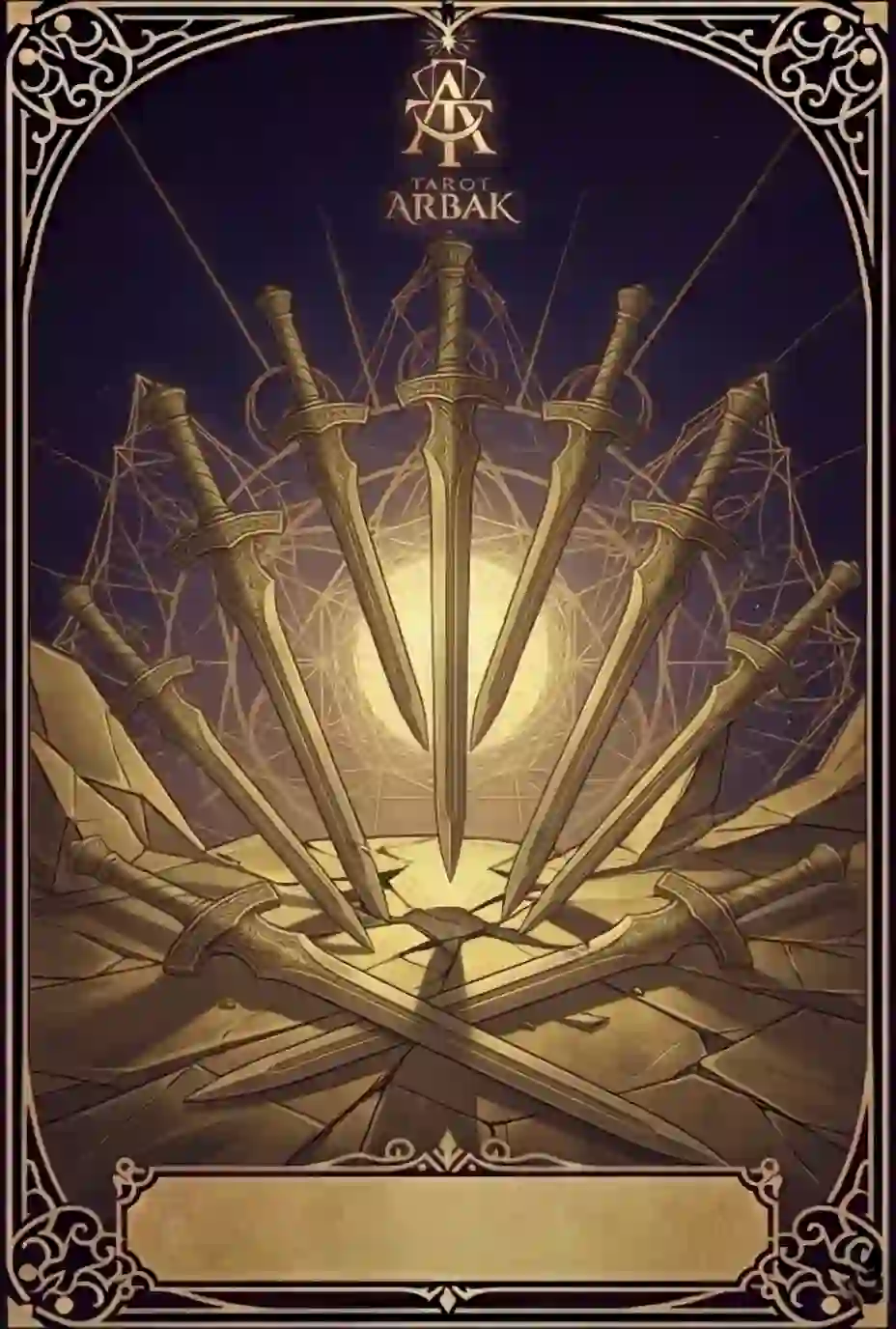
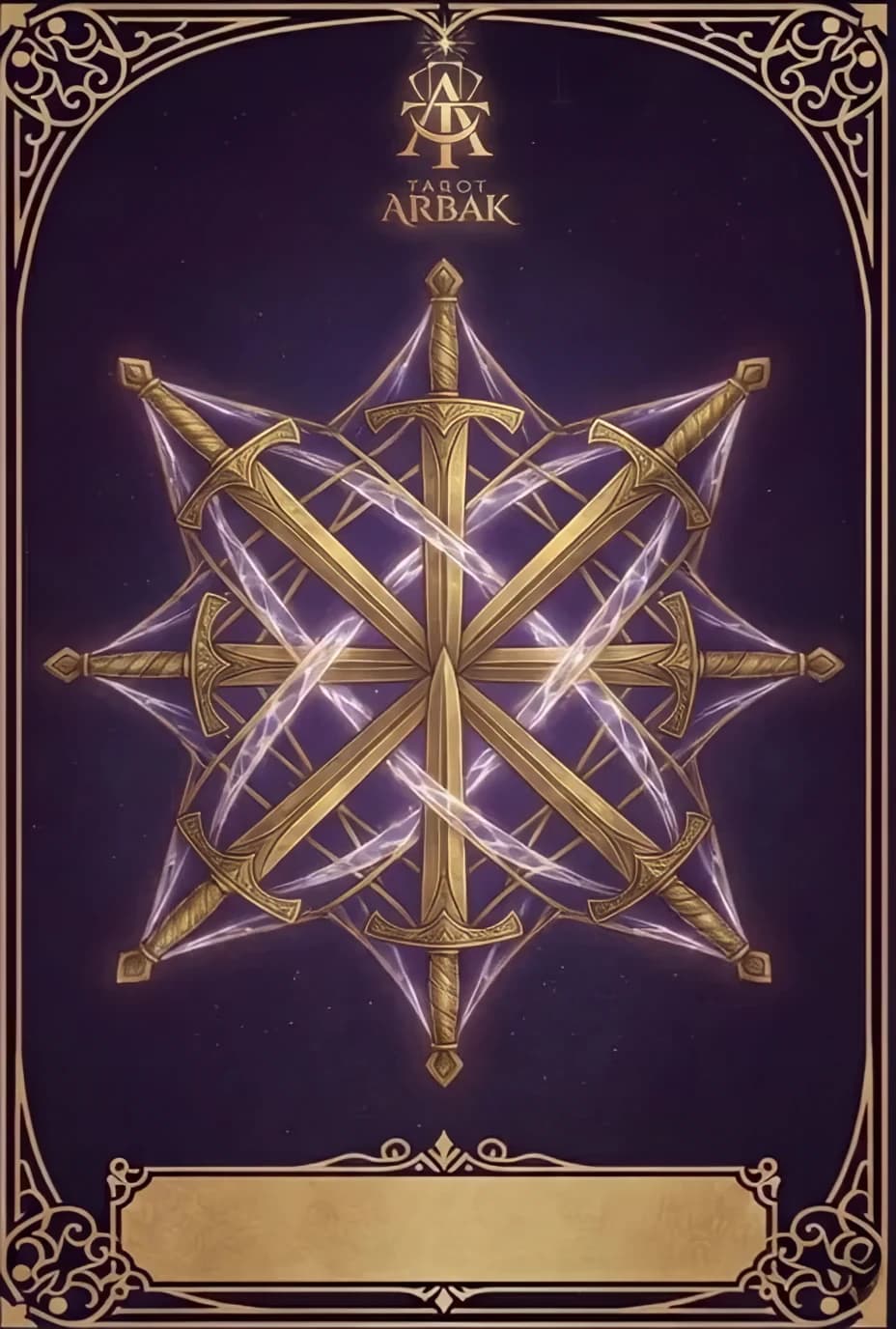
In Tarot Arbak, this card removes the human figure entirely, presenting only the swords themselves arranged in a star-like formation. This radical departure from traditional imagery teaches that the prison exists within consciousness itself, not in any external force. The swords create barriers through their positioning and the luminous connections between them, suggesting that thoughts have become entangled into a restrictive network. Understanding this card begins with recognizing that the feeling of helplessness stems from internal patterns, not external circumstances.

The number 8 in numerology represents balance, infinity, and cycles. When turned sideways, 8 becomes the infinity symbol—suggesting that mental traps can perpetuate endlessly unless awareness interrupts their pattern. The Eight of Swords appears not to confirm that you are truly stuck, but to reveal that your perception of entrapment has become the primary obstacle. Freedom requires recognizing the gaps between the swords, not destroying the weapons themselves.

Eight of Swords Symbolism

The eight of swords tarot meaning unfolds through its striking visual composition. Without a human figure present, the card presents the barrier structure itself as the primary subject—revealing that imprisonment is a condition of consciousness, not of circumstance. Each element contributes to understanding how mental prisons are constructed and maintained.

Tarot Arbak's Eight of Swords transforms the traditional bound-and-blindfolded figure into an abstract composition of swords and connections. This modern interpretation shifts focus from the victim to the trap itself, teaching that examining the structure of limitation is the first step toward liberation. The card invites deep contemplation of how thoughts create invisible walls.

Star-Like Sword Formation: The Architecture of Mental Barriers

The eight swords arranged in a symmetrical star formation at the card's center represent the systematic construction of mental limitations. Unlike random obstacles, these swords are deliberately positioned to create a sense of complete enclosure. This geometric precision teaches that psychological barriers are not accidental but structured—built through repeated thought patterns, reinforced beliefs, and self-protective strategies that have become counterproductive.

The formation resembles a cage without walls, suggesting that the barrier exists more in perception than in physical reality. The swords point in multiple directions, indicating that mental traps often involve feeling threatened from all angles simultaneously. This multidirectional threat perception keeps consciousness in a state of heightened vigilance, unable to relax enough to recognize escape possibilities.

The star formation creates the illusion of complete enclosure while gaps remain.

This arrangement teaches that limitation often feels more comprehensive than it actually is. The symmetrical perfection of the sword pattern reflects how the mind creates orderly systems of restriction—each belief reinforcing another until an impenetrable fortress of impossibility emerges. Understanding this structure reveals that breaking free requires not force but awareness of the pattern itself.

Non-Touching Swords: The Space Between Barriers

Crucially, the swords do not touch each other—they remain separate while creating the impression of a continuous barrier. This visual element carries profound meaning for understanding mental imprisonment. The space between swords represents freedom that remains available but unrecognized. Each sword stands independently, suggesting that limitations are separate thoughts rather than an indivisible wall.

This teaching is revolutionary: what appears as a solid barrier is actually a series of individual fears, each seemingly connected to the others through luminous threads. The gaps between swords are physically present, yet psychologically invisible to someone who has learned to see only the obstruction rather than the openings. The Eight of Swords reveals that escape routes exist but remain unperceived when focus remains fixed on the barriers themselves.

The non-touching nature of swords also teaches that mental traps are fragile—they exist through perception rather than structural integrity. Once attention shifts from the swords to the spaces between them, the barrier's completeness immediately dissolves. This realization marks the beginning of liberation.

Luminous Connections: The Web of Tangled Thoughts

Running between the swords are iridescent, semi-transparent connections representing the neural networks of fear and the associative chains that bind thoughts together into restrictive patterns. These luminous threads are not chains—they can be dissolved through awareness, yet they appear solid when consciousness operates within their framework. The connections show how one fear leads to another, creating a self-reinforcing web that feels impossible to escape.

These connections represent the associative thinking that characterizes anxiety and overthinking: "If this happens, then that will happen, which means this other terrible thing will result..." Each luminous thread links one sword (fear) to another, creating pathways that consciousness has learned to travel automatically. The network becomes so familiar that thoughts flow along established routes without conscious choice—mind follows its own grooves.

The semi-transparent quality of these connections suggests they are not as solid as they appear. What seems like permanent limitation is actually conditioned thinking that can be unconditioned through deliberate awareness. The luminosity implies these thought patterns have energy—they shine with the intensity of repeated activation. However, their translucence also reveals that they are filters rather than reality itself.

Purple-Toned Background: The Spiritual Dimension of Mental Traps

The deep purple ground of the card carries significant symbolic weight. Purple represents the spiritual plane, higher consciousness, and the realm of transformation. Its presence as the background suggests that even mental imprisonment exists within a spiritual context—that these struggles serve a higher purpose in soul development. Purple also indicates mystery and the unknown, suggesting that the true nature of limitation transcends surface understanding.

The purple tones create a sense of depth, teaching that mental traps exist within vast psychological space. This depth implies that consciousness has room to move even when it feels confined. The spiritual dimension represented by purple suggests that working through limitation is not merely psychological but part of a larger evolutionary process. The Eight of Swords does not represent failure but a necessary stage in developing discernment and self-awareness.

Purple also connects to the crown chakra, indicating that this card involves the mental-spiritual interface—how beliefs and thoughts shape perception of reality itself. The purple background reminds us that overcoming mental traps is not just about changing thoughts but about awakening to a deeper level of awareness that exists beyond the thought system.

Absence of Human Figure: The Shift from Victim to Pattern

Perhaps the most radical element of Tarot Arbak's Eight of Swords is the complete absence of a human figure. Traditional tarot decks show a bound and blindfolded person, visually representing victimhood and helplessness. By removing this figure, Tarot Arbak transforms the card's teaching entirely: the focus shifts from "who is trapped" to "what constitutes the trap."

This absence teaches that the real prison is not external or even internal in the sense of personal limitation—it is the thought structure itself. There is no victim, only a pattern of thinking that creates the experience of victimization. Removing the human figure liberates us from identifying with the role of prisoner, allowing consciousness to observe the trap rather than inhabit it.

Without a victim, there is no imprisonment—only a pattern to recognize and release.

This radical abstraction suggests that the solution to mental traps is not freeing a bound person but seeing through the binding mechanism itself. When consciousness stops identifying with the trapped self, the trap loses its power. The Eight of Swords in Tarot Arbak invites us to step outside the experience of limitation and observe its structure from a higher perspective.

Sacred Geometry Background: Order Transformed into Stagnation

In the background, sacred geometry patterns are visible—normally symbols of cosmic order, harmony, and divine perfection. In the Eight of Swords, these geometric forms take on a different meaning: they represent how the mind's natural capacity for pattern recognition and order-seeking can become rigid and excessive control. The sacred geometry that should facilitate understanding becomes a framework for limitation.

This background element teaches that psychological imprisonment is not chaotic but highly ordered—the trap follows internal logic and maintains internal consistency. The mind creates systems of restriction that make sense within their own framework. This explains why mental traps can be so persistent: they operate according to recognizable rules, just rules that no longer serve liberation.

The sacred geometry also suggests that the Eight of Swords involves distortion of natural order. When the quest for understanding becomes obsession, when self-protection becomes self-confinement, when caution becomes paralysis—natural capacities have been twisted into their opposites. The background geometry reminds us that balance exists between order and freedom, structure and openness. The Eight of Swords appears when structure has overpowered movement.

  • star-like sword formation
  • non-touching swords
  • luminous energy connections
  • purple-toned background
  • sacred geometry patterns
  • absence of human figure
  • gaps between barriers

UPRIGHT MEANINGS

General

When the Eight of Swords appears upright, eight of swords tarot meaning signals a period of perceived entrapment where fear-based thinking has created the experience of powerlessness. You may feel trapped in a situation, relationship, or pattern of thinking that seems to offer no escape. However, this card reminds you that the barriers are more mental than physical—created by beliefs, assumptions, and self-protective strategies that have become counterproductive.

The Eight of Swords asks not "How do I break out?" but "What am I not seeing?"

This position indicates that your mind has constructed an elaborate narrative about why change is impossible, what you cannot do, and what options are unavailable. The swords represent specific fears that feel threatening when approached from any direction. However, the luminous connections between them reveal that these fears are linked through associative thinking—one thought leads to another in a self-reinforcing pattern. The solution lies not in fighting the swords but in recognizing the gaps where freedom actually exists.

The Eight of Swords often appears during anxiety, overthinking, or situations where you feel backed into a corner. This card suggests that your perception of the situation has become more limiting than the reality. You may be focusing exclusively on obstacles while overlooking alternatives, rehearsing problems without noticing solutions, or telling yourself stories about impossibility that have no basis in fact. Freedom requires shifting focus from what blocks you to what remains available.

Love

In love readings, eight of swords tarot meaning upright may indicate feeling trapped in relationship patterns or believing that romantic fulfillment is impossible. For singles, this card might suggest that self-limiting beliefs about worthiness, desirability, or the availability of suitable partners have created a mental prison. You may have convinced yourself that love is unavailable for you based on past experiences or internalized messages, creating a self-fulfilling prophecy where you either don't recognize opportunities or don't act on them.

The swords represent fears that have been erected around your heart: fear of vulnerability, fear of rejection, fear of loss, fear of unworthiness. These fears feel real and threatening, and the luminous connections between them show how they reinforce each other in a web that seems impenetrable. However, the Eight of Swords reminds you that these barriers are self-constructed—they exist within consciousness, not in external reality.

For those in relationships, this card may indicate feeling trapped by patterns that seem impossible to change. You might believe that your partner cannot evolve, that the relationship cannot improve, or that your needs cannot be met within its structure. These beliefs may have some basis in experience, but the Eight of Swords suggests that your mind has extrapolated them into absolute limitations when possibilities for change actually exist. The card invites examining where you have convinced yourself of impossibilities that might be mutable with conscious effort and honest communication.

The Eight of Swords in love readings often appears when fear is masquerading as realism. You may believe you are being practical by recognizing limitations, when actually you are being paralyzed by fears disguised as facts. Liberation begins by questioning your own assumptions: Are these barriers absolute or merely perceived? What would you attempt if you believed freedom was possible?

Career

Professionally, eight of swords tarot meaning upright indicates feeling stuck in your career path, believing that advancement or change is impossible, or experiencing paralysis in the face of decisions. You may have convinced yourself that your options are severely limited based on past rejections, market conditions, or perceived lack of qualifications. While some constraints may be real, the Eight of Swords suggests your mind has amplified them into absolute barriers where openings actually exist.

This card often appears when overthinking has replaced action: you've analyzed a situation so thoroughly from every angle that all possibilities seem equally problematic. The swords represent career fears—fear of failure, fear of success, fear of visibility, fear of judgment—that point inward from all sides, creating the experience of no viable path forward. However, the gaps between swords represent opportunities that remain available but unrecognized when focus remains fixed on obstacles.

Professional paralysis often stems from fearing all possible outcomes equally.

The Eight of Swords may indicate feeling trapped in a job that seems impossible to leave due to financial constraints, market conditions, or perceived lack of alternatives. While genuine challenges may exist, this card suggests that your mind has constructed a narrative about impossibility that exaggerates the constraints and minimizes your agency. Freedom requires examining this narrative: What skills, connections, or options are you not seeing? What fears are presenting themselves as facts?

This position can also indicate that you have become trapped by perfectionism—unable to act because every possible path seems inadequate. The Eight of Swords teaches that movement often requires choosing imperfect action over perfect stillness. Sometimes forward momentum creates options that cannot be seen from a position of paralysis.

Spiritual

Spiritually, eight of swords tarot meaning upright represents a phase of spiritual entrapment where beliefs about what is possible for your awakening have become limiting. You may feel stuck in patterns of ego-identification that seem impossible to transcend, or you may have convinced yourself that enlightenment is unavailable to you. The Eight of Swords often appears when spiritual seeking has become spiritual imprisonment—when practices and beliefs that were meant to liberate have instead become cages.

The swords in this context represent spiritual fears: fear of ego death, fear of surrender, fear of the unknown, fear of losing control. These fears have been arranged in a formation that creates the experience of complete spiritual limitation. However, the luminous connections between them reveal that these fears are linked through belief systems—dogmas, concepts, and assumptions about spirituality that may have been internalized without examination.

The Eight of Swords invites examining where you have convinced yourself of spiritual impossibilities: "I cannot meditate properly," "I am not ready for this teaching," "Awakening is not possible in my situation." These beliefs may feel real, but the card reminds you that spiritual barriers are constructed in consciousness and can be deconstructed through awareness. Liberation requires recognizing that the prison is made of thoughts, and thoughts can be observed rather than identified with.

This card may also indicate that you have become trapped by the very concept of spiritual seeking—believing that awakening requires something you don't have, something you must achieve through effort, when actually freedom is already present. The Eight of Swords suggests that what blocks spiritual progress is often the seeker itself—the idea that there is someone who needs to become something else. Freedom may require recognizing that the trapped self is itself the prison.

REVERSED MEANINGS

General

Eight of swords tarot meaning reversed signals the beginning of liberation from mental imprisonment. The realization has dawned that the barriers are not solid as they appeared—that gaps exist between the swords, that the luminous connections are not chains, and that freedom has been available all along. This reversal marks a crucial psychological shift: from identifying with limitation to observing it, from feeling trapped to recognizing choice.

The reversed Eight of Swords marks the moment awareness interrupts the pattern.

This position indicates that you are beginning to question your own assumptions about what is possible. You may have realized that what felt like absolute constraint was actually conditional—that while real obstacles exist, alternatives also remain available. The reversal often follows a period of suffering sufficient to make the cost of continued imprisonment outweigh the fear of trying something new. When the pain of staying trapped exceeds the fear of liberation, movement becomes possible.

However, reversal can also indicate the shadow side of liberation: breaking out of mental traps through force rather than awareness, rebelling against limitation without transforming the underlying pattern, or refusing to acknowledge genuine constraints in the name of freedom. Not all barriers are illusory, and the reversed Eight of Swords asks you to distinguish between self-imposed limitations and real boundaries that must be respected. True freedom comes not from breaking every sword but from seeing clearly which barriers are real and which are constructed.

Love

In love readings, eight of swords tarot meaning reversed may indicate breaking free from self-limiting relationship patterns or recognizing that romantic possibilities exist where you previously saw none. For singles, this reversal often marks the moment when you stop believing love is unavailable for you and begin recognizing opportunities that have been present all along. The self-protective barriers that have kept your heart isolated begin to dissolve as you realize that vulnerability, while risky, is not the death sentence you feared.

This reversal may also indicate leaving a relationship that felt impossible to escape but where freedom was actually available. Sometimes we convince ourselves that we cannot leave due to financial constraints, fear of loneliness, or belief that our partner cannot survive without us. The reversed Eight of Swords represents the moment of recognizing these beliefs as self-generated limitations—not absolute truths. Liberation becomes possible when you acknowledge that while leaving may involve real challenges, it is not actually impossible.

For those in relationships, the reversal can indicate recognizing that partnership patterns you believed were immutable can actually change through conscious effort. You may have convinced yourself that your partner cannot change, that communication will never improve, or that your needs cannot be met within the relationship structure. The Eight of Swords reversed suggests these beliefs, while perhaps having some basis in experience, are not absolute truths. Transformation becomes possible when you stop assuming the worst and begin taking action toward improvement.

However, the shadow side of this reversal in love readings is using the realization of freedom as license to leave responsibly—breaking connections that actually deserve work, or swinging from feeling trapped to believing you are invulnerable to hurt. True relationship liberation comes from balance: recognizing freedom while honoring genuine commitments, seeing possibilities while making wise choices.

Career

Professionally, eight of swords tarot meaning reversed often indicates breaking free from career paralysis and recognizing that options exist where you previously saw none. You may have realized that the job situation you believed was impossible to change actually has exit points, that skills you thought were inadequate are actually valuable, or that the market constraints you feared are not as absolute as you imagined. This reversal marks the transition from feeling powerless to recognizing agency.

This position often follows a period of intense frustration where the cost of staying stuck has finally become unacceptable. When the pain of professional imprisonment exceeds the fear of the unknown, action becomes possible. You may begin taking steps toward a career pivot that previously seemed impossible, recognizing that while risks are involved, they are not fatal. The reversed Eight of Swords represents the moment when fear stops being the primary decision-maker and calculated risk-taking begins.

Professional liberation often requires distinguishing between real constraints and imagined ones.

The reversal may also indicate recognizing that a career path you convinced yourself was mandatory is actually optional. Perhaps you have stayed in a field due to family expectations, financial pressure, or belief that you have no other options. The Eight of Swords reversed suggests that while real considerations may exist, you have amplified them into absolute barriers. Freedom begins by acknowledging your power of choice even in constrained circumstances.

However, the shadow side of this reversal professionally is acting impulsively without adequate preparation—quitting a job without plans, burning bridges needlessly, or swinging from paralyzing caution to reckless abandon. The Eight of Swords reversed calls for balanced liberation: recognizing freedom while planning wisely, taking action while managing risk, leaving prison while building foundation.

Spiritual

Spiritually reversed, eight of swords tarot meaning may indicate a breakthrough in spiritual awakening—the realization that the prison was made of thoughts and that freedom is available through recognition rather than attainment. You may have realized that all the spiritual seeking, practicing, and striving was based on the assumption that you were separate from what you sought, when actually awakening was your already-present nature. This reversal represents the moment when the seeker recognizes that there is no seeker, no path, no destination—only the eternal presence that has never been lost.

This reversal can also indicate breaking free from dogmatic spiritual beliefs that have become cages. You may have realized that a teaching you once followed rigidly is actually a pointer, not a prison; that practices you once believed were mandatory are optional; that teachers you once placed on pedestals are human like you. The Eight of Swords reversed invites examining your spiritual beliefs: which point toward freedom, which have become barriers themselves?

The reversal often marks a crisis of faith—the collapse of the seeker's story. When the identity of "someone on a spiritual journey" begins to dissolve, it can feel terrifying even as it is liberating. The Eight of Swords reversed represents this liminal space where the old structure of seeking is breaking down but the new understanding has not yet stabilized. This uncomfortable transition is actually the doorway to genuine realization.

However, the shadow side of this spiritual reversal is the trap of spiritual bypassing—using the realization that "all is illusion" to avoid genuine transformation, or swinging from spiritual imprisonment to spiritual inflation where you believe you have arrived when understanding is merely conceptual. The Eight of Swords reversed asks for deep honesty: has the prison truly dissolved, or have you merely convinced yourself of liberation to avoid doing the work? Freedom that bypasses responsibility is merely another form of bondage.

Frequently Asked Questions

Related Cards