Four of Swords
Four of Swords
restrecoverymental restorationsanctuarywithdrawal

Four of Swords

Four of Swords
Four of Swords

Minor Arcana

Four of swords tarot meaning stands as one of tarot's most counterintuitive teachings in a culture obsessed with constant activity. This card does not show defeat or failure; it displays the conscious decision to step back, withdraw, and create space for restoration. Four swords are arranged in perfect parallel alignment, suspended on a structured frame that protects rather than confines. These are not weapons discarded in surrender—they are instruments of mental discipline temporarily at rest, deliberately positioned for maintenance and recovery.

In Tarot Arbak, the Four of Swords presents a remarkable absence of human figures. Unlike traditional depictions that show a reclining figure resting on a tomb or bed, this card communicates the principle of withdrawal through pure symbolic arrangement. The swords themselves tell the story: stillness, order, deliberate suspension of activity. This teaches that the need for rest transcends individual personality—it is a universal pattern of mental hygiene, an essential rhythm that applies regardless of who you are or what challenges you face.

The Four of Swords teaches that stillness is not the absence of action but the preparation for more effective action.

The number 4 represents stability, foundation, and the creation of structure where chaos once reigned. In the Swords suit, which governs thought, communication, and mental activity, the Four marks the point where momentum pauses to allow recalibration. The Three of Swords brings pain; the Four of Swords responds with the wisdom of withdrawal. This is not escape but recovery—not fleeing from problems but creating the conditions necessary to face them with renewed clarity and strength.

Four of Swords Symbolism

The four of swords tarot meaning reveals itself through precise visual composition. Every element speaks to the wisdom of conscious withdrawal—the moment when the mind recognizes that sustainable effectiveness requires periodic restoration. Understanding these symbols is key to mastering the card's profound lesson about the rhythm of activity and rest.

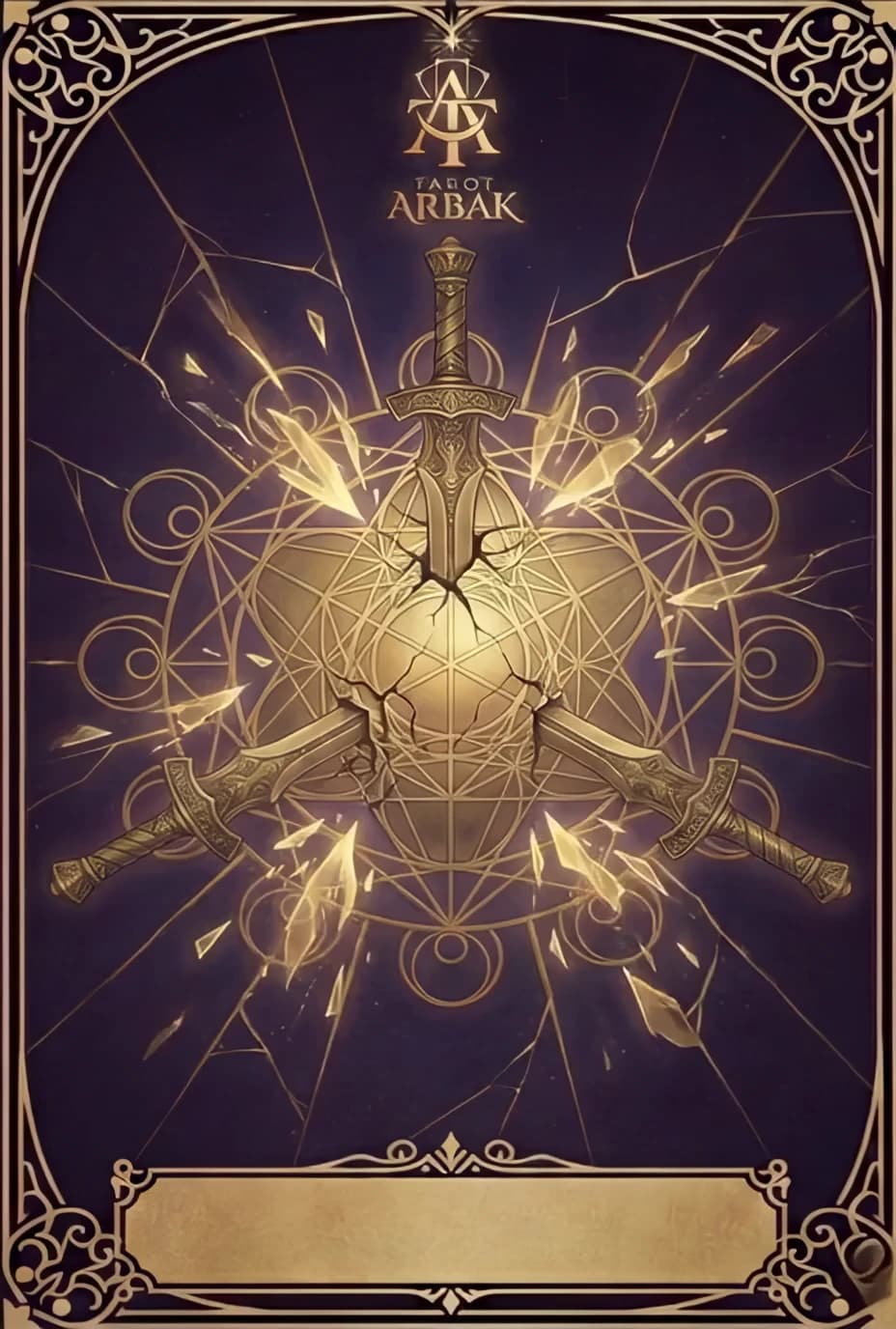
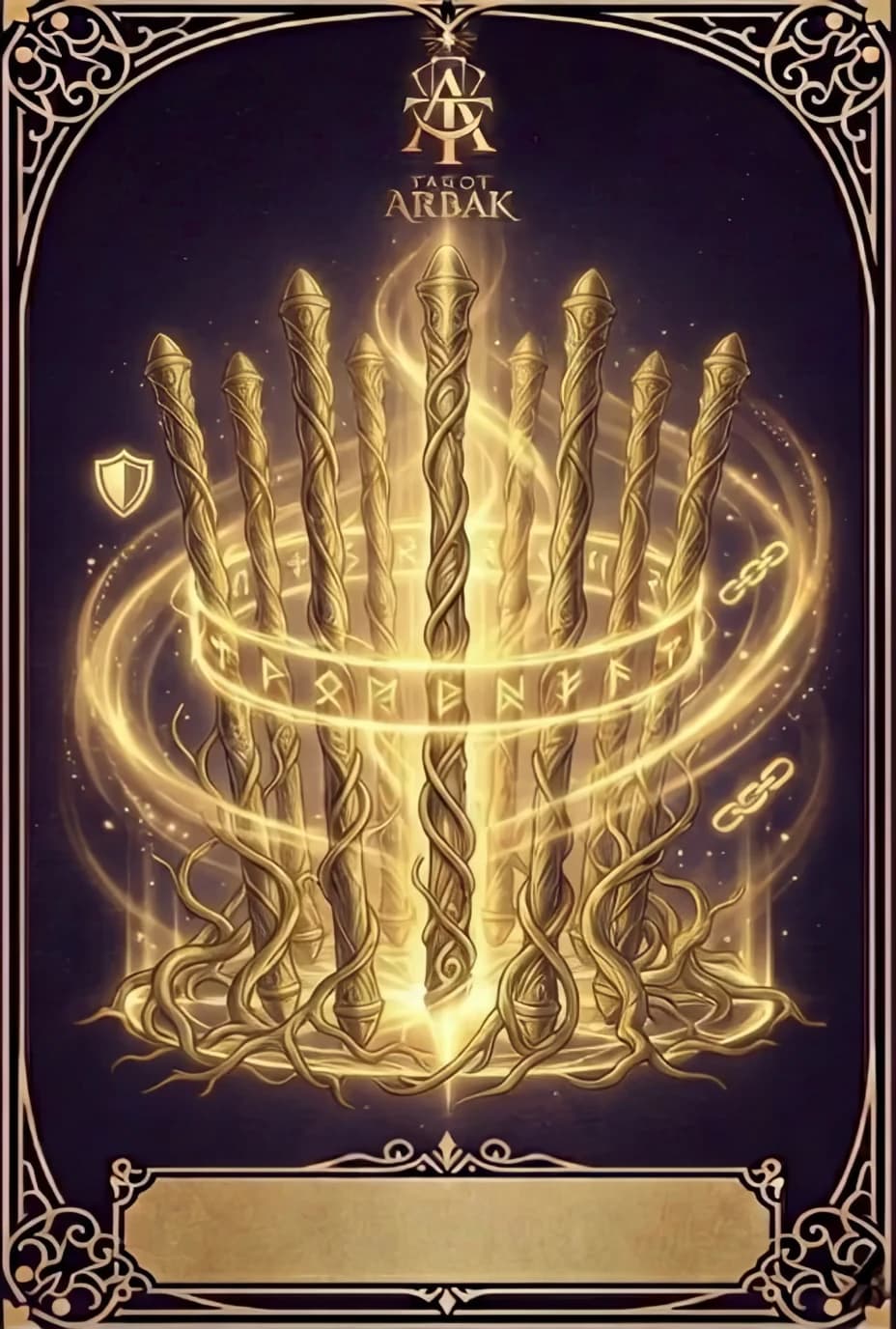
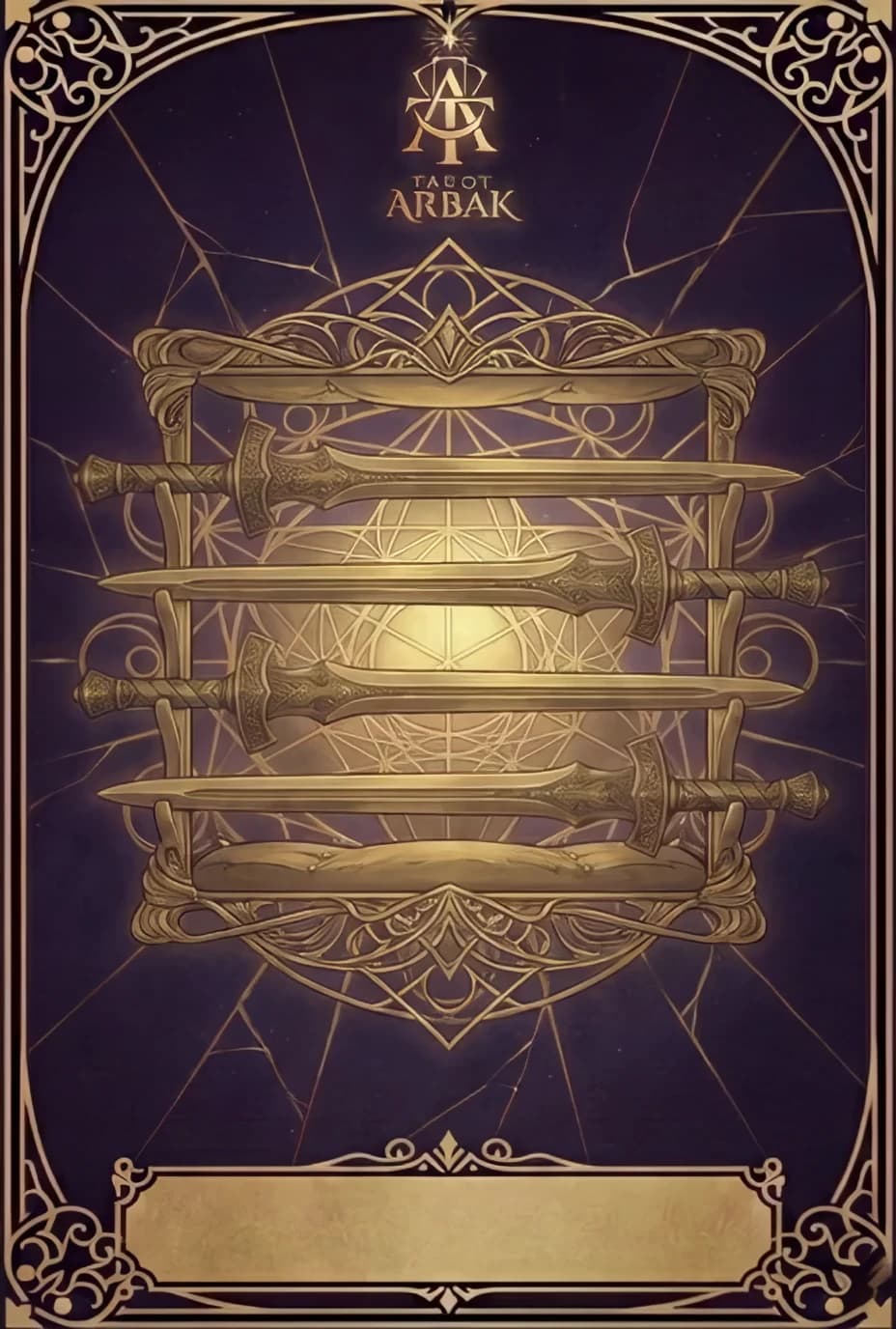
Tarot Arbak's Four of Swords presents rest not as a scene but as a system. The card shows four swords arranged in perfect parallel alignment, suspended on a golden frame, surrounded by sacred geometry that radiates soft light from the center. No human figure appears to perform rest or model withdrawal; the principle itself is communicated through symbolic arrangement. This abstraction teaches that rest is not a personal choice unique to individual circumstances but a universal law of mental functioning.

Four Parallel Swords: The Discipline of Stillness

The four swords arranged in perfect parallel alignment at the card's center represent the conscious discipline of mental suspension. These swords have not been scattered or dropped in chaos—they have been deliberately positioned with geometric precision. Their parallel orientation demonstrates that effective stillness is not collapse but structure. When the mind withdraws from activity, thoughts are not abandoned to disorder but arranged into orderly calm.

The number four carries specific significance here: four represents stability and the establishment of foundation. After the turbulence and pain of the Three of Swords, the Four creates a stable platform where recovery can occur. The parallel arrangement shows that different aspects of the mind are now aligned rather than in conflict. Thoughts that were racing, worrying, or obsessing have been brought into coherent relationship with one another.

The swords are not defeated; they are being maintained.

This perspective fundamentally redefines rest. The Four of Swords does not advocate letting everything go—abandoning structure, routine, and discipline in the name of "relaxing." Rather, it teaches that effective restoration requires its own architecture. The parallel swords demonstrate that stillness itself can be orderly, intentional, and disciplined. Rest is not the absence of structure but the creation of a different kind of structure—one designed for recovery rather than production.

Horizontal Suspension: Contrast to Aggressive Action

The horizontal orientation of suspended swords, in contrast to the vertical positioning typical of swords in conflict cards, represents the temporary cessation of mental aggression. Swords are weapons of the intellect—tools for analysis, argument, and cutting through confusion. When these tools are oriented vertically and in motion, they represent active mental engagement, the cutting edge of thought analyzing and responding to problems. When they are suspended horizontally, this aggression has been voluntarily paused.

The suspension of these swords on a supporting structure is crucial. They have not been thrown to the ground in defeat or exhaustion; they have been deliberately placed on a frame that holds them securely. This teaches that withdrawal is not collapse but strategic choice. The swords remain accessible and ready to use again when the time for action returns. Their current stillness is preparation for more effective future use, not abandonment of their purpose.

Unlike Rider-Waite's depiction, where a human figure reclines in passive rest, Tarot Arbak's horizontal swords emphasize that stillness is a principle rather than a person. The swords themselves carry the teaching: all cutting forces—mental, emotional, spiritual—require periods of suspension. This universalizes rest beyond individual circumstance; it becomes a cosmic law that applies regardless of personality, situation, or culture.

Golden Frame and Carrier Structure: Protected Boundaries

The golden frame and carrier structure that surrounds and supports the suspended swords represent the strengthening of mental boundaries during withdrawal. This frame creates a protected sanctuary space where restoration can occur without interference from external stimuli. The golden color suggests the sacred nature of this boundary-setting—it is not selfish withdrawal but the honoring of principles necessary for sustainable functioning.

The frame demonstrates that rest requires protection. When the mind is depleted, boundaries that were once firm become permeable; scattered energy makes it difficult to distinguish between necessary engagement and draining distraction. The Four of Swords suggests that during recovery periods, boundaries should actually become more defined, not more lax. The frame represents deliberate limits on what will and will not be permitted to enter consciousness during this sanctuary time.

Recovery does not happen in open exposure; it requires protected space.

This structure also teaches that withdrawal need not be complete isolation. The frame holds the swords but does not hide them from view—they remain visible within their container. This suggests that healthy rest is not disappearing from the world but creating specific parameters for engagement. Certain activities, conversations, and concerns are temporarily suspended; others may continue in modified form. The frame provides the container that makes this selective engagement possible.

Sacred Geometry and Center Light: Conscious Inner Work

The sacred geometry radiating from the card's center, with its precise angles and emanating lines of light, represents the conscious inner work that occurs during withdrawal. This is not emptiness or vacuum; it is active space where deep reorganization takes place. The geometry's mathematical perfection suggests that rest follows cosmic principles of renewal—it is not deviation from the path but its very architecture.

The soft light radiating outward from the center indicates that consciousness, though withdrawn from external engagement, remains active and luminous within its protected space. This is a crucial distinction: the Four of Swords does not advocate shutting down or becoming numb. Rather, it teaches redirecting awareness from external stimuli to inner reality. The center light represents the Self—the deeper psychic identity that persists through all phases of activity and rest, continuing to radiate even when surface struggles cease.

The sacred geometry also suggests that rest itself contains its own order and intelligence. The patterns emerging from the center are not random but follow precise mathematical principles. This teaches that restoration is not passive collapse but active reorganization. When we step back from constant doing, the psyche engages in deep work: processing experiences, integrating lessons, rebuilding resources, reorganizing priorities. The geometry reveals that this inner work follows intelligent design; rest is not the absence of activity but the presence of different—deeper—activity.

Deep Purple Background: Twilight States of Consciousness

The deep purple tones dominating the card's background represent the twilight states between waking and sleeping, between active consciousness and restful receptivity. Purple has traditionally been associated with spiritual contemplation, the transition between worlds, and the liminal space where transformation occurs. This color suggests that the Four of Swords operates in a threshold state—not full unconsciousness but a different mode of awareness.

Purple also carries associations with the crown chakra and higher spiritual perception. This indicates that withdrawal is not merely escape from difficulty but an opportunity for elevated perspective. When consciousness is withdrawn from constant engagement with mundane concerns, higher dimensions of understanding become accessible. The Four of Swords teaches that stillness opens doors that constant activity closes.

The purple background also evokes the time between sunset and complete darkness—the moment when activity of the day has subsided but consciousness remains alert in a different mode. This twilight state is profoundly fertile for insight, creativity, and spiritual perception. The card suggests that the sanctuary period it advocates is not a blacked-out void but a luminous space of heightened receptivity where deeper truths can surface.

Fine Crack Traces: Evidence of Previous Stress

The fine crack-like traces visible in the surrounding structure tell an important story: this rest follows stress. The Four of Swords does not exist in isolation from struggle; it arrives after periods of difficulty, depletion, or damage. The cracks in the imagery represent the wear and tear that life has inflicted on mental architecture—the strain of sustained effort, the wounds of conflict, the erosion of constant demand.

These traces teach that rest is not a luxury but a response to damage. Just as a body requires recovery time after physical exertion or injury, the mind requires restoration after periods of intense mental activity or psychological difficulty. The cracks demonstrate that withdrawal serves a purpose: repairing damage before it becomes catastrophic, addressing strain before it leads to collapse.

Rest arrives not when we have energy to spare but when we have exhausted it.

The presence of these cracks also prevents romanticizing the Four of Swords as mere peaceful meditation. This card is not about pleasant relaxation but necessary recovery. The cracks acknowledge that something has been strained, perhaps damaged, and that restoration work is now required. This is the card that appears after heartbreak, after conflict, after prolonged stress—not when everything is going smoothly. The Four of Swords is the wisdom response to difficulty, not the leisure response to ease.

Absence of Human Figures: Universal Pattern of Withdrawal

The complete absence of human figures in Tarot Arbak's Four of Swords is among its most significant symbolic elements. In traditional depictions, this card shows a figure resting on what appears to be a tomb or sarcophagus, visually modeling the principle of withdrawal through human form. Tarot Arbak removes the human entirely, presenting only the swords themselves in their suspended, orderly arrangement.

This abstraction teaches that rest is not a personal preference or individual habit but a universal law of mental functioning. The need for withdrawal applies regardless of personality, circumstance, or cultural conditioning. The swords communicate this principle without requiring a human demonstration—rest is not something some people do and others avoid but something all minds require for sustainable operation.

The absence of figures also universalizes the teaching across time and culture. Different people might rest differently, in different contexts, for different durations—but the principle itself remains constant. By removing the human element, the card emphasizes that the architecture of rest is more important than the specific circumstances of any individual's withdrawal. The swords demonstrate the pattern; all human applications of this pattern are variations on the same essential theme.

This abstraction also prevents identification with either the rested figure or the figure avoiding rest. When a human is shown, we might compare ourselves: am I like that person, or do I need to be more like them? Without the human, the card presents a pure principle that we cannot reduce to personality comparison. The Four of Swords teaches about rest as a universal necessity, not as a personal trait or achievement.

UPRIGHT MEANINGS

General

When Four of Swords appears upright, four of swords tarot meaning signals a necessary period of mental rest, recovery, and recalibration. This card rarely suggests physical exhaustion alone—rather, it indicates that your mental architecture requires maintenance. You may have recently experienced stress, conflict, heartbreak, or sustained effort that has depleted your inner reserves. The Four of Swords does not signal defeat; it signals strategy. Continuing without this restoration period would compromise the quality of your future actions and decisions.

The swords are not discarded; they are being maintained.

This card gives explicit permission to step back, withdraw, and create space for recovery. Modern productivity culture often stigmatizes rest as weakness or wasted time. The Four of Swords challenges this conditioning directly. Stillness is not failure—sometimes it is the most decisive action available. Consider the suspended swords: they have not been thrown away; they have been carefully positioned for the next phase of use. Similarly, your current pause from activity does not mean abandoning your goals—it means preparing to pursue them more effectively when action resumes.

The Four of Swords asks: What would happen if you stopped pushing, even for a brief period? What might emerge in the space that constant activity has been crowding out? This card often appears after difficult experiences—the Three of Swords' heartbreak, the Five of Swords' conflict, periods of prolonged stress or struggle. The fine cracks in the imagery remind us that this rest serves a purpose: repairing damage, processing difficult experiences, rebuilding inner resources before the next challenge arrives.

Love

In love readings, four of swords tarot meaning upright indicates the need for space, recovery, or a deliberate pause in romantic matters. If you have experienced relationship difficulties, heartbreak, or emotional turbulence, this card counsels taking time for healing before actively pursuing new connections. Modern dating culture often pressures us to immediately 'get back out there' after painful endings. The Four of Swords challenges this timeline: emotional wounds require genuine recovery time, and rushing into new romance while still processing old pain rarely serves anyone's highest good.

This pause is not permanent withdrawal—it is preparation for healthier future engagement. Use this time to process what has happened, to understand your own patterns and needs, to restore the emotional reserves that relationships require. If currently in a relationship, the Four of Swords may indicate that one or both partners need space within the connection. This need not signal relationship trouble; sometimes healthy relationships require periods of individual restoration to maintain their vitality.

Healthy withdrawal serves return to relationship, not replacement of it.

One partner may need solitude, reduced social engagement, or simply time for personal pursuits. The card asks that this need for space be respected rather than interpreted as rejection. For those actively dating or seeking partnership, the Four of Swords suggests stepping back from the search. Constant swiping, messaging, and arranging dates can become exhausting, depleting the very energy that makes relationships fulfilling. Sometimes the best thing you can do for your love life is to temporarily stop pursuing it—focusing on yourself, your interests, your own restoration until you can engage from a place of wholeness rather than neediness.

Career

Professionally, four of swords tarot meaning upright indicates the need for rest from work demands or a strategic pause in career activity. You may be approaching burnout—running on depleted reserves, pushing beyond sustainable limits, sacrificing long-term effectiveness for short-term productivity. This card strongly advises taking time off, whether through vacation, mental health days, or temporarily reducing your workload.

Modern workplace culture often glorifies overwork, treating exhaustion as proof of dedication. The Four of Swords rejects this framing: depleted workers make poor decisions, produce lower-quality work, and eventually crash in ways that cost more time than the rest would have required. The card asks: What is the long-term cost of continuing without pause?

Sometimes the Four of Swords indicates a need for career contemplation rather than rest from overwork. You may be in a period of transition—between jobs, after completing a major project, or sensing that your current path no longer aligns with your deeper values. The card suggests that strategic pauses serve career advancement. Use this time to reassess your direction, reflect on your authentic priorities, and ensure that your next professional moves emerge from clarity rather than momentum.

Sustainable productivity requires rhythm: intense engagement balanced with deliberate recovery.

If you cannot take extended time off, create smaller sanctuaries within your workday—protected periods for deep work without interruption, boundaries around after-hours communication, deliberate practices that restore rather than deplete you. The Four of Swords reminds us that professional athletes do not train at maximum intensity every day—they cycle effort and rest. Your mind requires similar respect for its recovery cycles.

Spiritual

Spiritually, four of swords tarot meaning upright represents the contemplative pause essential to deep development. Every wisdom tradition recognizes periods of withdrawal as necessary for spiritual maturation. The sacred geometry in this card's imagery suggests that rest follows divine principles—it is not deviation from the path but its very architecture.

This may be a time for meditation retreat, reduced social engagement to focus on inner work, or simply establishing a daily practice of stillness and contemplation. The Four of Swords asks: What spiritual work can only happen in stillness? Insights often emerge in quiet moments that constant activity obscures. Direct connection with divine presence frequently deepens during periods set apart from ordinary concerns.

The profoundest spiritual truths may reveal themselves when we stop seeking and simply allow presence.

The card reminds us that withdrawal is not abandonment of spiritual practice—it is its essence. The mystics, saints, and sages across traditions consistently testify to periods of solitude, silence, and withdrawal as the crucible of transformation. This is not escape from the world but preparation for more effective engagement with it. The center light in the Four of Swords imagery indicates that consciousness remains active during this pause. You are not becoming less aware—you are becoming differently aware, turning attention from external phenomena to inner reality, from surface engagement to depth exploration. This period of contemplation prepares you for renewed spiritual action when the time for engagement returns.

REVERSED MEANINGS

General

Four of swords tarot meaning reversed indicates two possible patterns—context determines which applies. The first: you have completed your period of rest and restoration, and now it is time to emerge from sanctuary and re-engage with life. The swords that were suspended are ready to be taken up again. The recovery period has served its purpose, and continuing withdrawal risks stagnation. The second: you desperately need rest but are refusing to take it, pushing beyond your limits toward a crash that will eventually force the pause you are avoiding.

The reversed orientation can signal that the structured stillness of the upright card has become disturbed—either by premature emergence or by refusal to enter necessary stillness. Which pattern applies? If you have genuinely rested, processed recent difficulties, engaged in self-care, and now feel energy returning, the Four of Swords reversed confirms that it is time to resume activity. Sometimes what begins as necessary rest becomes avoidance, and the reversal warns against staying withdrawn past the point of benefit.

However, if you have continued pushing through exhaustion, ignoring your body's and mind's signals, the reversed Four of Swords is an urgent warning. Burnout does not ask permission—it simply arrives when limits are exceeded. The card asks: What are you refusing to pause? What are you afraid might emerge in stillness? The refusal to rest often stems from fear—fear that productivity will suffer, fear that problems will accumulate, fear that worth is tied to constant activity.

Temporary pause prevents long-term collapse; the crash you are avoiding will force a pause you cannot control.

Sometimes the Four of Swords reversed indicates forced rest—illness, breakdown, or external circumstances that create the pause you were avoiding voluntarily. This is not punishment but the body's wisdom enforcing what the mind would not choose.

Love

In love readings, four of swords tarot meaning reversed may indicate emerging from a period of romantic withdrawal, ready to engage again after healing. If you have been taking time after a breakup or relationship difficulty, the reversal suggests this rest period has served its purpose—you have processed, healed, and are now prepared to date again or re-enter the relationship market with restored energy.

However, this reversal can also indicate relationship restlessness—inability to be still with a partner, constant need for external stimulation, or avoiding the quiet intimacy that deep connection requires. Some people interpret the Four of Swords reversed as a partner refusing necessary space, crowding someone who needs distance. In this case, the reversal warns that pressure to reconnect before someone is ready will backfire, creating resistance where patience would have allowed natural return.

The reversal asks for honest assessment: Is rest complete and it's time to re-engage? Or is rest being avoided/refused when it is still needed?

For those currently in relationships, the reversal may indicate that space has extended beyond what serves connection. What began as necessary recovery may have slipped into avoidant distance. If communication has broken down, if emotional connection has atrophied through prolonged withdrawal, the reversal calls for examination: Is this withdrawal still serving return to relationship, or has it become a substitute for the relationship itself?

Career

Professionally, four of swords tarot meaning reversed often indicates returning to work after a break, refreshed and ready for renewed engagement. If you have taken vacation, mental health leave, or simply stepped back from career demands, the reversal suggests the restoration period has been successful and you are prepared to resume with renewed energy.

However, this reversal frequently warns of burnout you are refusing to acknowledge. If you have been working through exhaustion, skipping breaks, sacrificing sleep and recovery for productivity, the reversed Four of Swords is an urgent warning that you are approaching a crash. The card asks: What are you afraid would happen if you stopped? What problems do you believe will accumulate if you rest? The reality is that problems handled by exhausted consciousness tend to multiply, while rested consciousness resolves them more efficiently.

The crash you are avoiding will arrive on its own schedule, and it will not care about your deadlines.

The reversal can also indicate frustration with enforced rest—being unable to work due to illness, external circumstances, or market conditions, feeling stuck and stagnant when you want to be active. The card asks whether you are genuinely ready to return or whether you are avoiding necessary withdrawal. Sometimes the universe creates the pause we refuse to choose ourselves, and the wisdom lies in accepting rather than resisting it.

Spiritual

Spiritually reversed, four of swords tarot meaning may indicate emerging from contemplative retreat ready to apply insights in the world. The period of withdrawal has served its purpose, and now is the time for engaged spirituality—bringing the fruits of meditation into ordinary life, expressing inner stillness through outer action. This is an important integration point: spirituality is not about permanent escape from the world but about bringing divine consciousness into ordinary activity.

However, this reversal can indicate spiritual restlessness—inability to be still, avoidance of meditation or contemplation, constant seeking without allowing time for integration. Sometimes what appears as spiritual activity is actually avoidance of the inner work that requires stillness. The person may attend endless workshops, read constantly, participate in endless discussions—yet never sit in the quiet that allows deeper integration.

Constant spiritual activity without stillness can become a sophisticated form of spiritual avoidance.

The reversal asks whether your spiritual life has appropriate rhythm of action and rest, or whether one has become unbalanced. Are you constantly seeking without allowing time to receive? Constantly doing without allowing time to be? The Four of Swords teaches that the deepest spiritual insights emerge not in the noise of constant seeking but in the quiet that follows it. The reversed card calls for examination: Is your spiritual path about authentic depth, or about staying busy to avoid what stillness might reveal?

Frequently Asked Questions

Related Cards