Temperance
✦ Major Arcana ✦
Temperance tarot card meaning stands as the fourteenth card of Major Arcana, representing the profound art of balance that emerges not from divine grace but from human mastery. Where earlier cards have explored dramatic transformation and ego death, Temperance demonstrates what happens when consciousness learns to blend opposites into harmonious wholeness through deliberate, patient adjustment. The figure pours between two cups with effortless precision, creating a flow that defies gravity and creates something new from seemingly incompatible elements. This is not a card of compromise or mere avoidance of extremes, but of conscious synthesis where opposing forces become complementary rather than conflicting.
Temperance is no longer a divine gift—it has become human mastery.
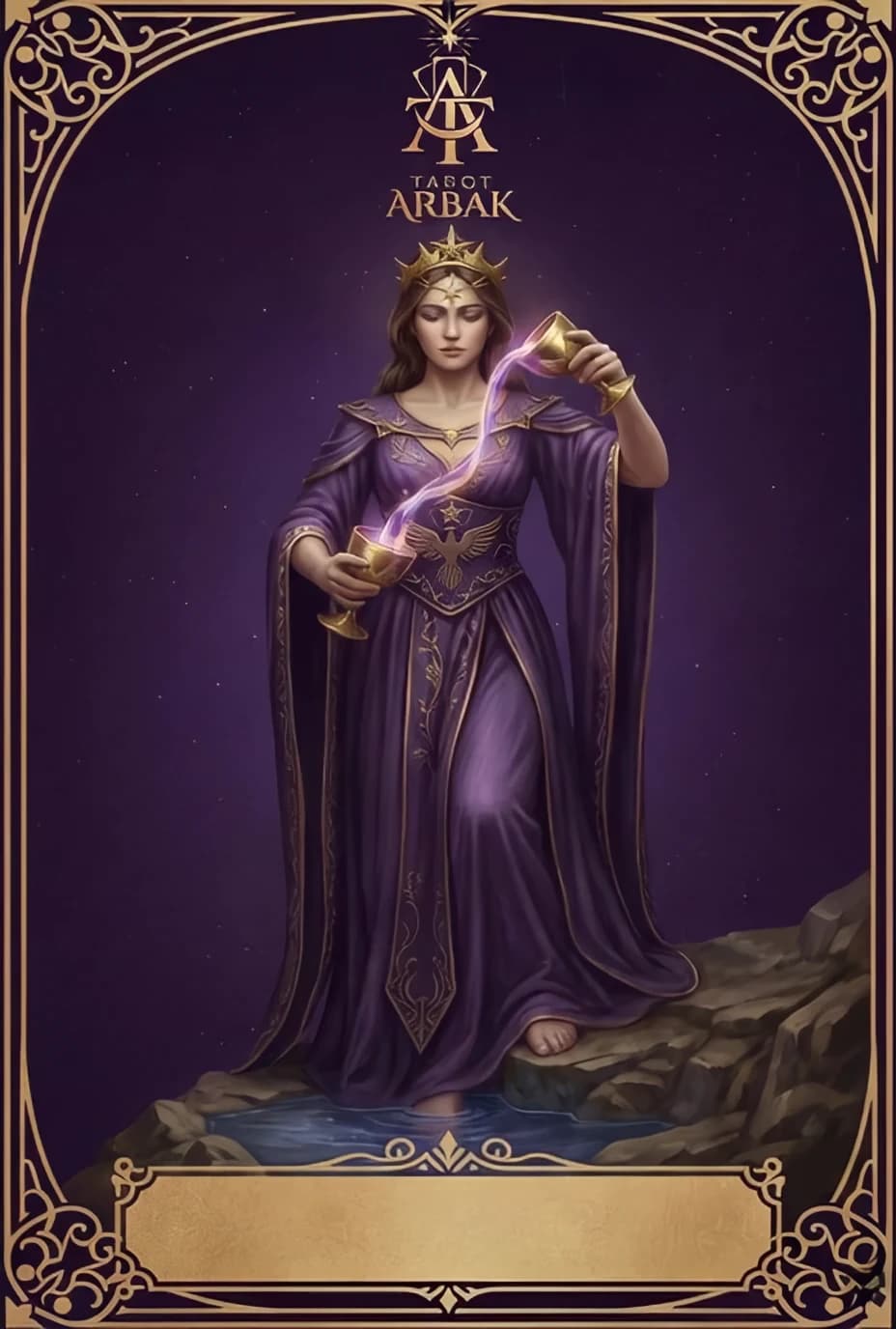
In Tarot Arbak, Temperance represents a significant evolution from traditional interpretations. The angelic figure has been replaced by a queenly, human presence who embodies conscious control over the balancing act. This crucial distinction teaches that balance is not something bestowed from above but a skill developed through practice, awareness, and intentional adjustment. The liquid flowing between cups is neither entirely light nor entirely water, representing the controlled synthesis of elements that by nature resist blending. This is not mixing equal halves but understanding exactly how much of each element should enter the whole.
The number 14 marks this card as the midpoint of Major Arcana's journey. In numerology, 14 reduces to 5 (1+4), representing the synthesis of duality and the emergence of something new from the integration of opposites. Temperance embodies the energy of having experienced the full range of human experience and now developing the skill to harmonize rather than choosing between. This is the alchemist of consciousness—the one who understands that true power comes not from domination but from the artful blending of all elements into something greater than any single component.
Temperance asks the central question: What opposites within you are calling for integration rather than elimination? The card does not say 'avoid extremes.' It says 'master the art of blending what seems unblendable.' This is not passive moderation but active alchemy—the conscious work of creating wholeness from apparent fragmentation.
Temperance Symbolism
Temperance tarot card meaning reveals itself through symbols that speak of conscious integration and the patient artistry of balance. Every element shifts between opposing forces, creating a bridge where duality becomes synthesis. Understanding these symbols is key to mastering the card's profound spiritual message.
Tarot Arbak's Temperance presents a human figure rather than an angel, standing between two cups with effortless precision. The figure embodies conscious control over the balancing act, teaching that balance is not instinctual but deliberately achieved. Here is the blueprint for understanding how opposites transform through patient integration rather than conflict.
Human Figure: Mastery Over Miracle
The human figure at the card's center represents conscious mastery—the evolved state where balance is achieved through intentional practice rather than bestowed as divine favor. In Rider-Waite, the angelic figure suggests that temperance comes from higher realms, that balance is granted rather than developed. Tarot Arbak transforms this teaching completely: balance is not something that happens to you but something you learn to do through conscious awareness, patient practice, and deliberate adjustment.
The figure stands with both dignity and accessibility—human enough to be relatable, regal enough to represent mastery. This teaches that temperance is within human capacity, not reserved for beings of another realm. The queenly presence signifies that balance has become a sovereign authority within oneself, not an external force that must be petitioned. You are not waiting for grace—you are developing skill.
Two Cups: The Controlled Synthesis
The two cups held by the figure represent opposites in dialogue—conscious and unconscious, spirit and matter, giving and receiving, active and passive. The liquid flowing between them does not follow a straight line but moves in a spiral or illuminated arc, teaching that balance is not a static state but a dynamic process of ongoing adjustment.
The flow teaches: balance is not mathematics—it is artistry.
The liquid itself is neither entirely light nor entirely water. This detail matters profoundly. Tarot Arbak emphasizes that this is not the mixing of equal halves but the controlled synthesis of elements that by their nature resist easy blending. The figure knows not just that things should be balanced, but how much of each element belongs in the whole. This is the difference between compromise and alchemy—between watering down and genuine transformation.
One Foot in Water, One on Land
The figure's stance—one foot immersed in water, one planted on solid ground—represents simultaneous contact with opposing realms. The water symbolizes emotion, intuition, and the unconscious. The land represents reality, material concerns, and conscious action. Temperance does not choose between these worlds but maintains presence in both simultaneously.
This teaches that balance is not about cutting off from emotion to be purely rational, nor escaping reality to be purely spiritual. True integration involves developing the capacity to stand with one foot in each realm, allowing both to inform and balance each other rather than pulling in opposite directions. You feel without drowning. You act without becoming rigid.
Crown: Conscious Authority
The crown or tiara upon the figure's head represents conscious authority over internal processes. Unlike the halo of divine blessing found in traditional depictions, the crown signifies that balance has been claimed through deliberate effort and awareness. This is not the instinctual balance of those who have never known extremes, but the earned equilibrium of those who have mastered their internal contradictions through conscious work.
The crown teaches that temperance is a sovereign act—the reclamation of authority over your own internal landscape. You are not at the mercy of conflicting desires or opposing needs. You have developed the skill of harmonizing them through conscious awareness and patient adjustment.
Empty Background: The Silence Within
The simple, uncluttered background is not an absence but a teaching about the nature of true balance. Temperance is not achieved through external manipulation of circumstances but through internal adjustment. The outer world has grown quiet because the real work is happening within.
Balance is not imposed upon the world—it is cultivated in the silence of conscious awareness.
This detail reminds that the alchemy of Temperance is an internal process. You do not find balance by perfectly arranging external conditions but by developing the inner capacity to harmonize whatever conditions arise. The empty background invites you to turn attention inward, where the real synthesis occurs.
- Symbol 1
Human figure instead of angel: mastery over miracle
- Symbol 2
Two cups: controlled synthesis of opposites
- Symbol 3
Spiral/illuminated flow: dynamic adjustment
- Symbol 4
One foot in water: contact with emotion
- Symbol 5
One foot on land: connection to reality
- Symbol 6
Crown: conscious authority
- Symbol 7
Empty background: internal work
Temperance as Feelings: The Patient Art of Emotional Integration
When examining temperance as feelings, this card reveals an emotional landscape defined by patient integration, conscious harmony, and the deliberate blending of opposing emotional currents into wholeness.
Upright: Emotional Mastery
When Temperance appears as feelings upright, the emotional state is characterized by:
- Patient integration — The person feels capable of holding contradictory emotions simultaneously without being torn apart by them. They are not rushing to resolve emotional tension but allowing synthesis to occur naturally.
- Conscious balance — There is awareness of emotional extremes and deliberate choice to find the middle path. This is not emotional suppression but the skill of harmonizing intensity with calm.
- Healing presence — The emotional energy brings restoration and equilibrium to relationships. This person can sit with difficult feelings without being overwhelmed or needing to fix immediately.
- Measured expression — Emotions are expressed with precision rather than explosion. They know how much to reveal, when to hold back, and how to create space for genuine exchange.
Reversed: Emotional Imbalance
When Temperance appears reversed as feelings:
- Swinging between extremes — The emotional state oscillates between intensity and numbness, engagement and withdrawal. There is no stable center, only pendulum motion between opposites.
- Impatient with process — Frustration with emotions that take time to integrate. There may be rushing toward resolution before genuine synthesis has occurred.
- Repression masked as calm — Surface emotional balance conceals suppressed feelings that have not been genuinely integrated. The appearance of equilibrium is maintained through avoidance.
- Avoidance of intensity — Fear of strong emotion leads to premature moderation. Authentic feeling is diluted before it can be fully experienced or expressed.
Temperance Tarot Advice: Master the Art of Harmonious Integration
When Temperance appears in your reading, temperance tarot advice centers on developing the skill of conscious balance and patient synthesis. This is not passive waiting but active alchemy—the deliberate work of harmonizing opposites into wholeness through awareness and adjustment.
The core message is clear: extremes will not serve you now, but neither will forced balance. The middle path Temperance counsels is not lukewarm compromise but the conscious integration of what is valuable in apparent opposites. You are being asked to develop the skill of both/and awareness rather than either/or thinking.
Specific advice by situation:
-
Facing internal conflict — Do not choose between opposing desires or values. Instead, ask how both might be honored through synthesis. What seems like contradiction may reveal itself as complementarity through patient examination.
-
In relationships — Practice the patient work of integration. Your differences with others need not be resolved through one winning and one losing. Seek the alchemy that honors both perspectives and creates something neither could achieve alone.
-
Career challenges — Resist all-or-nothing thinking. Professional success now comes through balanced engagement, patient development, and the integration of different skills or experiences into coherent whole. Honor natural timing over forced urgency.
-
Spiritual practice — Balance transcendence with embodiment. Your spiritual insights must be tested in daily life to become genuine wisdom rather than mere concept. Neither withdraw entirely nor lose yourself in worldly concerns.
-
Health and wellbeing — Examine where you swing between extremes—total indulgence and total restriction, intense activity and complete collapse. Sustainable wellness comes through consistent, moderate practice rather than dramatic intervention.
The ultimate Temperance advice: Balance is not something you achieve once. It is a skill you develop through ongoing conscious adjustment. Stop looking for the perfect equilibrium and start practicing the art of harmonious integration.
Trust the process. The flowing liquid between cups cannot be rushed, and neither can genuine synthesis. What you are integrating needs time to blend properly. Your patience now will yield results that haste would destroy.
UPRIGHT MEANINGS
General Meaning
When Temperance appears upright, temperance tarot card meaning signals a time for conscious balance, patient integration of opposites, and the development of harmonious synthesis in your life. You are being called to move beyond either/or thinking and develop the skill of both/and awareness—how to hold and harmonize opposing forces rather than choosing between them. This is not a card of compromise or mere moderation but of alchemical transformation through conscious, patient blending of elements that by their nature resist easy integration.
Temperance asks: What opposites in your life are calling for harmonious integration rather than elimination?
This position indicates that extremes will not serve you now, but neither will forced balance or artificial moderation. The middle path that Temperance counsels is not the lukewarm center between two extremes but the conscious integration of what is valuable in both while eliminating what is limiting in each. This requires patient work and honest self-examination, not simplistic formulas or quick fixes. The flowing liquid between cups teaches that true integration takes time and cannot be rushed—trying to force harmony faster than it naturally occurs typically produces the very conflict you are trying to resolve.
This card often appears after periods of upheaval, transformation, or intense experience, suggesting that the time for integration and healing has arrived but must be approached with patience rather than urgency. Temperance teaches that after dramatic change, the real work is the quiet, patient synthesis that stabilizes the new and allows it to integrate into a coherent whole. Your challenge now is not to avoid extremes but to develop the skill of conscious integration that can harmonize whatever intensity arises.
Love & Relationships
In love readings, temperance tarot card meaning upright indicates relationships characterized by balanced integration, patient development, and the harmonious blending of two individuals into partnership. This is love that grows slowly but deeply, connection that develops through patient nurturing rather than dramatic extremes or forced progression. For couples, Temperance suggests a time of healing, balance restoration, or the patient work of integrating different needs, values, and perspectives into a functioning whole.
For those seeking relationships, this card counsels patience—the right connection develops in its own time and cannot be forced. Temperance in love reminds that healthy relationships require balancing independence with togetherness, passion with stability, giving with receiving. Neither total enmeshment nor emotional distance serves love well; the path of harmonious integration involves developing the skill of maintaining both closeness and individuality, both intensity and stability.
Temperance in love teaches that true partnership is not about becoming the same but about harmonizing differences into complementary synthesis.
For couples facing challenges, Temperance suggests that the solution lies not in proving who is right or choosing between opposing needs, but in developing the skill of integration that honors both perspectives. This may require patience, honest communication, and the willingness to adjust—like the liquid flowing between cups, finding the precise proportion of each element that creates harmonious balance. Temperance teaches that relationship integration is not a one-time achievement but an ongoing process of adjustment and refinement.
This card also warns against the extremes that sabotage relationships: total emotional enmeshment that loses individuality, or total independence that loses connection. Neither extreme serves true partnership. Temperance counsels the middle path of conscious integration that maintains both self and relationship, both giving and receiving, both intimacy and autonomy.
Career & Money
Professionally, temperance tarot career meanings indicate that balance and patient integration serve your career best now. This may be a time for harmonizing different skills or experiences into a more coherent professional identity, for finding balance between work and other life areas, or for patiently developing projects that need time to mature. Temperance favors collaboration and synthesis over competition and extremes.
This card counsels avoiding extreme positions in professional matters—all-or-nothing thinking, impulsive decisions, or the insistence that everything must be perfect now. Temperance teaches that some professional processes cannot be rushed and that attempting to force development faster than it naturally occurs typically produces inferior results. The flowing liquid between cups moves at its own pace; your career development will benefit from honoring natural timing rather than imposing artificial urgency.
Temperance in career asks: Are you forcing outcomes, or are you practicing patient integration?
If facing workplace conflicts, Temperance suggests seeking the middle ground that honors all perspectives rather than forcing one extreme over another. This may require the skill of integrating opposing viewpoints into a synthesis that addresses legitimate concerns from all sides—a form of professional alchemy that requires patience and conscious awareness. Temperance teaches that leadership often involves the capacity to harmonize conflicting interests rather than simply choosing sides.
This card may also indicate that you are being called to integrate different aspects of your professional self into a more coherent whole. Perhaps you have developed diverse skills or experiences that feel disconnected; Temperance counsels the patient work of integration, finding how these different elements can contribute to each other rather than remaining in separate compartments. True professional mastery often involves the capacity to synthesize apparent contradictions into functional wholeness.
REVERSED MEANINGS
General Meaning
Temperance tarot card meaning reversed signals imbalance, impatience, or extremes that are creating problems in your life. Perhaps you have lost your center, abandoned moderation for one extreme or another, or grown impatient with processes that require time. The reversal may also indicate that elements in your life are not integrating well—things that should work together are in conflict instead. Sometimes Temperance reversed suggests that enforced moderation has become repression, or that 'balance' has become an excuse for avoiding necessary choices or authentic intensity.
The reversed Temperance asks: Where has balance become repression? Where has moderation become avoidance?
This card may represent swinging between extremes rather than finding harmonious integration. You might find yourself alternating between total indulgence and total restriction, between intense activity and total withdrawal, between emotional overwhelm and emotional shutdown. Temperance reversed teaches that these are not opposites but two sides of the same coin—the failure to develop the skill of conscious integration. The reversal calls for honest examination of what extremes you are swinging between and what the middle path of genuine harmonious integration would look like in your specific circumstances.
The reversal may also indicate impatience with processes that naturally require time. Trying to force integration faster than it can occur, pushing for outcomes before conditions are ripe, or refusing to honor the natural timing of development—these are all manifestations of Temperance out of balance. The flowing liquid cannot be forced, and neither can genuine synthesis. The reversal may be telling you to slow down, to allow more time, to practice patience with the process of integration.
Sometimes Temperance reversed indicates that what appears as balance is actually repression or avoidance. You might be maintaining a surface calm while suppressing uncomfortable truths, avoiding necessary conflict by pretending everything is fine, or using 'balance' as justification for never committing fully to anything. The reversal calls for honest examination of what lies beneath the surface of your apparent equilibrium.
Love & Relationships
In love readings, temperance tarot card meaning reversed may indicate relationship imbalance—one partner giving too much while the other takes, or extreme swings between closeness and distance. There may be impatience with the natural pace of relationship development, or difficulty integrating individual needs with partnership demands. The reversal may also indicate that enforced harmony is suppressing authentic expression or necessary conflict.
For couples, Temperance reversed can represent the kind of superficial balance where problems are avoided rather than genuinely addressed. Perhaps you maintain peace by not discussing difficult topics, by suppressing frustrations, or by refusing to acknowledge real differences that need integration. The reversal asks whether your relationship balance is genuine harmonious integration or fearful avoidance of the work that true intimacy requires.
The reversal in love asks: Are you truly integrating your differences, or avoiding the work of doing so?
For singles, Temperance reversed may suggest that impatience or extreme approaches are blocking connection. Perhaps you swing between total emotional availability and total emotional shutdown, between intense pursuit and total withdrawal. Neither extreme serves authentic relationship development. The reversal calls for developing the skill of balanced engagement—neither rushing nor retreating, neither overwhelming nor withholding.
This card may also indicate that your standards for relationship have become impossibly rigid, or conversely, that you have abandoned all standards and accept anything. Neither extreme serves authentic connection. Temperance reversed counsels finding the balanced path of clear standards maintained with openness and flexibility.
Career & Money
Professionally, temperance tarot career meanings reversed warn of work-life imbalance, professional extremes, or impatience that undermines long-term success. You may be overworking or underworking, pushing too hard or not hard enough, or struggling to integrate different aspects of your professional life into a coherent whole. The reversal may also indicate workplace conflicts where middle ground seems impossible, or career frustration born of impatience with natural developmental timelines.
This reversal can represent swinging between extremes in your professional approach—total immersion in work to the exclusion of all else, followed by periods of total disengagement and avoidance of work altogether. Temperance reversed teaches that these are not opposites but symptoms of the same underlying issue: failure to develop the skill of sustainable, balanced professional engagement.
The reversal in career asks: Are you forcing professional development faster than it can naturally occur?
The reversal may also indicate impatience with professional development processes. Perhaps you are pushing for promotion, recognition, or advancement before you have developed the necessary skills or experience, or trying to force career transformation faster than conditions support. Temperance teaches that professional integration, like all integration, requires time and cannot be rushed without compromising quality.
If facing workplace conflicts, Temperance reversed may indicate that you are stuck in rigid positions that prevent finding harmonious synthesis. Perhaps you are unwilling to consider opposing viewpoints, or convinced that only one extreme can be correct. The reversal calls for developing the skill of integrating different perspectives into a synthesis that addresses legitimate concerns from multiple sides.
Frequently Asked Questions
Maintain the Crystalline Infrastructure
Tarot Arbak exists beyond ads and algorithms. Your contribution ensures the permanence of the Logos.