Six of Swords

✦ Minor Arcana ✦
Six of swords tarot meaning captures a universal human experience: the difficult but necessary transition from mental turmoil toward greater clarity. This card speaks to the moment when staying where we are has become untenable—when old patterns have transformed from comfortable containers into prisons that restrict our growth. Unlike cards that represent crisis or chaos, Six of Swords illuminates the in-between space: the journey itself, not just the destination, constitutes the healing. The movement toward clarity changes us regardless of whether we fully arrive at our intended destination.
The journey itself, not just the destination, transforms us.
In Tarot Arbak, Six of Swords represents conscious mental restructuring—the recognition that our current mental and emotional landscape has become exhausted and must be left behind, even when the new territory remains unclear. This is not a card of escape but of transition; the difference is crucial. Running away means fleeing problems without addressing them, hoping that changing external circumstances will magically resolve internal patterns. Conscious outgrowing means recognizing that we have become too large for our current container, that the situation itself may not be inherently wrong but is no longer right for who we are becoming.
The number 6 marks this card as a card of harmony and balance, yet Six of Swords captures a paradoxical state: the harmony of balanced swords moving together, yet within the context of difficult transition. Six suggests that the journey toward clarity is not chaotic but follows natural patterns of growth and transformation. The swords move in coordination rather than conflict, indicating that thoughts are becoming organized, mental activity is gaining direction, and what once felt like random turmoil is now following a clear trajectory toward integration.
Six of Swords Symbolism
Six of swords tarot meaning reveals itself through precise visual composition that transforms the traditional boat imagery into pure abstract energy. Every element shifts between the old chaotic patterns being left behind and the new ordered consciousness toward which we journey. Understanding these symbols is key to mastering the card's profound spiritual message about necessary transformation.
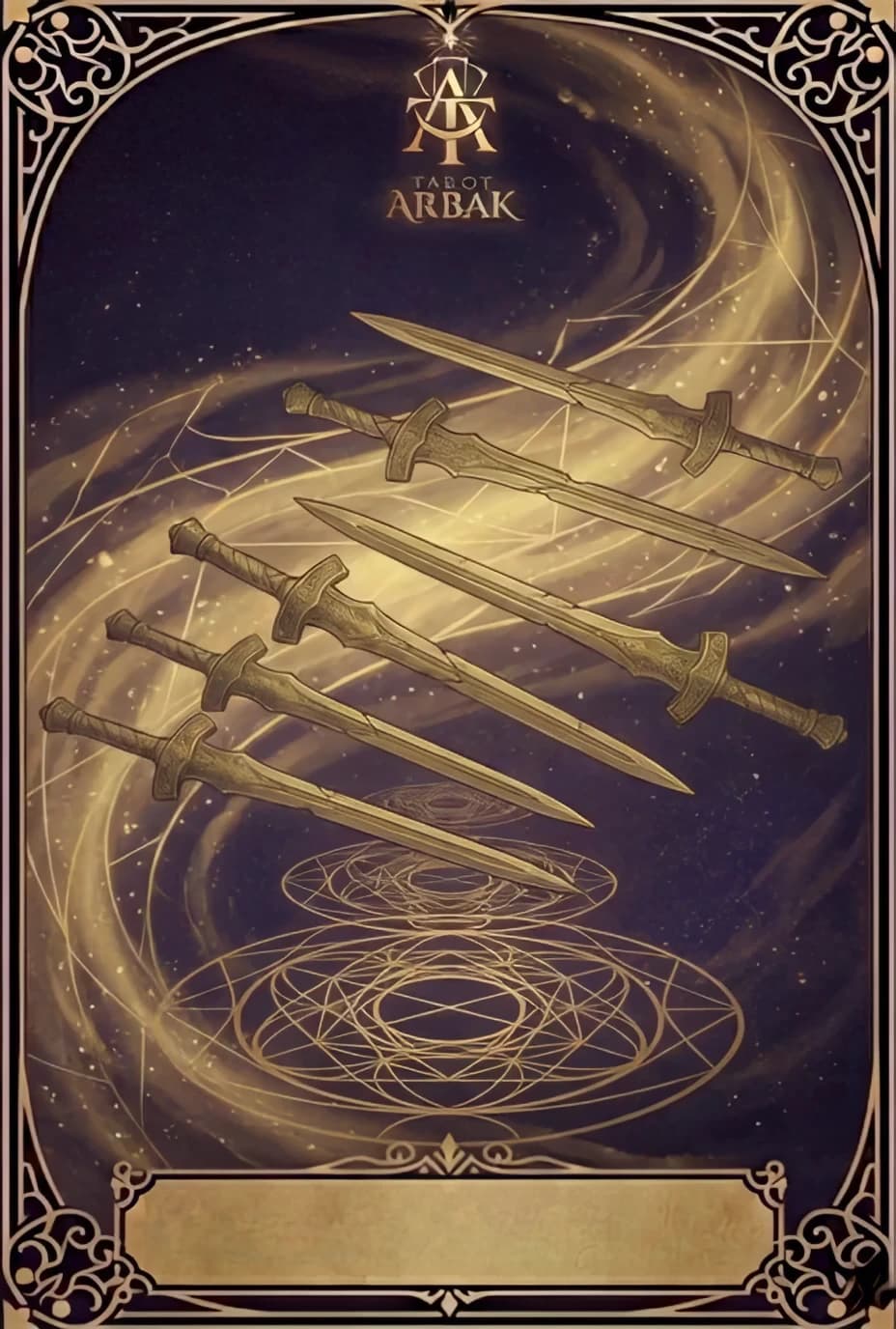
Tarot Arbak's Six of Swords is structurally precise yet emotionally resonant. The swords move together in coordinated formation, surrounded by energy patterns that suggest transformation rather than simple displacement. Here is the blueprint for understanding how consciousness restructures itself through the journey of transition.
Unlike traditional representations that feature figures in a boat being ferried across water, Tarot Arbak's Six of Swords presents the essence of transition itself through the movement of swords and the energy patterns that surround them. This abstraction teaches that the journey is internal—not physical movement but mental restructuring. The absence of human figures emphasizes that transition is an archetypal experience that all consciousness must navigate, not a personal failure or unique crisis.
Six Swords in Same Direction: Conscious Alignment
The six swords moving together in the same direction represent conscious choice and coordinated movement toward integration. Unlike scattered weapons in conflict or swords pointing in opposing directions, these swords move in parallel formation, suggesting deliberate progress rather than chaotic motion. Their aligned direction indicates that thoughts are becoming organized, mental activity is gaining purpose, and what once felt like random turmoil is now following a clear trajectory. The swords are not fighting each other—they are journeying together, moving as a coordinated unit rather than fragmented conflict.
This formation embodies the integration of mental energies—logic, memory, perception, judgment, reason, and discernment working together rather than at cross purposes. When swords point in different directions, mental conflict persists; when they align parallel, consciousness achieves coherence. Six of Swords teaches that the journey toward clarity requires bringing all aspects of mind into coordinated alignment. This is not about silencing thoughts but about organizing them, giving them direction, allowing them to serve the journey toward integration rather than creating internal war.
The swords do not fight; they journey together.
This coordinated movement suggests that consciousness is becoming coherent—fragmented aspects of mind are learning to work together toward common purpose. The parallel formation indicates that the transition itself is bringing mental unity, that the chaos of fragmented thinking is resolving into coordinated movement toward clarity. Six of Swords reminds us that when our thoughts move in the same direction, when all aspects of consciousness align toward the same intention, the journey toward healing accelerates naturally. The swords' unified direction represents the internal harmony that emerges when we stop fighting ourselves and commit to moving forward as a whole being rather than fragmented parts.
Golden Spiral Flow: Natural Transformation Patterns
The golden spiral flowing around the swords represents thought patterns being restructured according to natural laws of growth. The spiral signifies transformation rather than simple displacement—this is not about abandoning problems but about restructuring consciousness itself according to sacred patterns of death and rebirth. The spiral moves inward and outward simultaneously, indicating that this transition both releases old patterns and integrates new understanding. The golden color suggests that this transition follows sacred patterns of transformation, assuring us that the dismantling of old mental structures serves a higher purpose.
The golden spiral embodies the evolutionary nature of consciousness change. Just as spiral galaxies follow mathematical patterns of growth, just as plants unfold according to golden ratio, our mental restructuring also follows universal patterns of transformation. The spiral indicates that what feels like personal chaos actually participates in larger patterns of consciousness evolution. Six of Swords teaches that the confusion we experience during transition is not random or meaningless but follows sacred patterns of death and rebirth that have operated throughout human experience.
This surrounding energy pattern suggests that transformation is not linear but spiral. We may feel we are going in circles, returning to the same lessons, but the spiral pattern reveals that each return occurs at a different level of consciousness. The golden spiral flows both inward—releasing old patterns at deeper levels—and outward—expanding into new ways of being. Six of Swords reminds us that the journey toward clarity is not a straight line but a spiral path that both releases and integrates, transforms and evolves. The golden color of this flow indicates that despite the difficulty of transition, something beautiful and sacred is emerging through the restructuring process.
Sacred Geometry in Foundation: Order in Transformation
The sacred geometry patterns forming the foundation represent universal order within what feels like chaos. The geometric patterns indicate that there is order and purpose in the dismantling of familiar structures, that the transition follows ancient principles of transformation rather than random collapse. Old ways of thinking don't simply disappear; they are being reorganized at a fundamental level according to geometric patterns of consciousness. The sacred geometry suggests that this restructuring, however disorienting, participates in larger patterns of cosmic order.
The geometric patterns embody the structured nature of consciousness change. Our minds do not restructure randomly; even the dismantling of beliefs follows patterns that can be recognized and trusted. The sacred geometry at the foundation indicates that the ground upon which this transition occurs is stable and ordered, even when the experience itself feels unstable and chaotic. Six of Swords teaches that we can trust the process of mental restructuring because it follows patterns of transformation that have guided consciousness throughout human experience.
The dismantling follows ancient patterns, not random collapse.
This foundation geometry suggests that transition has structure and purpose. We are not merely escaping into the unknown; we are participating in a profound reorganization of consciousness that follows universal principles of growth. The sacred geometry reminds us that even in the midst of disorientation, there is an underlying order that we can trust. Six of Swords encourages us to recognize that the confusion we feel during transition is temporary, but the restructuring of consciousness that occurs serves a permanent purpose—we are being rebuilt from the foundation up according to patterns of wisdom that transcend our individual experience.
Dark to Light Color Trajectory: From Burden to Clarity
The color progression from deep night tones to golden luminosity represents the trajectory from mental darkness toward clarity. The dark tones in the foundation represent the mental anguish being left behind—the confusion, pain, and turmoil of the old patterns we are outgrowing. The golden luminosity of the swords and surrounding energy suggests the clarity that awaits at the journey's destination. This color progression acknowledges the pain of leaving behind while illuminating the destination, reminding us that the journey, however difficult, leads toward light.
The color trajectory embodies the reality of transition difficulty. Six of Swords does not romanticize the journey; it acknowledges that leaving behind familiar patterns, even when necessary, brings genuine pain. The dark tones honor the mental burdens we have carried and are now releasing. The golden luminosity of the swords and spiral suggests that what awaits at the other side of this transition is not merely different but fundamentally clearer—consciousness freed from the weight of old patterns, illuminated by understanding that could not emerge within those patterns.
This visual progression suggests that movement toward light is already underway. Even when we still feel the weight of what we are leaving behind, even when clarity has not yet fully arrived, the color trajectory from dark to light indicates that the transition is progressing. Six of Swords teaches that the journey from turmoil to clarity is not instantaneous but gradual—the darkness does not simply vanish but gradually transforms into luminosity through the process of transition. The golden color of the swords suggests that clarity is not a distant destination but is actually present within the journey itself, carried forward by the swords as they move away from darkness.
Absence of Human Figures: Archetypal Journey
The absence of human figures or boats represents facing the archetypal dynamics of change itself. We cannot identify with a specific passenger or guide—we must face the reality of mental restructuring as a universal human experience. The journey belongs to no one and everyone. By removing the human element, Tarot Arbak asks us to recognize that transitions are not personal failures but archetypal passages that all consciousness must navigate. This is not my journey or your journey but THE journey—the universal experience of moving from exhausted patterns toward greater clarity.
This absence embodies the impersonal nature of transformation. Our egos want to believe that our transition is unique, that our suffering is special, that our resistance to change is personal failing. Six of Swords teaches that the patterns we experience during transition—the grief, the fear, the disorientation—are universal human experiences that have accompanied consciousness throughout history. The journey from turmoil to clarity is not something we undergo alone but a river in which all consciousness swims when the time for transition arrives.
The transition is archetypal, not personal.
This abstraction suggests that we can trust the journey because it follows universal patterns. What we are experiencing is not unique suffering but the universal pattern of consciousness restructuring itself. The absence of human figures reminds us that we can learn from how others have navigated this transition, that we are participating in patterns that have guided transformation throughout human experience. Six of Swords encourages us to recognize that the courage required for this transition is not unique to us but is the universal courage of consciousness choosing growth over comfort, truth over familiarity, clarity over chaos.
- six swords in same direction
- golden spiral flow
- sacred geometry foundation
- dark to light color trajectory
- absence of human figures
UPRIGHT MEANINGS
General
When Six of Swords appears upright, six of swords tarot meaning signals being in the midst of a conscious transition from turmoil toward greater clarity. You may have recently decided to leave behind a difficult situation, toxic pattern, or exhausted way of thinking. The card acknowledges that this journey feels difficult—you are not yet at your destination, and the familiar chaos you're leaving behind, however painful, still feels safer than the unknown ahead. Six of Swords asks you to trust the transition itself. The movement toward clarity is already changing you, regardless of whether you've arrived.
The movement toward clarity changes you, regardless of arrival.
This position suggests that you may be processing grief, recovering from depression, or restructuring your consciousness after a period of intense mental or emotional difficulty. The card honors this process while encouraging you to keep moving, to trust that the trajectory from darkness toward light, however gradual, is fundamentally sound. Six of Swords often appears when you've made the decision to change but haven't yet seen results. You've left a toxic relationship, quit an exhausting job, or begun therapy, but the new reality hasn't taken shape yet. The card asks you to honor the in-between—to recognize that the journey itself, not just the destination, constitutes the healing.
Love
In love readings, six of swords tarot meaning upright typically signifies transitions that may be difficult but are ultimately necessary. This could mean recognizing that a relationship has become exhausted and must be left behind, or it could indicate the painful processing period after a breakup. The card acknowledges that leaving a relationship, even when necessary, feels like a small death—you are mourning not just the person but the future you imagined with them. Six of Swords honors this grief while reminding you that the movement toward healing is already underway, even if you still feel the weight of what you're leaving behind.
For those currently in relationships, this card may suggest that you are moving from a pattern of conflict toward greater understanding but haven't yet arrived. The relationship is transitioning, old dynamics are being left behind, but new patterns haven't fully formed. Six of Swords asks for patience during this restructuring period. The relationship may survive this transition and emerge stronger, or the transition may lead to its end—either outcome represents movement toward greater clarity.
For singles, this card often indicates recovery from past relationship pain. You are moving from the darkness of heartbreak toward the light of clarity, though you may not yet be ready for new love. Six of Swords honors this healing journey while reminding you that the movement toward emotional freedom is already underway. The card asks you not to rush this process or to seek new relationship before the old one has been fully processed.
Career
In career readings, six of swords tarot meaning upright often represents leaving a job or professional path that no longer aligns with your values or wellbeing. You may have resigned from a toxic work environment, been laid off from a role that had become exhausting, or recognized that your current career trajectory no longer serves your growth. The card acknowledges that this transition feels precarious—you are leaving behind the familiar, however unsatisfying, for an unclear future. Six of Swords honors the courage of this decision while encouraging you to trust that the journey itself is transformative.
For those between jobs, this card suggests that the journey toward new employment is itself transformative. The period of unemployment or career transition, however stressful, is restructuring your professional identity. You are not merely finding a new job—you are becoming someone new, and that transformation requires time. Six of Swords asks you to honor this in-between period rather than rushing through it. The restructuring of professional consciousness that occurs during career transition is itself valuable, regardless of what job comes next.
For those currently employed but considering change, Six of Swords may indicate that you've already begun the internal transition. You are mentally moving away from your current role, though you haven't left yet. The card asks you to honor this inner journey and to trust that the clarity you seek will emerge from the movement itself, not from forcing immediate answers. Sometimes we must mentally leave before we can physically leave.
Spiritual
In spiritual readings, six of swords tarot meaning upright represents profound psychological restructuring and consciousness evolution. You may be recovering from a dark night of the soul, transitioning from one belief system to another, or undergoing deep psychological work that is dismantling your previous understanding of reality. The card acknowledges that this transformation, however necessary, feels disorienting—you are leaving behind familiar spiritual or mental frameworks for something you cannot yet fully see. Six of Swords honors this deconstruction while reminding you that the dismantling of old structures is making room for something more authentic.
This card often appears during recovery from depression, anxiety, or other mental health challenges. The movement toward healing is underway, but you are not yet recovered. Six of Swords honors this in-between state, asking you to recognize that healing is not a destination but a journey, and that the movement toward clarity changes you regardless of whether you ever fully arrive. The card encourages patience with the slow nature of genuine transformation.
For those experiencing spiritual crisis, this card suggests that the deconstruction of old beliefs is not a failure of faith but a necessary transition. You are moving from spiritual darkness toward greater light, though the journey requires releasing certainty and embracing mystery. Six of Swords asks you to trust the transition itself, to recognize that the dismantling of old frameworks is making room for something more authentic, even if you cannot yet see what that is.
REVERSED MEANINGS
General
Six of swords tarot meaning reversed signals resistance to necessary transition, incomplete journeys, or the return to old patterns out of fear. You may be staying in situations you've already outgrown because the familiar, however painful, feels safer than the unknown. The reversed card acknowledges that you know change is necessary—that you've mentally begun the journey—but you haven't taken physical action, or you've started the transition but turned back when it became difficult. Six of Swords reversed asks you to examine your resistance to necessary movement.
What does the familiar chaos give you that the unknown threatens to take away?
This position may indicate that you began a necessary transition but didn't complete it. You left a toxic situation but returned when the loneliness of the unknown felt too heavy. You started therapy but stopped when it became challenging. You began changing a pattern but reverted when the new way felt unfamiliar. Six of Swords reversed asks you to recognize that incomplete journeys don't heal—that staying in the in-between between old and new is itself exhausting. The card encourages you to recommit to the journey rather than abandoning it.
Love
In reversed love readings, this card often indicates staying in relationships you've already outgrown. You know the relationship has become exhausted, but the fear of being alone or the uncertainty of what lies ahead keeps you from leaving. Alternatively, you may have left a toxic relationship but returned when the pain of separation felt too heavy, or you may be leaving one relationship only to repeat the same patterns with a new partner because you haven't done the internal work of transition. Six of Swords reversed asks you to examine your resistance to fully moving on.
The reversed card asks: What are you afraid will happen if you leave this relationship behind completely? What does the familiar dissatisfaction give you that the unknown threatens to take away? The card suggests that the loneliness of leaving may be temporary, while the misery of staying will be permanent—but only you can make that assessment. Six of Swords reversed encourages honest examination of whether staying is actually serving you or merely avoiding the fear of the unknown.
For those recovering from breakups, the reversed position may indicate resistance to healing. You may be staying attached to your ex-partner, refusing to process the grief, or returning to the relationship mentally even though it has ended. Six of Swords reversed asks you to recognize that returning to what you've already outgrown will not restore what was lost—it will only prolong the pain. The card encourages facing the grief of ending rather than avoiding it through denial or return.
Career
In reversed career readings, this card often indicates staying in jobs that compromise your wellbeing because the familiar feels safer than the unknown. You may have mentally checked out but remain physically present, or you may be actively searching for new work but sabotaging opportunities out of unconscious fear of change. The card acknowledges that leaving a job, especially in uncertain economic times, feels risky—but it asks you to consider whether staying in a role that depletes you is actually safer than taking a chance on something better. Six of Swords reversed encourages honest assessment of your professional situation.
For those between jobs, the reversed Six of Swords may indicate that you started a career transition but turned back. You may have explored new paths but retreated to your old field when the journey became difficult, or you may be resisting the internal restructuring that unemployment invites—clinging to your old professional identity even though it no longer serves you. The card asks you to examine whether this resistance is based on realistic assessment or on fear of the unknown.
For those considering entrepreneurship or major career change, this card suggests that you are resisting the necessary transition out of fear. You know your current path is exhausted, but the uncertainty of the new path keeps you paralyzed. Six of Swords reversed asks you to recognize that refusing to choose is itself a choice—and that staying where you are indefinitely is not viable. The card encourages committing to a direction rather than remaining paralyzed in indecision.
Spiritual
In reversed spiritual readings, Six of Swords often indicates resistance to necessary psychological or spiritual work. You may have begun therapy or a spiritual practice but stopped when it became challenging, or you may be intellectualizing insights without allowing them to transform your behavior. The card acknowledges that genuine consciousness restructuring is terrifying—it requires dismantling familiar beliefs and facing aspects of yourself you've avoided—but it suggests that the pain of this transformation is temporary, while the pain of remaining stuck is permanent. Six of Swords reversed encourages you to persist through the discomfort of spiritual growth.
For those experiencing spiritual crisis, the reversed position may indicate a refusal to move through the deconstruction phase. You may be clinging to old beliefs even though they no longer resonate, or you may be desperately seeking to restore a faith that has naturally evolved. Six of Swords reversed asks you to recognize that the dismantling of old frameworks is not a failure but a necessary passage—and that resisting this transition only prolongs the darkness. The card encourages embracing the deconstruction rather than fighting it.
Sometimes this card appears when you have intellectual insight but refuse to live it. You understand what needs to change, but you continue old patterns out of habit or fear. Six of Swords reversed asks you to bridge the gap between understanding and action, to recognize that insight without behavioral change is merely another form of stagnation. The card encourages moving from intellectual recognition to lived transformation.